A New Farm Spreads Its Roots
Sharing the earth’s bounty at Northwest Corner Farm
By David Beers
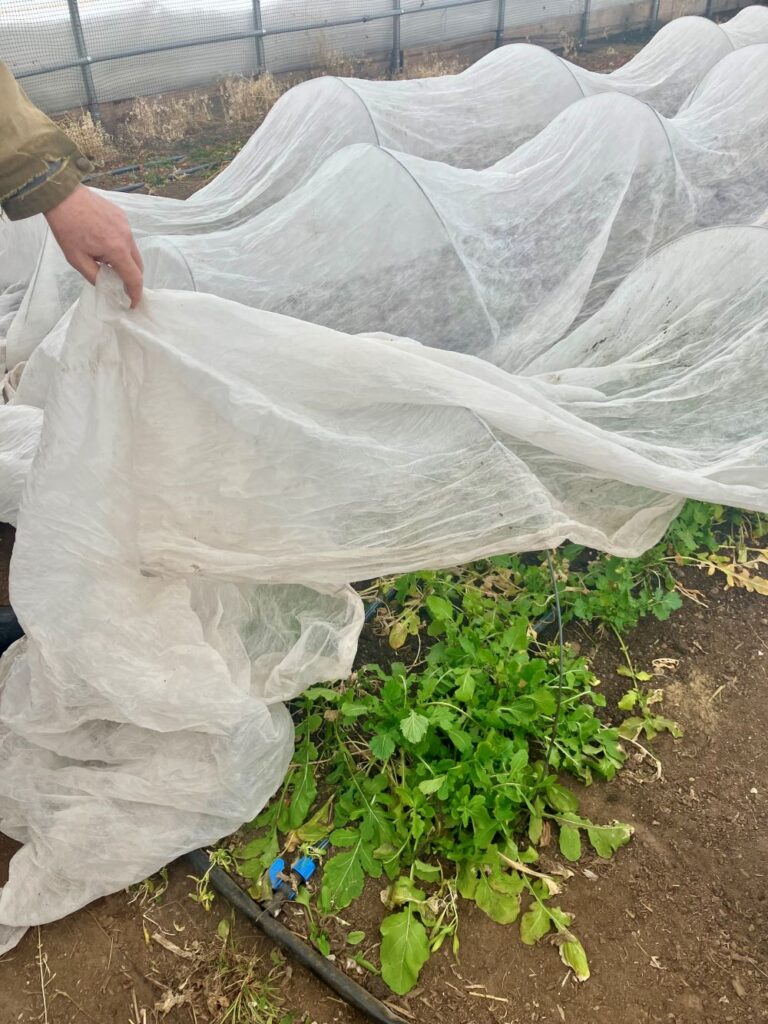
Salad greens get a head start on spring at Northwest Corner Farm
Among the vast woods between Norfolk and Winsted there is a patch of fields on Grantville Road, just over the town line in Winchester. For decades, this open patch lay quiet. Then, in 2023, it came alive with the activity of the Northwest Corner Farm.
After many years of being vacant, Stephen Plumlee and Holley Atkinson purchased this 420-acre former dairy farm in 2021. Plumlee and Atkinson live across the street from the property. Both are avid gardeners and have jobs affiliated with agriculture. Soon after this purchase, they donated 330 acres of forest to the Nature Conservancy. The 90 acres they retained have about 20 acres of fields and 70 acres of woodland.
In early 2023, a farm manager was hired to start Northwest Corner Farm from scratch. A well was drilled, underground utilities were installed, fields were prepped, a deer fence and a high tunnel were erected and drip irrigation lines were laid out. Soon, 25 Community Supported Agriculture (CSA) members signed up. In 2024, the area under cultivation doubled, organic certification was achieved and the CSA expanded to forty members.
Beyond the CSA, the farm also provides produce to local restaurants, food pantries and the Northwest Connecticut Regional Food Hub. Plumlee and Atkinson say they are pleased to work with the Northwest Connecticut Regional Food Hub (NWCTFoodHub.org). This nonprofit aggregator and distributor of fresh food works with 40 local farms to provide nutritious food to local schools, hospitals, Meals on Wheels for the homebound, food pantries and restaurants.
Vegetables, mushrooms and maple syrup are the three legs of Northwest Corner Farm’s sturdy stool of abundance. Like a stool, these three legs sit on the land in a triangular shape. The crops and high tunnel are just off the road, in the middle of the fields. Downhill to the northeast is the forest, filled with large maple trees being tapped for syrup. Downhill to the southeast is the mushroom yard, nestled under a patch of shady conifers beside a pond.
The mushroom yard has 350 logs growing oyster and shiitake mushrooms from May through October. The sugarbush has over 100 tapped trees, with the potential to at least triple that number. The sap is trucked to a nearby saphouse for spring boiling.
The bulk of the farm’s activity takes place in and around the high tunnel. In addition to the half-acre of no-till crops beside it, there is an apiary producing honey, an outdoor produce washing station, an electric gator for hauling and a storage shed. The property’s vacant farmhouse has been outfitted with a walk-in refrigerator to store produce and a CSA pickup area.
The 30-foot by 72-foot high tunnel is particularly impressive. A high tunnel functions like a greenhouse, but is made of polyethylene (poly), providing much better air circulation and temperature control than a greenhouse. Unlike a greenhouse with a cement floor, a high tunnel allows planting directly in the ground. The farm works with University of Connecticut agriculture students to optimize the tunnel’s functionality.
When visited on a cold, windy February day, the high tunnel was amazingly warm, and some salad greens were growing in rows running along half of the tunnel. The other half was full of raised boxes set up with radiant electric heating to get seedlings started before the outdoor growing season.
The tunnel is not heated, but it gets enough daylight starting in February to begin the growing season. During this cold time of year, nighttime row covers protect against frost damage. A small fan maintains an insulating air space between the two layers of poly. Temperature sensors will automatically open the sides of the tunnel when it gets too hot in the summer.
Plumlee and Atkinson’s plans include potential expansion of all parts of the operation, with plenty of room to grow. The farm has received grant support for two new projects in 2025. The first is the purchase of an array of solar panels to power the irrigation, ventilation and heating systems. Winter solar heating will allow produce to be grown year-round in the high tunnel. The second project is the creation of a pollinator garden between the house and the tunnel.
Northwest Corner Farm is currently seeking a full-time farm manager and seasonal staff. They have temporarily paused the CSA but are still directly selling products to interested parties. More information is available online at northwestcornerfarm.com or via email at info@northwestcornerfarm.com.
