Solar Farm Has Benefits for Town
Town landfill solar farm up and running
By David Beers
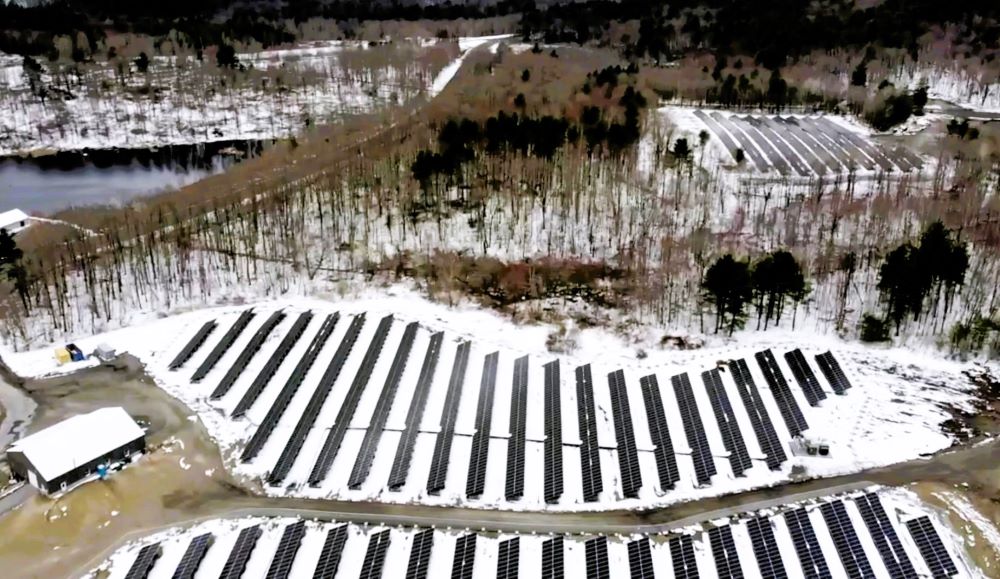
After about a year of prep work and construction, the solar farm at the town landfill began operations this past October. The farm occupies about ten acres of the 149-acre town property. In addition to the more extensive array around the transfer station, there is a smaller array just south of the cell tower.
All of the solar power flows to the southeast corner of the farm. Here, the power connects to a short section of overhead powerlines that connect the farm to the main lines on Route 44. This short section was cleared through the woods along an old stonewall and includes a new access road. The additional power going to the Route 44 electric lines was one of the reasons a third wind turbine was never considered. The lines cannot handle any more power inputs.
The 9,300 3’X5’ solar panels have a capacity of about five megawatts, which powers the annual electricity needs of about 870 homes. This covers the electricity needs of the 743 households in Norfolk that are occupied full-time (2020 census.) This clean energy can offset roughly 4,000 metric tons of carbon annually, equivalent to the yearly emissions of approximately 400 cars.
This project started in 2018 with the re-establishment of the Norfolk Energy Advisory Committee. A pandemic-era outdoor town meeting gave the project the official green light in 2022 when it awarded the contract to Lodestar Energy of Avon. Bloomfield-based CTEC Solar did the construction. New Jersey Resources Clean Energy Ventures (NJRCEV) later purchased the farm from Lodestar. NJRCEV maintains the equipment and grounds, and monitors the energy production.
NJRCEV is an owner/operator of commercial solar projects, with a portfolio of approximately 400 megawatts of installed capacity across six states. Robert Pohlman, Vice President of NJRCEV, stated, “NJR Clean Energy Ventures has a long history of investing in commercial solar projects, like the Norfolk Solar Farm. By turning this brownfield into clean energy, we are making the benefits of solar more accessible while optimizing underutilized property that would otherwise sit dormant.”
The town receives $42,000 a year for leasing the land to NJRCEV, which increases by 1.5 percent each year for the 20-year lease term. The town also received pre-operation, about $100,000 in upfront payments to cover legal fees and other costs. This means that no municipal taxpayer dollars are spent on this project. The town hall, police and fire department have keys for emergency access within the fencing.
The former landfill is covered with a protective membrane, so any digging is off-limits. All the infrastructure has to be anchored above ground. The panels are mounted on steel frames, and these frames are anchored into baskets of stones held together by a steel wire mesh. This is called a geoballast, and it sits on the ground surface. This is the first solar farm in Connecticut to be installed on top of a capped landfill as part of the State’s Shared Clean Energy Facility (SCEF) program.
The SCEF program allows eligible customers to receive some benefits from a local project, like this one. Subscribers will get a fixed monthly bill credit equal to $0.025 multiplied by their average monthly electric usage. This credit will last up to 20 years. Most eligible customers will be automatically subscribed, but you may also apply on the Eversource website. There is no cost or obligation to participate in the SCEF program. Some Norfolk businesses and residents have started receiving this discount on their electric bill.
Jeff Macel of Lodestar Energy summarized, “This has been a great partnership between a Connecticut-based energy developer and a Connecticut town to help enable the state to achieve its clean energy goals. What makes it extra great is that it uses otherwise unusable land.”
First Selectman Matt Riiska added, “The ransfer Station solar project could not have happened without the foresight, encouragement, technical expertise and dedication of the Norfolk Energy Committee, lead by Tom Strumolo and committee members Hartley Mead, Susannah Wood, Paul Madore and former Norfolk resident Bruce Bennedeto, the Lodestar Energy Team lead by Jeff Macel and Jamie Smith, and our consultant Kirt Mayland who always kept us on track and made this project a reality. The focus of the Energy Committee was not just the desire to generate revenue for the town, but to do the right thing for the environment.”