Historical Society Explores Norfolk’s Civil War Past
By Andra Moss
Norfolk had already been a thriving town for over a century when President Abraham Lincoln issued the call on April 15, 1861, for 75,000 volunteer soldiers to defend the Union after the fall of Fort Sumter at the entrance of Charleston Harbor.
The men of Norfolk responded—some immediately, others throughout the four long, brutal years of the Civil War. In total, 145 Norfolk men served in the war. Thirty-nine lost their lives.
The Norfolk Historical Society’s summer exhibition, “A New Birth of Freedom: Norfolk in the Civil War,” examines the personal stories of some of these soldiers and their families during this pivotal time. The exhibition focuses on the regiments in which Norfolk’s men served—for example, Company E of the 11th Regiment Connecticut Volunteer Infantry captained by Norfolk’s John H. Dewell—and the battles they fought.
Samuel Carter Barnum, whose letters home are on display, enlisted one week after the call and soon found himself in the Battle of Bull Run. He re-enlisted, was mustered into the 11th and fought alongside at least six Norfolk soldiers at the Battle of Antietam on Sept. 17, 1862, the deadliest single-day battle in American history.
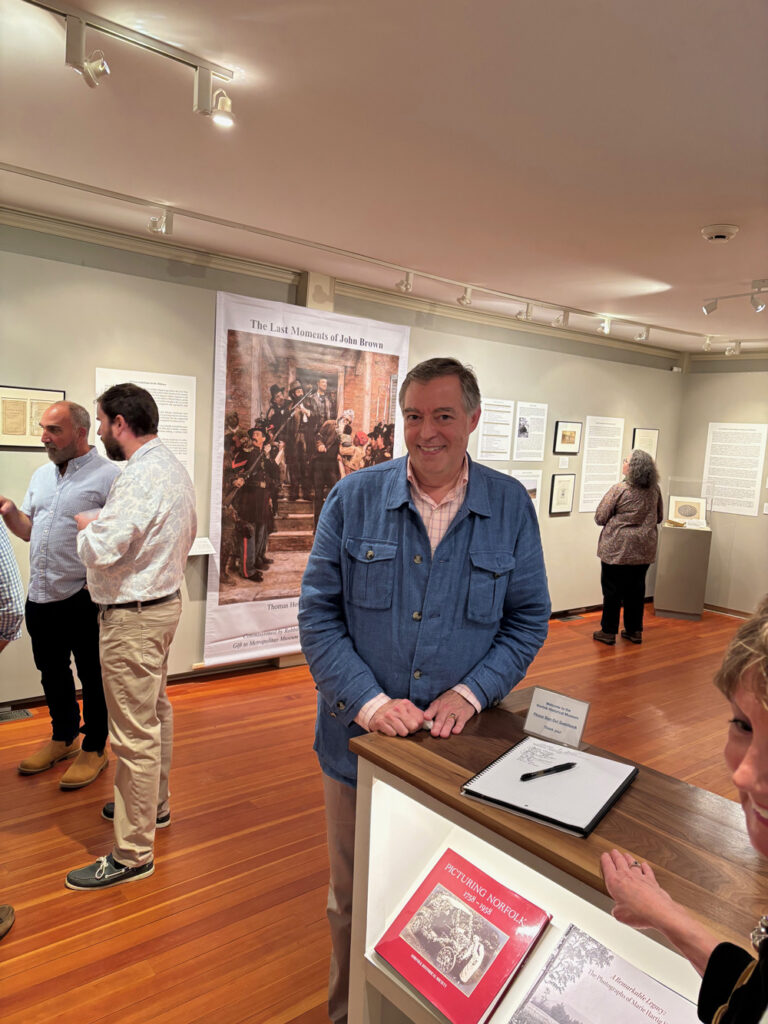
Photo by Andra Moss
Photographs of Norfolk militiamen are scarce, but exhibition curator Ann Havemeyer found a photo of 20-year-old Theodore Parrett, whose family had a farm on today’s Bruey Road. Parrett was among the many who fell at Antietam. Their sacrifice halted Lee’s northern advance, shifting the momentum of the war.
The contributions of Norfolk’s Black soldiers are also highlighted in the exhibition. “The number of African Americans from our town who served is really quite extraordinary,” notes Havemeyer. Eight Black residents enlisted, once they were finally allowed to join in 1863. Some, including Edward Hine, were part of the famous 54th Massachusetts Regiment, one of the first all-Black volunteer infantry regiments in the Union Army.
The experience of Timothy Ryan, a member of the Irish Volunteers, tells yet another personal story. Born to Irish immigrants who became Norfolk farmers, Ryan was a self-made man. He was admitted to the Connecticut bar at age 27, enlisted in the first weeks of the war and fought at Bull Run. After being mustered into the 9th Connecticut, considered an “ethnic” regiment, he was tragically sent to the South to do grueling work digging a canal for Navy gunboats. Ryan was one of the thousands who died from malaria and dysentery.
Havemeyer and Norfolk Historical Society Director Barry Webber uncovered various war-era items in the society’s collection, many passed down through generations. These include bullets from the fields of Gettysburg, a Union Army blanket, Confederate currency and a medical kit that retains some (unknown) powders in its vials.
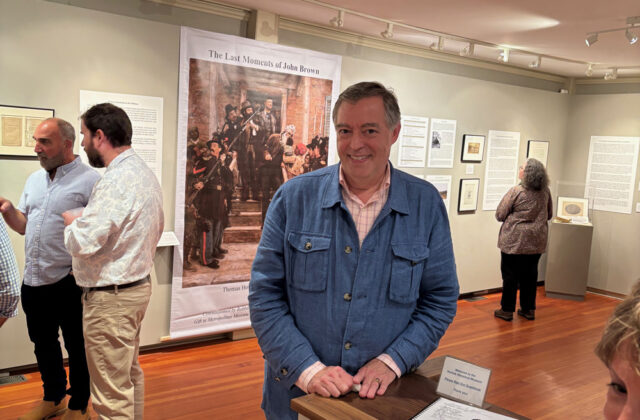
A large panel shows a copy of the 1884 painting “The Last Moments of John Brown” by Irish American artist Thomas Hovenden, commissioned by Robbins Battell and later donated by Carl and Ellen Battell Stoeckel to the Metropolitan Museum of Art. Brown was executed in 1859 for his failed raid on the arsenal at Harper’s Ferry, an attempt to arm a slave revolt in the South.
The Battells, ardent abolitionists, reportedly felt a strong connection to Brown’s story. Brown’s father, Owen Brown, once lived in Norfolk and worked here as a tanner before moving to Torrington where the son was born. The Stoeckels were also dedicated to perpetuating Brown’s memory. In 1901, they helped found the John Brown Association, including purchasing Brown’s Torrington birthplace. Although the home was lost to a fire in 1918, the 40-acre homestead is now owned by the Torrington Historical Society and is a stop on the Connecticut Freedom Trail.
Given the month, a visitor to the exhibition might feel compelled to linger over a letter written by Private Orson M. Miner to a family friend in Goshen dated July 4, 1863. He writes that he “should like to be up in Conn today [and] am in hopes I shall be before another Fourth of July comes around.” Sadly, this was not to be.
Throughout those heavy years of war, the Norfolk bells tolled each time a soldier was lost—young, old, Black, white. The Norfolk Historical Society exhibition, running weekend afternoons through Oct. 12, similarly acknowledges the sacrifices of many, offering the prosaic and profound stories that bring them back home once again
