City Meadow Update
Native Plants Begin to Show Their Colors
By Avice Meehan
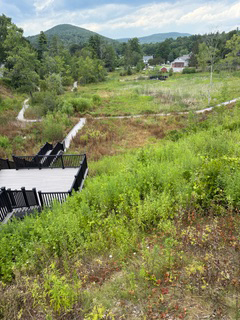
Looking out from the height of Robertson Plaza, the expanse of City Meadow is marked by large patches of dead, brown vegetation and bleached plant stalks. Don’t be fooled. These are signs of progress: the result of selective herbicide treatment of phragmites, invasive cattails, mugwort and purple loosestrife.
“We are peeling back the bad outer layers and what you are left with is a good foundation,” said Beth Romaker of Meadowscapes, the firm brought in by the Friends of the Meadow to help design, plant and maintain this once-forgotten slice of Norfolk. It was a hot July afternoon. Goldfinches twittered. A pair of monarchs chased among the swamp milkweed. What may have been banded pennant dragonflies hovered above the grasses and sedges.
“I would love to say that we could be looking for blooming flowers, but that is not going to happen for a while,” Romaker said as she descended three flights of stairs to reach the meandering boardwalk. She is part of a team that has been working steadily for the last several years to restart the restoration of City Meadow.
The project drew fire during the annual town meeting in May over an appropriation of $40,000 for maintenance. Opponents argued that expenditure of town funds went against assurances made at the outset of the project, which is nonetheless on land owned by the town.
The controversy came as something of a surprise to Libby Borden and George Cronin, who co-chair the Friends committee. It left them determined to work more closely with the Norfolk Volunteer Fire Department, whose property abuts City Meadow, and to consider creative approaches for engaging volunteers in critical tasks, including the ongoing work of removing invasive plants.
Borden estimates that bringing City Meadow to a steady state could take upwards of five years. The town funds, which will be kept in a separate account and used for, are being supplemented by robust fundraising. That includes grants of $4,000 from the Evan Hughes Fund and $20,000 from the AKC, along with pledges totaling $50,000. More money will be needed, Borden acknowledged.
Under Romaker’s guidance, a plant’s eye tour of City Meadow brings many surprises. Despite the colt’s foot that lines a rocky drainage channel, the spiky leaves of northern blue flag iris are standing tall around the wet area known as the forebay, which collects silt and will require periodic dredging. And amid the winter rye seed sown for cover, Romaker spots swamp marigolds that sprouted from seeds thrown down last fall. Come spring, this engaging spot will include a mix of golden groundsel and shooting star.
With the eye of a landscape designer focused on planting and restoring meadows, Romaker looks at City Meadow critically: perhaps some aspens need to be thinned; one dead tree will be kept because it provides useful habitat, but another will be removed; last year’s blueberries are doing well; a healthy shrubby cinquefoil with its bright yellow flowers gets a thumbs up. “This will never be perfect. That cannot be what we strive for. Stabilized and perfect are two different things,” Romaker said, passing by healthy specimens of Joe-Pye weed and vervain next to an unwelcome patch of vetch.
Romaker said that upwards of 90 percent of the shrubs planted last year—a mix of whips and nursery-grown plants—managed to come through the winter. Those that did not will be replaced and augmented over time: button bush, winterberry, summer sweet.
The spring and early summer have been slow because of extended rainy periods and the high temperatures that followed, but later August and fall will be busy. For starters, the team from Native Habitat Restoration will return to continue the plant-by-plant treatment of invasives. High on the list will be the shrubby buckthorn growing all around the fringes—also known as purging buckthorn, it is the bane of birders everywhere.
“We have a good seedbank here,” Romaker said. “Wet meadows are the only true meadows we have ever had in New England, and it is really important to protect them because we are losing wetlands at a pretty rapid rate.”
