Eversource Bills Under Scrutiny
Outcry over public benefits charge
By Joseph Kelly
It’s said that death and taxes are the only two certainties in life, but Connecticut residents can count on one more: high electricity rates.
Flick on the lights, run a hairdryer, vacuum the carpet—anything requiring electricity costs more in the Nutmeg state. The electricity rates here run 50 percent above the average charged elsewhere in the U.S.
A key reason is the cost of the fuel used in Connecticut to generate electricity. While wind, solar, biomass, hydro, nuclear and petroleum are all part of the mix (no coal since 2021), natural gas is number one.
Seven of the state’s 10 largest power plants are natural gas-fired. Because Connecticut has no in-state sources of natural gas, the state’s two major utilities (Eversource and United Illuminating) buy the gas on the wholesale market and pipe it in, which can get very expensive and be subject to bottlenecks. During a hot summer or a cold winter when demand goes up, so do gas prices.
In 2023, residential rates for electricity soared by 88 to 100 percent—an unparalleled jump in recent memory—driven largely by steep rises in natural gas prices. They have come down since then but are still higher than they were in 2020.
All of this is reflected in the supply portion of an Eversource bill which, along with three other buckets—local delivery, transmission and public benefits—make up the total monthly charge. For most households, supply tends to be the largest and most volatile part of the bill, but as there is perhaps no easy fix for the state’s reliance on natural gas, it’s not the most controversial. That distinction goes to public benefits and, increasingly, transmission.
Whenever Connecticut passes a law that imposes a cost on electricity, the utilities pass that cost directly on to consumers as a public benefits charge (PBC). Take unpaid bills, for example. During winter months, the utilities are barred by law from cutting off electricity to households that qualify as “hardship customers.” Because this is the result of a state law, the cost of paying those unpaid bills becomes part of the PBC.
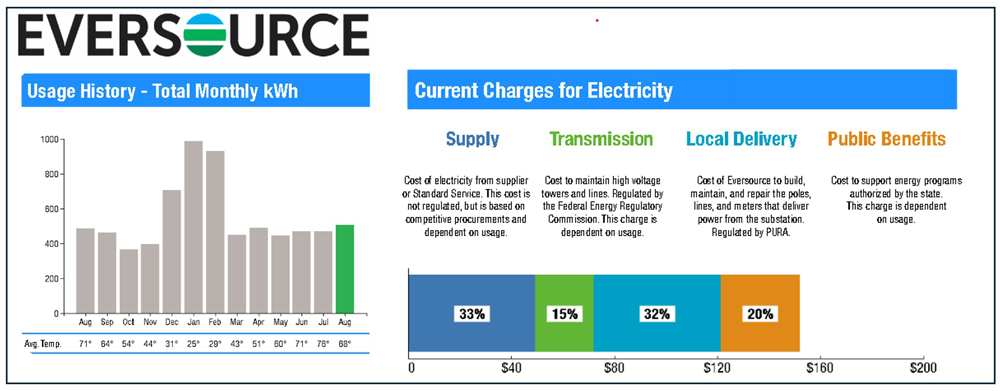
The public benefits charge increases a Connecticut resident’s electric bill by more than 20 percent. Transmission costs can add another 15 percent.
Or consider Connecticut’s energy efficiency program that offers residents a free home energy assessment or rebates for installing new windows or a heat pump. These initiatives are all funded out of PBC payments, at an annual cost of some $148 million.
While hardship and green initiatives tend to get most of the attention, in fact the single largest driver of the PBC is Connecticut’s 2017 decision to purchase electricity at a fixed price from the Millstone and Seabrook nuclear power plants. While this might nominally be considered “supply,” because the utilities are required to buy the electricity based on an act of the legislature, it gets funded as part of the PBC.
The PBC has been around for years but went largely unnoticed because it was buried along with other charges deep inside electric bills and it wasn’t all that big. Starting in 2023, all that changed.
First, Eversource customer bills were redesigned. A review of a current Eversource bill shows all four areas of costs—supply, transmission, local delivery, public benefits—presented clearly.
Then, in 2024, PBC costs skyrocketed, going from well under 10 percent of an average bill to as much as 29 percent. An average household saw its PBC costs rise $40 to $50. For many businesses, the dollar increase was in the thousands. This generated a huge outcry, including an online petition that got more than 75,000 signatures.
What caused the steep rise in PBC? More than 60 different cost components are funded via the PBC and, according to Jamie Ratliff, an Eversource spokesperson, many were found to be underfunded previously. Also, during Covid there was a total moratorium on hardship cutoffs, not just during the winter months. The moratorium ended in 2024, and Eversource and United Illuminating moved to recoup those costs.
However, the single biggest factor driving up the PBC remains the Millstone/Seabrook nuclear power agreement. When Connecticut legislators agreed to that deal, electricity generated by nuclear power was far cheaper than burning natural gas, enabling Connecticut to resell the electricity from Millstone at a profit and use that money to keep the cost of the PBC down. Then, in 2024 the price of natural gas fell from its 2023 high. Reselling the power generated by Millstone and Seabrook was no longer as profitable. This alone increased the PBC costs by over $600 million.
All told, the cost of all public benefits charges in 2024 was approximately $794 million, according to Ratliff.
This past May, Eversource cut the PBC charge significantly. Now, instead of accounting for 29 percent of the bill, it’s closer to 20 percent. Also, sensing the political fallout, Connecticut’s legislature and governor took action this year, shifting the funding of the unpaid Covid moratorium bills, as well as costs related to the state’s new electric vehicle charging incentive program, from the PBC and into a $155 million state bond. This will further cut average monthly bills by about $13 starting as early as September.
Along with the PBC, the cost of maintaining the high voltage backbone grid is also getting scrutiny. This is funded via the portion of the bill labeled transmission and covers the costs of long-distance lines, regional substations and reliability projects that bring power to all the wires and poles. (The latter are covered under the local delivery heading.)
Like the PBC, transmission costs were once a relatively small part of an electric bill. Ten years ago, actual or planned spending on transmission projects amounted to $58 million. Today, according to U.S. Senator Richard Blumenthal (D-Conn.), the price tag on transmission is $1.2 billion—a rise of over a third in the past year—and now accounts for 12 to 15 percent of a consumer’s bill. Connecticut’s Office of Consumer Counsel expects these charges to rise another 20 percent through 2030.
The charges on a user’s bill for the PBC, transmission and local delivery are prorated based on usage—regulators set a specific price for each charge and that gets multiplied by how much electricity is used. For example, the current charge for transmission is 4.4 cents per kWh. So, if 1,000 kWh of electricity is used in a month, the cost is 4,400 cents for the transmission part of the bill–or $44.
Barring more legislative action, a major change in the mix of fuel or a dramatic change in the price of natural gas, the only sure way to keep an electricity bill in check is to reduce usage.
The upshot: It may be true that it’s better to light a light than to curse the darkness, but the reality is that in Connecticut, that strategy will cost extra. n
