Backyard Bird Chronicles
Sandhill Cranes Have a Tough Summer
By Susannah Wood
For more than 10 years, North Norfolk residents Marie and Stan Civco have recorded the coming and going of the Sandhill cranes that nest in nearby wetlands and spend much of each day feeding and hanging out in their yard or across the road at Drew and Sally Quale’s house. Every March, a pair of adults appear, usually with one adolescent born the previous year. After shooing the juvenile off, they get down to nesting. Only one colt, as the young are called, typically survives to adulthood.
This year, that scenario went awry. When the first nestlings did not survive, the adults mated again. By June 17, two small colts made their appearance, crossing the road into the Civcos’ yard. They were about a month behind the usual stage of development, which delayed their ability to fly and escape danger.
The Quales’ hayfield was mowed in August as usual. Two days later one colt disappeared, perhaps the victim of the coyotes or other predators that visit the field. The adults arrived alone on Aug. 21, beginning a story of rescue, hope and ultimately heartbreak because three days later, on Sunday, Aug. 24, a surviving colt appeared at the edge of the Quales’ field. It was lying down and clearly distressed.
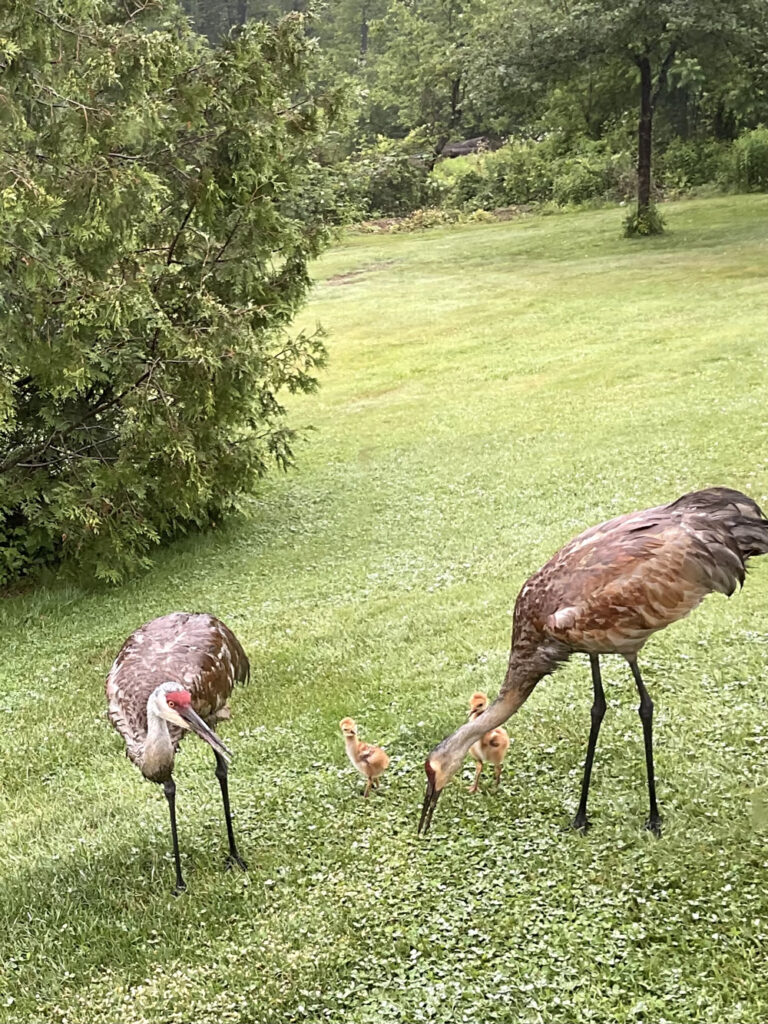
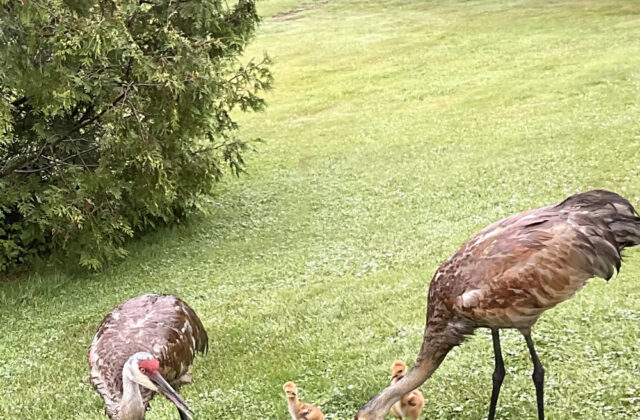
A pair of adult Sandhill cranes that make summer their home in North Norfolk tried a second time after their first hatchlings failed. Here they are on June 17 with the second set of colts, as the young cranes are known
Drew Quale called the Civcos with the news. They arrived, bringing corn and water to the colt, which was able to eat and drink. Unsure of how the adults might behave, Stan had armored himself in a heavy jacket, hat and thick gloves. The adults merely watched when he approached the young one and tried to get the injured crane to stand. Its legs kept buckling. The loss of some feathers on one flank was the only outward sign of possible damage.
The Civcos had no luck reaching the state Department of Energy and Environmental Protection (DEEP), Sharon Audubon or even the Aldo Leopold Center in Baraboo WI, a fall stop for migrating cranes. Leaving the crane outside overnight was not an option so they gently wrapped the bird in a blanket, put it in a large dog crate and carried it into their garage.
On Monday, they connected with Sunny Kellner, the wildlife rehabilitation manager at Sharon Audubon, and delivered the crane into her care. Following the usual protocol, Sunny kept the bird in isolation to make sure it did not have bird flu, giving it supplemental fluids and nourishment by feeding tube to help it recover weight and strength. The bird continued to eat and drink and made some progress but could not stand on its own. So Kellner sent x-rays from the local veterinarian to wildlife specialists at the Cummings School of Veterinary Medicine of Tufts University where staff diagnosed degeneration in one hip.
But after a few weeks, the bird’s recovery stalled. With more diagnostic expertise needed, volunteers drove the colt to Cummings. The examination showed deterioration in the hocks, but did not produce any answers as to the original injury or its exact cause. Sandhill cranes are very sensitive to the stress of captivity and rehabilitation, which frequently leads to secondary problems. The fact that the crane had been unable to stand for such a long time would be enough to trigger problems in its legs. At this point, the Cummings veterinarians decided euthanasia was the kindest option.
Not every rescue story is successful, yet each one is a team effort. The condition of the young Sandhill was so serious that only Sharon Audubon’s trained staff could be involved in its care, but volunteers played an essential role in bringing the bird to Tufts—much as they did in driving a swallow-tailed kite all the way to Florida when it missed the fall migration.
Families of Sandhill cranes now regularly breed in several Norfolk locations, often in wetland areas close to grasslands where they can feed on seeds, grains, invertebrates, small amphibians and more. Many of these parcels would qualify for what is known as a PA 490 designation because the land is classified as forest, farm or open space. This approach is used by some towns to reduce property taxes on land actively used for agriculture or forestry.
No one knows whether mowing had a direct bearing on the loss of the two Sandhill colts, but grassland ecologists suggest only mowing one third of a field each year and mowing in a circular pattern from inside to outside of the field at slow speed. This gives wildlife time to escape and reduces mortality of grassland birds and animals. Of course, this was also an unusual year, as normally the young would have fledged before the field was mowed.
To learn more about the Sharon Audubon Center’s rehabilitation efforts visit: www.audubon.org/sharon. The site provides guidance about how to assist injured birds or wildlife, how to become a volunteer, an Amazon wish list (think mealworms and bird vitamins). To donate, send a check to Sharon Audubon, 325 Cornwall Bridge Rd., Sharon CT 06069. Specify that the donation is for the Sharon Audubon Center Wildlife Rehabilitation Clinic.
