From Freeze to Flow: Extreme Temps and the Maple Syrup Season
Reaching that ideal mix of natural conditions
By Jude Mead
The extreme cold and heavy snowfall this season has raised some concern among maple syrup producers. Reports of loud, cracking noises in wooded areas have set the stage for a phenomenon called “frost cracking.” During these periods of intense cold, the water and sap inside a maple tree’s trunk can freeze and expand. This creates an intense pressure inside the trunk that builds faster than the wood can adjust, leading to a sudden rupture or split in the tree trunk. The resulting crack gives off a sharp loud sound much like that of a sudden explosion – hence the humorous term “exploding trees.” The severe split left behind, however, is not funny and can weaken a tree. A stressed tree means less sap production for maple producers, at least temporarily. Fortunately, sugar maples are resilient and will heal with time.
Russell Russ, who has worked at Great Mountain Forest (GMF) for many years and holds a degree in forest resources management, said he never saw a tree explode but was familiar with frost cracks. According to Russ, who also monitors the weather at GMF and maintains all weather records, the lowest recent temperature was -10 degrees, with -40 degree wind chills. “That’s cold, but not crazy cold. I think the exploding must happen in VERY cold temperatures and probably very rarely. Probably colder than what we’d get here locally,” said Russ.
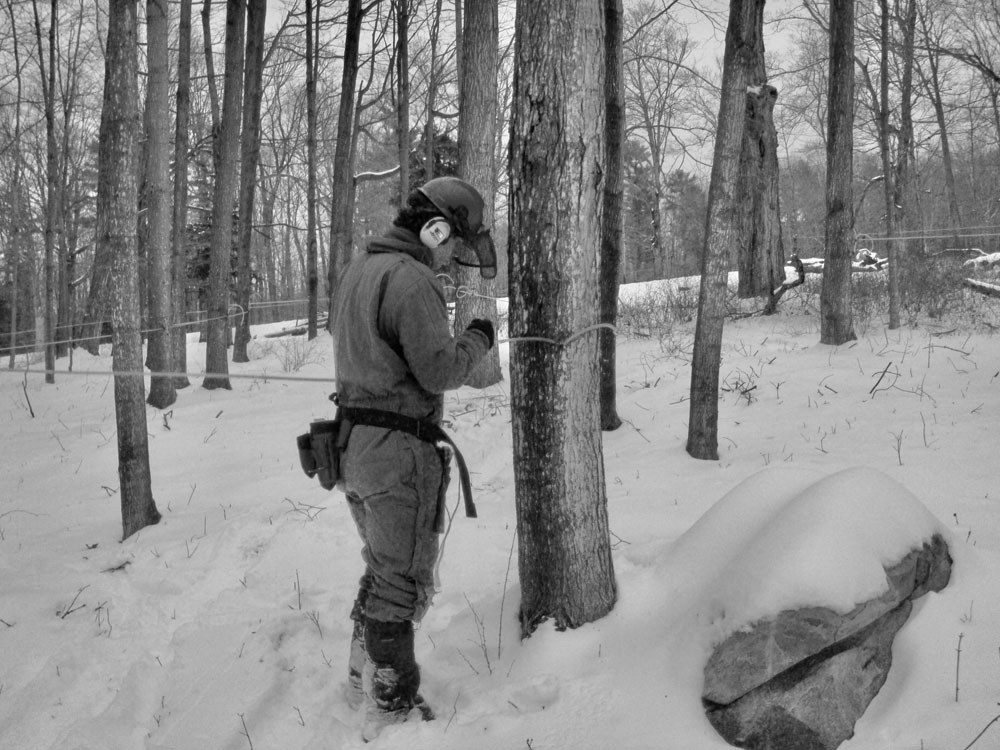
PHOTO BY JUDE MEAD
Russ added that he had never heard or seen a tree explode at GMF. “We’ve seen frost cracks in winter, which is normal, but no explosions Also, when it’s very cold you can hear trees creaking in the wind, but again, not exploding. I did hear the creaking during our early February cold snap when we had below zero temps and windy conditions,” explained Russ.
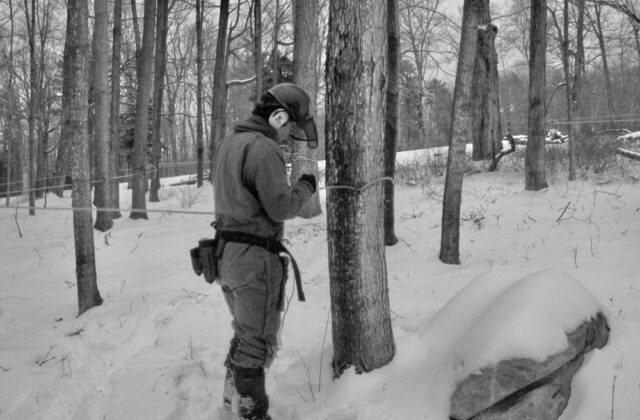
Ironically, cold weather and pressure are not always bad things for maple trees or for maple producers. The intense cold that triggers frost cracks is also responsible for the much-needed changes inside the dormant trees that convert the stored starches in the roots into sugars. This produces the sweet sap that is collected and boiled down to make maple syrup. The pressure also causes the gases in the wood to contract and expand, forcing the sap to flow upward in the tree.
Without prolonged cold periods, this system falters. In other words, while too much cold and pressure can harm a tree’s structure, a necessary amount of cold and pressure is required for sap to run. Maple producers understand the physical properties behind this complex change that happens and they know that winter’s harsh grip is needed to ensure a productive syrup season.
Consequently, this extreme cold is not just endured by maple producers—it’s welcomed—because a good, cold January lays the groundwork for a productive March. Peter Gregg, the publisher of Maple News and a maple producer himself, reported that maple trees rely on the freezing temperatures and he emphasized the importance of a cold winter. According to Gregg, sap flow depends on the freeze–thaw cycle, with ideal conditions occurring when daytime temperatures rise above freezing (32°F / 0°C) and nighttime temperatures fall below freezing. The process of syrup producing cannot be separated from the rhythms of weather and trees. So, the next time a deep freeze grips the area, or you hear a tree crack, think about the biological changes happening inside the maple tree and how it contributes to the delicious maple syrup you pour over pancakes. A taste of real maple syrup is a reminder that its flavor comes from the work of nature and that its creation depends on those below-zero temperatures and the warmer spring days that follow.
