How Botelle (Carefully) Uses AI for Learning
By Avice Meehan
For more than three decades, children visited the fictional town of Frog Creek, Penn., home to two children named Jack and Annie. With the help of a magic tree house, the pair are whisked away to distant places where they have adventures, solve problems and, perhaps, learn a thing or two.
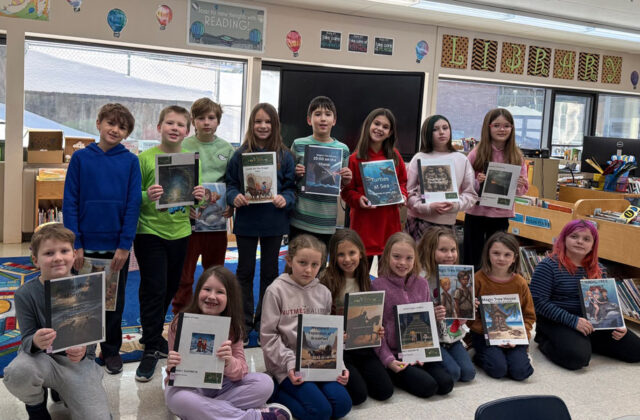
Like Jack and Annie, students in Nicole Partyka’s classroom at Botelle Elementary School have their own magic tree house—although they had to build it themselves, word by word and picture by picture over the course of a month. As authors of titles such as “Penguins at Noon” and “10:00 on the Titanic,” the third and fourth graders identified a setting, imagined characters to travel with Annie and Jack and researched, wrote, revised and illustrated a 10-chapter book with a related non-fiction companion book.
Toward the end, they worked with Erin Dubecky, the school’s library and media specialist, to use the “magic media” artificial intelligence (AI) tool in the Canva design platform to design the book cover. Except, of course, the AI tool is not magic and required a fair amount of work. “They had to write a clear prompt and for some it took 20 tries,” said Dubecky, noting that students had to think and write clearly to achieve a good result. It is not enough, for example, to specify that one wants to illustrate an adventure in a desert.
It is one of several examples of how AI is being used in modest ways by students at Botelle. Older students have gone beyond creating book covers to designing food webs for a book about ecosystems and other, more complex projects. Those who are working on personal interest projects through EdAdvance, the regional education agency, have access to a bot called “Sidekick” to generate project ideas—although, for some, the reams of ideas have proven to be overwhelming.
“AI is THE thing that schools are thinking about, Students are using it whether schools are teaching it or not. It is not going away,” said Elizabeth Radday, director of research and innovation at EdAdvance. Radday cohosts the ChatEDU, which focuses on how AI is transforming K-12 education. “If we were a middle or high school, we would be on a highs-peed train ride and our lens would be different,” said Botelle Principal Lauren Valentino. “At the elementary school level, the entry point [into AI] is much more carefully scaffolded and we have the gift of approaching this methodically and in a way that is developmentally appropriate.”
The Botelle Board of Education is in the earliest stages of thinking about what policies should be in place governing the use of AI. Northwestern Regional District No. 7 adopted a policy in January that requires students to disclose use of AI-generated material.
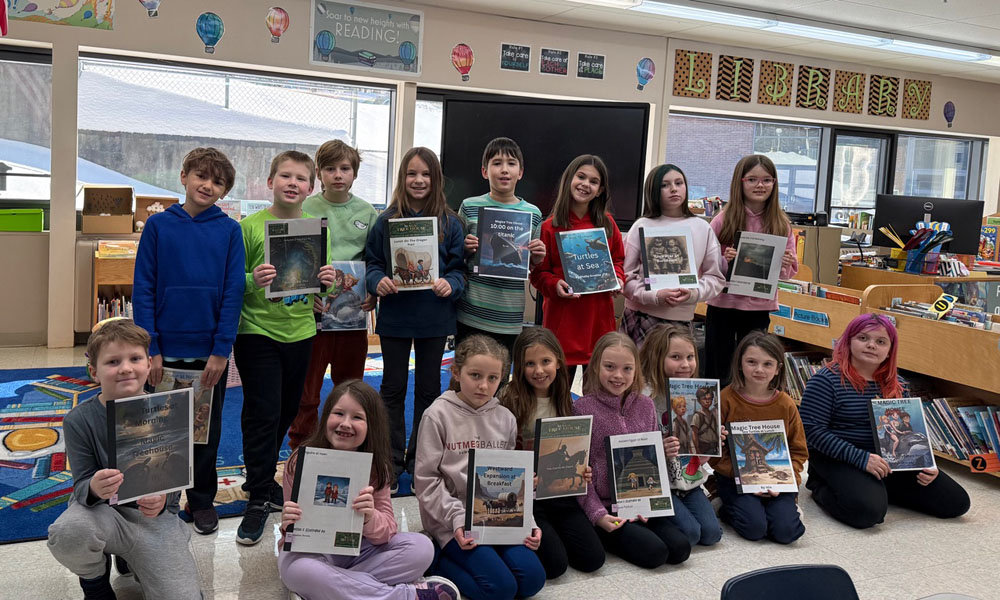
PHOTO BY AVICE MEEHAN
Dubecky, whose husband is a software engineer, views the advent of generative AI—that is, a computer program that can generate content based on the ideas or prompts supplied by a user—as “the most disruptive thing that’s come around in my lifetime.” In her role at Botelle, she looks for ways to allow students to try the technology in a protected environment and that includes helping them understand what it is and what it is not. “AI is not a human, and it doesn’t think.
It doesn’t tell us what to do. We have to tell it what to do,” said Dubecky, who believes it offers particular opportunities for teachers working with students at different developmental stages. “You can upload a worksheet and ask [an AI program] to make it appropriate for a student’s needs. Or ask it to make a worksheet more advanced. It can make a job that a teacher does every day more efficient.”
