Propelling Norfolk into the 21st Century
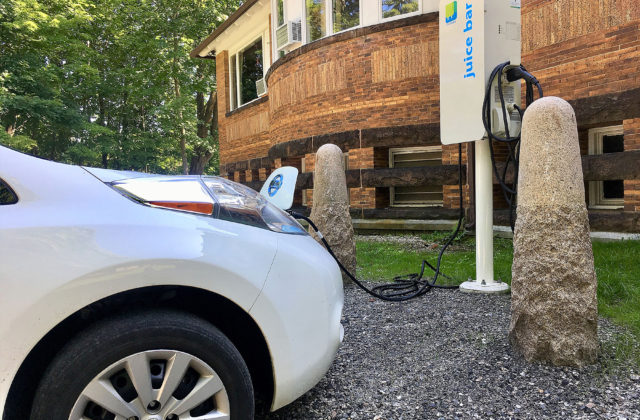
Charging station for electric cars installed at Town Hall
Text and photo by David Beers
Last summer, an overnight visitor to town inquired at Town Hall about charging their electric car and found out that the closest chargers were in Winsted and North Canaan. This prompted a conversation in the town’s newly revitalized town Energy Advisory Committee about installing an electric car charger at Town Hall. The committee took this task on, with Matt Riiska leading the work. The car charging station is now up and running behind Town Hall.
First some electric car history.
In 1834, the first electric car was invented, long before the first gas-powered car. By the 1890s, for every single gas-powered car there were 10 battery-powered cars on the road. This trend continued until 1913 when Henry Ford started mass production of gas-powered cars, which lowered their price in comparison to electric cars. Gas cars dominated the roads after 1920, and battery cars became a fringe curiosity car for the next 90 years—like the lunar rover sitting on the moon right now.
This downward trend started to shift in the late 1990s with the growing sales of hybrid cars that use regenerative braking to charge a battery that supplements the engine power. The hybrid’s success led to car companies building plug-in hybrid electric vehicles (PHEVs), and then to reviving the all-electric battery powered car (EV) in the early 2000s. Now there are over one million plug-in vehicles (EVs and PHEVs) on U.S. roads today and over 18,000 car charging stations throughout the United States in places like car dealerships, highway rest stops, schools, workplaces, hotels, apartment buildings, commuter lots and, of course, town halls.
Plug-in cars are still much more expensive that their gas equivalents, but this is gradually changing. New car prices range from $20,000 for a car with a 58-mile battery range to $100,000 for a 345-mile range. The $2,500 to $7,500 federal tax credit helps, along with a State of Connecticut rebate of up to $2,000. There are significant cost savings over the life of the vehicle due to fewer moving parts to wear out and break, reduced or no engine use, extended brake life and a combined cost for electricity and fuel equivalent to $1 per gallon. The PluginAmerica.org website helps you learn about the 40 plus plug-in cars you can choose from, and it also has a great interactive map of charging stations. CT DEEP has a great website for information about incentives and its own Connecticut charger map. The Norfolk Town Hall station will soon be on these maps.
The Town Hall station was paid for by the Town Hall building fund, and the town plans to recoup the costs of the charger from the charging fees. It cost about $1,000 to connect and install the 220-volt line outside and another $5,940 for the two-outlet charging station. While having the charger will certainly be a convenience to the town residents that own an electric vehicle (yes, there are a few), it will mainly be a benefit and a draw to those visiting town. For example, a visitor can charge their car while at Infinity, or at the Music Shed or at the farmers market, or even purposely stop in town to get some much-needed battery life on their way to somewhere else and then do some downtown shopping during the wait time.
The Norfolk Town Hall charging station will charge a depleted car battery in 2-3 hours using a J1772 plug. Most cars can use this plug, either directly or with an adapter. Two cars can charge at the same time. Users will need a Greenlots app on their phone to use the charger, or they can call the phone number printed on the charger. The app starts the charging, keeps track of the amount of electricity used and transfers the funds from the user to the town. The town sets the rate per kilowatt-hour and receives the revenue from each charge. The town can change the rate as needed and can also charge a parking fee for using the charger longer than a specified time. This will prevent “charger loitering,” which keeps others from being able to use the charger—like leaving your car plugged in all day or night. The all-weather charger has two large granite bollards in front of it to prevent a car hitting the charger. These bollards originally protected a water fountain at the intersection of Route 44 and Westside Road from getting hit by horse buggies 100 years ago.
Ted Hinman is a Norfolkian who has used a Nissan Leaf EV to commute to work in Hartford for the past two years. He charges every night in his garage to maintain the 100-mile range of his car battery. Occasionally he does use a public charger on longer trips. He enjoys the lower operating and maintenance costs of his EV, along with the fast acceleration when dodging rush-hour traffic. He was very excited to be the first resident to charge at Town Hall, and he hopes he will only be the first of many to do so.
