Keeping Vital Supplies Flowing to Ukraine’s Front Lines
Two men with local ties send equipment where it’s needed most
Text By Andra Moss
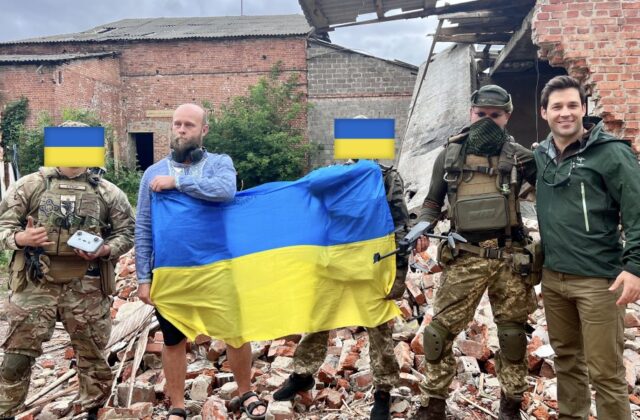
Photo Courtesy of Evan Platt
On May 1, barely two months after the start of Russian invasion of Ukraine, Evan Platt boarded a plane in Salt Lake City, Utah, bound for Warsaw. His friend and former Massachusetts Institute of Technology (MIT) roommate Ian Miller had called, urging Platt to come “for a week.”
Miller had been based in eastern Poland since the third day of the invasion, working with a small international team to deliver medical aid and vehicles to Ukrainians on the front lines. Recalls Platt, “My second day in Poland, I was in a 4×4 truck with a Swedish air force veteran, carrying 600 tourniquets and other aid into Ukraine. We drove from Warsaw to Kyiv. I’ve been in Ukraine ever since.”
Platt and Miller have been friends since 2008, when they both rented rooms in a Georgetown house while interning in Washington, D.C. “We were roommates for over a month before we connected the dots that our parents were [living] in Norfolk,” says Platt via a call from his apartment in Kyiv.
The two men reunited at MIT for graduate school and now, in Kyiv, are forging a new bond through Zero Line, the nonprofit organization they have founded to deliver high-impact aid to Ukrainian soldiers at the front of the front lines (a.k.a. the “zero line”).
They have built a supply-chain infrastructure with a demand system, led by Platt, utilizing his MIT degree in supply chain and systems engineering; a fulfillment system, led by Miller; and a procurement system, led by their third team director, Isaac Flanagan.
Together with teammates from Ukraine, Poland, Sweden, Finland, the United Kingdom and Canada, and a sizable and growing group of Ukrainian partners, the three started by packing vehicles with trauma medical aid and finding ways to convoy them to the front lines. By May, Zero Line had delivered over 100 vehicles and 100 tons of aid. In April, responding to new requests from their Ukrainian partners, they increased their focus on electronic communications equipment such as satellite phones, encrypted radios and drones for reconnaissance and artillery units.
This shift was highlighted in one of Zero Line’s weekly Zoom calls with supporters around the world. Norfolk resident Anne Garrels was sitting in on that call. Garrels, an award-winning foreign correspondent once based in Russia, had recently cofounded the nonprofit Assist-Ukraine. She listened as Platt, Miller and Flanagan discussed a Ukrainian reconnaissance commander’s urgent request for satellite phones to enable field communication and to avoid detection by the Russians. Garrels decided to put her funding behind Zero Line to find and deliver this vital equipment.
Platt recounts that “with support from Anne Garrels and her charity partner, Art Davidson, we delivered the Iridium 9575 satellite phones the commander had requested. This is one of the most difficult items in the world to procure right now.” The Zero Line team was able to convince a European distributor both to reduce other private-sector allocations to make these phones available and to agree to a 30 percent price reduction.
This experience helped reinforce the Zero Line’s team conviction that they had found their role in the fight for Ukraine’s survival. “This is an artillery duel,” says Miller. “Russian artillery units use Soviet-era cannons that shoot missiles up to 50 kilometers without much accuracy. Their standard procedure is to flatten whole cities, kill huge numbers of civilians and then move in. Both the Ukrainian and Russian forces use drones to direct their artillery fire. At Zero Line, we supply drones and satellite phones to help improve the effectiveness of Ukraine’s artillery units.”
Zero Line now concentrates its procurement efforts in three areas: used 4×4 vehicles, which are delivered full of medical aid; electronic communications equipment—encrypted radios and satellite phones—for the Ukrainian special forces; and drones to assist artillery correction units. It works with a host of Ukrainian army and government partners to identify where the equipment should be delivered to provide the greatest impact.
With the ongoing closure of Ukraine’s air space, Zero Line’s fulfillment process is complicated. Their greatest asset, says Platt, is local partners. “To speed this up, we have fulfillment partnerships with a network of wonderful humanitarian organizations based in Ukraine.”
Moving supplies through customs in Warsaw, for instance, requires help with the right licenses. Partners with warehouses at the border in Lviv make them available for a quick stop, if needed. Then, says Miller, “we have ways to cut the line to get things across the border.” Next is the trip from Lviv to Kyiv or Dnipro (the end of the safe “green zone”) and finally the 200 kilometers known as “the last mile.” Here, says Miller, local assistance is vital. “We have drivers with training, vehicles and bullet-proof vests who will take everything to a designated drop-off point.”
“Turnaround time is so important,” he emphasizes. “One of our major values is saving lives quickly. Speed matters.”
Zero Line reports that it has raised $1 million to date, with 100 percent of giving going to the procurement of aid supplies. They have facilitated an additional $2 million in in-kind donations. “The money we’re raising now,” says Platt, “will expand the number of military units we can support with electronic eyes and ears.”
What started for Platt as a one-week visit with a friend has transformed into something much larger. He, Miller and Flanagan are dedicated to doing all they can to help save Ukrainian lives and end the war. “Most large, established aid organizations can’t take sides in a conflict,” they assert. “We are taking sides. Ukrainians are fighting for their most basic human rights, and we are appealing to anyone who wants to lend a hand to please join in and do whatever they can.”
Donations to Zero Line can be made via their website, https://www.zero-line.org/ , and interested supporters can email Platt (EHP@zeroline.org) or Miller (IGM@zeroline.org) to join a weekly Zoom call for updates.
