
Local Conservation Groups Work to Protect Connecticut’s Bat Population
Friends Not Foes
Text By Avice Meehan
Photo By Pamela Velez
Don’t be surprised if you see a strange-looking vehicle with an antenna on its roof crawling along Goshen East Street late at night. It’s a scientific bat mobile, deployed by the state Department of Energy and Environmental Protection (DEEP) to assess Connecticut’s bat population.
Moving at 20 miles an hour, just a bit faster than the average bat, the mobile laboratory uses acoustic listening devices to collect bat calls that are silent to human ears. With an assist from specialized software, researchers can then identify individual species and make rough population estimates.

It’s important work. The state began surveying bat populations more than a decade ago after a fungal infection called white nose syndrome was discovered in the Northeast. It has since killed millions of bats, including an entire hibernating colony of 4,000 little brown bats in nearby Roxbury.
“Bats are not a popular animal, but without a doubt, they are among the most significant living creatures. Every species benefits from them. The planet cannot survive without a bat,” says Gerri Griswold, a Norfolk resident who is director of administration and development at the White Memorial Conservation Center in Litchfield and a passionate bat educator.
Silent to humans and often only visible in waning daylight, bats use a combination of sight and echolocation to navigate their world and find prey, usually night-flying insects. Weighing less than half an ounce, a little brown bat has a wingspan of up to 11 inches and eats at least half its weight each night. The more common big brown bat—Griswold describes them as the golden retriever of the bat world—weighs just a quarter of an ounce more.
Connecticut’s surveys run from May to October along 12 routes or transects, with organizations such as White Memorial contributing property-specific information from its own acoustic surveys and bat counts. Devaughn Fraser, who began working as the state mammologist 18 months ago, is beginning a deep dive into the data to better understand what’s happening to different species of bats in specific areas of the state.
“There are some hopeful signs,” said Fraser, whose postdoctoral research focused on analyzing the genes of little brown bats before and after exposure to the fungus. “Little brown bats seem to be developing a natural resistance to the fungus and slowly making a comeback based on data from Connecticut and other states.”
But it’s an uphill battle. Nine species of bats can be found in Connecticut, and every single one of them, even the relatively common big brown bat, has been designated a species of greatest conservation concern, and five are considered endangered. Like humans, bats reproduce slowly with females generally giving birth to only one pup a season over the course of a lifetime that can last 30 years. It’s the opposite of what Fraser calls the “live fast, die young” strategy of other small mammals like mice.
And this is a time of year when bats are particularly vulnerable to colliding with nervous humans. Bat pups learn to fly in July and August, and then colonies disperse ahead of migration to warmer climates or shelters like caves that provide temperature-controlled environments for hibernation.
“There’s a seasonality to most human interactions with bats,” says Fraser. “You have young, dumb babies learning to fly, and then the colonies spread out after the pups learn to fly. This is the cycle of activity that would dictate when we encounter a bat. Bats aren’t out to get you, although they may swoop around your head to catch insects.”
Preserving maternal colonies is particularly important because bats like to return to the same location every year. Fraser cited the Salisbury Association as a good example of an organization that originally wanted to exclude a colony of big brown bats but agreed to partner with DEEP to both retain the colony and identify ways to preserve its historic building. A recent count found 29 big brown bats living in the association’s Academy Building.
An even bigger partnership will debut next year between DEEP and White Memorial, which is home to a maternal colony of about 200 big brown bats that live in an old hay barn. Assuming supply chain issues are resolved, members of the public will soon have a bat’s-eye view of activity in the colony through a live feed available via websites at DEEP and White Memorial.
“It’s a highly dynamic place,” says James Fischer, a wildlife biologist and research director at White Memorial.
In the meantime, the bat-curious can participate in Bat Appreciation Day on Sept. 10 at the Old New-Gate Prison and Copper Mine in East Granby. Wildlife biologists will be there, and hands-on activities will be available for children and adults alike.
Being a Good Bat Neighbor
Pulling out invasive plants such as garlic mustard and multiflora rose and replacing them with native plants is just one way to support Connecticut’s bat population, according to James Fischer, research director at the White Memorial Conservation Center. Bats play an important role in pollination and need a healthy supply of insects. They love mosquitoes and naturalists claim they are much more effective than a bug zapper.
Leaving snags in a woodland also helps tree-roosting bats while also providing food sources for birds like the brown creeper. Homemade or manufactured bat houses can also be a good option and DEEP offers extensive resources and simple plans here: https://portal.ct.gov/DEEP/Wildlife/Learn-About-Wildlife/Bats-in-Connecticut.
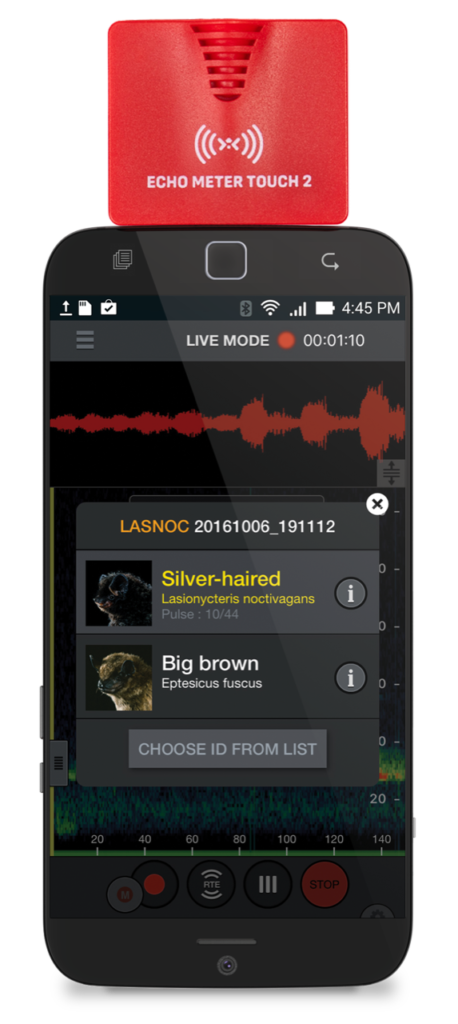
If you want to count bats, pull up a chair about half hour before sunset, equip yourself with a beverage and a pair of binoculars to watch the sky. For a higher tech approach, Android users can attach a small device called an Echo Meter Touch 2 to a phone or tablet and, with the help of an app, listen to the bats around them. The device is available through www.wildlifeaccoustics.com.
If You Encounter a Bat
Bats found outdoors during the colder months (November-March) should be reported to DEEP’s Wildlife Division at deep.batprogram@ct.gov or 1-860-424-3011. This is a sign that they are likely suffering from white nose syndrome.
If a bat comes into your home, close off the room and open a window. If that doesn’t work, put on a pair of heavy gloves, and use a large cardboard box or glass jar to gently cover the bat. You can create a lid by sliding a piece of cardboard over the opening before releasing the bat. Remember that fewer than 1 percent of all bats are rabid.
“It’s illegal to kill bats, but people still do rotten things because they are afraid,” says Gerri Griswold, who is licensed to house bats and currently cares for two big browns, including one whose wing was deliberately smashed.
For bats in distress, DEEP maintains a list of license wildlife rehabilitators including one in Litchfield County: https://portal.ct.gov/DEEP/Wildlife/Rehabilitator/Animals-in-Distress/Bats-in-Distress.
“My objective is to educate children and then get the children to educate their parents,” says Griswold. “This is an animal that has been discriminated against solely for the fact that it’s unattractive. [In a way] it is a champion for every kid who has been bullied.”
Beauty is relative, say Griswold, Fraser and Fisher. A big brown bat – which
Griswold currently works with two big brown bats – the most common species in Connecticut today – as part of her teaching. Both were rescued, one after her wing was deliberately broken and the other after being found in Branford covered with mites. In the wild, a big brown can eat half its weight in insects every night
