Discovering Norfolk
In the Heart of the Village, Time Moves with the Sun
By Jude Mead
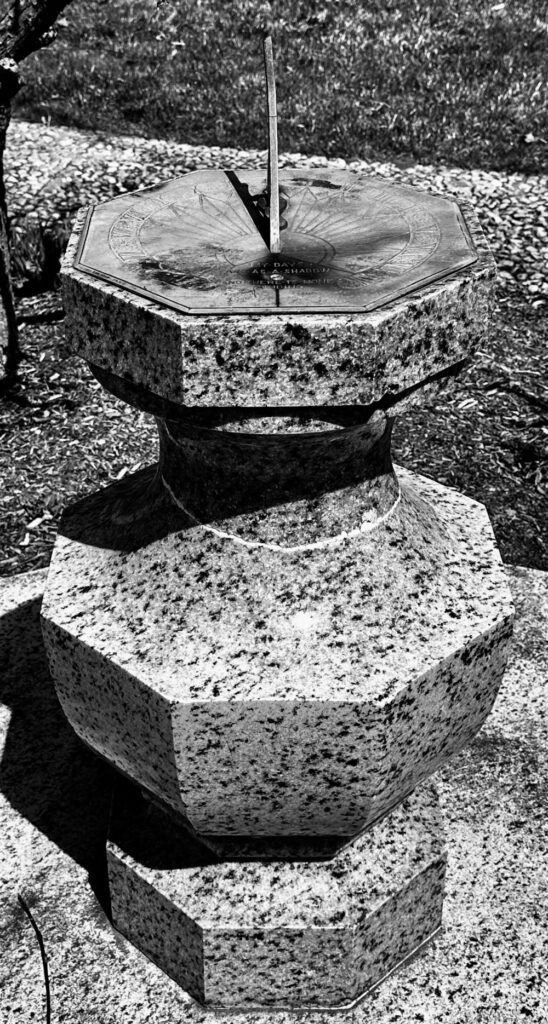
Nestled modestly behind the Battell Fountain on the Norfolk village green sits a sundial purchased by Mary Eldridge in 1904. Eldridge had also gifted the town with the Stanford White designed fountain that the sundial sits behind in 1889 in memory of her uncle Joseph Battell. The words “Our days are as a shadow and there is none abiding.” are engraved on the top. Many sundials were often inscribed with aphorisms that reflected philosophical musings intended to inspire those viewing it. If not paying attention however it is easy to walk by and not notice this symbolic feature that has graced this spot for over a century.
The sundial on the village green stands not only as an instrument to mark the passage of time but also as a testament to human ingenuity and a community’s social life. Before mechanical clocks became available rural communities relied on the sundial to organize their daily lives, from farmers using it to schedule a workday to villagers synchronizing meeting times. Modern technology though has made its timekeeping role obsolete, leaving it appreciated more for its heritage value than original function.
A sundial simply tells the time by using the sun’s shadow. Its design is based on the movement of the sun across the sky. A gnomon—the upright part of the sundial—casts a shadow onto a flat plate marked with hour lines. As the Sun moves, so does the shadow, indicating the time. Wherever the shadow points, that’s the solar time. In short, a sundial turns the sun’s motion into a moving shadow, and the time is read based on where that shadow falls!
It sounds simple but there is a bit of astronomy, mathematics and science involved as well. For example, the gnomon must be angled so it points toward true north and not magnetic north. Locating these points means knowing that true north points straight toward the geographic North Pole while magnetic north, is the direction that a compass needle points. Its tilt must also match the latitude of the sundial’s location. The sundial shows solar time, which can be a little different from clock time because of earth’s tilt and orbit.
Sundials also make great backup timekeeping devices because they require no electricity, no batteries, and no maintenance—just sunlight and proper alignment. While today, sundials are no longer essential tools for telling time, they continue to serve as reminders of history and cultural importance. And that is timeless. So, take a moment and stroll over to the village green and check out this symbol of our connection to the natural world and the sun.
