High or Low Tech?
New Strategies Considered for Speed Control in Norfolk
By Avice Meehan
First Selectman Matt Riiska often ends his monthly Norfolk Now column by asking people to slow down and observe the speed limit. But what exactly is the speed limit on town roads?
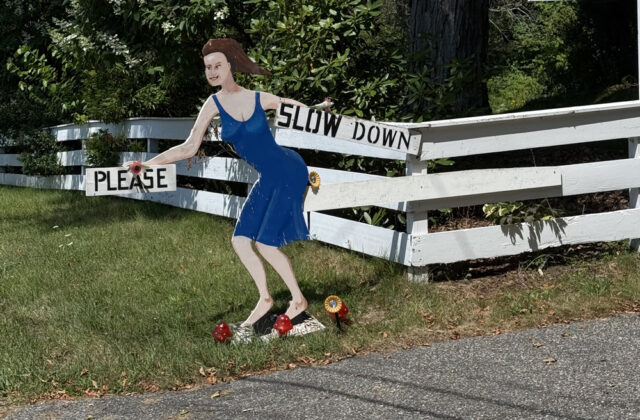
“It is 25 miles an hour all through the town, on all town roads,” said Riiska. That includes Ashpohtag Road where residents have long struggled with speeders. The road has multiple solar-powered speed signs and speed bumps—plus John Thew, who continues to demonstrate his creativity at the age of 98. When the town crew attempted to remove a speed bump near his home—and its personalized no speeding sign—Thew and his daughter stood on the bump and prevented its removal.
On state roads, such as Route 44 or Route 272, the speed limits vary by location—as do the attempts to slow traffic. Along Route 44, the scene of a massive gasoline spill in 2022, residents placed their own “Go Slow” signs coming into the center of town. On Route 272, canoe-maker Schuyler Thomson has been known to park a gray Volvo wagon to mimic a state police cruiser or use his own, hand-held radar gun to track speeding.
But traffic enforcement in Norfolk could become less homegrown and more high tech. Riiska met on Aug. 26 in Newington with representatives of a Massachusetts-based company that provides “automated traffic enforcement” equipment—otherwise known as speed cameras. The system, if implemented by the company, would be free to the town because costs would be offset by fines levied on speeders. He is now actively promoting the value of testing the technology on state roads in Norfolk, and the idea is likely to be discussed at the Sept. 2 meeting of the Board of Selectmen.
This is all possible because of a 2023 law that allows Connecticut municipalities to use speed and redlight cameras to improve safety for pedestrians, cyclists and motorists with a specific emphasis on locations near schools. Five towns have received the necessary approvals from the state Department of Transportation—Washington was the first, in December 2024—and another five towns have plans under review. More applications are expected, including one from Winchester to cover the Winsted business district.
Sitestream, the company with whom Riiska met, currently has a three-year contract with Hamden to provide cameras in as many as 25 locations. Sitestream, founded three years ago, lists no other clients on its website, but is engaging with other communities, including Newington. Andrew Noble, the company’s founder, formerly led the U.S. division of a Swedish company called Sensys Gatso that provides traffic enforcement systems around the world. He could not be reached for comment.
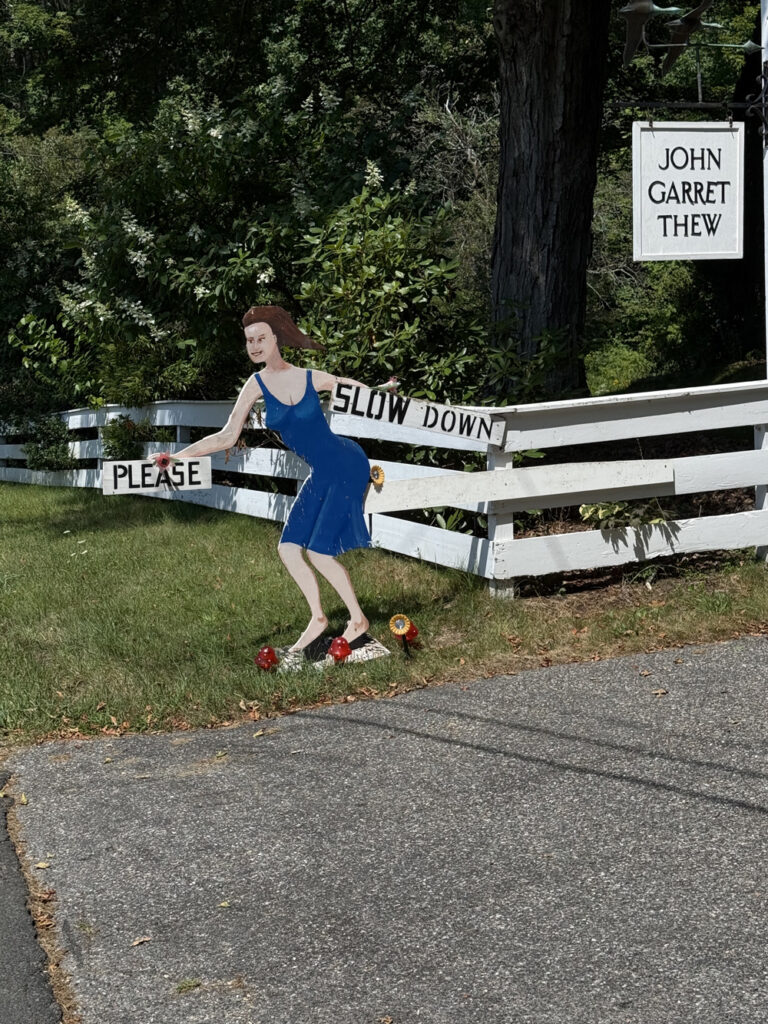
Ashpohtag Road resident artist John Thew gets creative when it comes to alerting drivers to the speed limit.
“My contact with Sitestream is preliminary. There is still a lot of information that needs to be collected,” Riiska said. “Sitestream would collect information to see where the best points are for data collection and then review that data to see if it makes the most sense to work with Norfolk and that the volume meet their business plan.”
Selectman Henry Tirrell, the only candidate running to succeed Riiska, said he was interested in learning more about the idea based on a brief conversation with Riiska. “Speeding is definitely an issue. I hear about it from a lot of people all the time and, because we don’t have a resident state trooper any more, we don’t see (as) much enforcement,” he said, adding that he wanted to better understand how Sitestream or any other company would manage private data collected during enforcement.
There are many steps to complete before Norfolk might see traffic cameras, and the process could extend well beyond Riiska’s term in office. These include adoption of a town ordinance, a public hearing and development of a detailed plan that documents both the need and locations for cameras. As part of any plan, Norfolk would have to identify employees to review all citations before they can be issued, a challenge for a community with no law enforcement resources. Once the system is up and running for a minimum of 30 days, municipalities can charge $50 for the first offense and $75 for each subsequent infraction. An electronic processing fee of up to $15 can also be charged.
Washington, with a population about twice the size of Norfolk’s, has a three-person police force and shares a resident state trooper. Its plan was submitted in October 2024 and included historical traffic stop data—about 40 percent of the more than 6,000 traffic stops in 2023 were for speeding—and detailed studies of three locations. Washington worked with an Illinois company called Dacra Tech, which also manages the back-end payment system. Speed enforcement has already changed behavior on Old Litchfield Road (Route 109) and the town’s Board of Selectmen is now considering possible new locations. n
