Making Hay When the Sun Shines
Rain, drought dictate farming strategies
By Jude Mead
Hay production is always influenced by weather and this year producers faced a challenging dry season. Drought conditions are known to reduce yields, compromise hay quality and force farmers to make difficult choices about cutting. Duncan Wilbur and Mark Jurgilewicz, two local farmers who cut many of the fields in the area, understand the changing weather patterns in New England and prepare for the unexpected.
For Wilber, dry summers have been historically ideal for hay production. “Various different properties/soil types and the type of farming I do (organically based as opposed to chemically based) mean there is little change year to year. I guess I don’t get too worked up about the weather because you can’t change it and you can’t control it,” he said.
Jurgilewicz said some of his hay production was affected by the lack of moisture and agrees that farmers can adjust to what they can’t change. “Adjusting to a drought varies depending on the versatility of each field, whether it’s a naturally wet field or a field that is very dry. Like the saying goes make hay when the sun shines,” said Jurgilewicz.
In dry years, just as in other extreme weather conditions, taking care of the fields becomes a priority for farmers. According to Wilber, fields need to be enriched to be productive. “Planning for dry years or weather-related events, I practice crop rotations, plowing fields, planting cover crops, as well as applying limestone and manure. I am just trying to build nutrients and organic matter. Earth worms also do work for you if the soils are healthy,” Wilbur said. “Stay off the fields when they’re wet but hammer them when they are dry.”
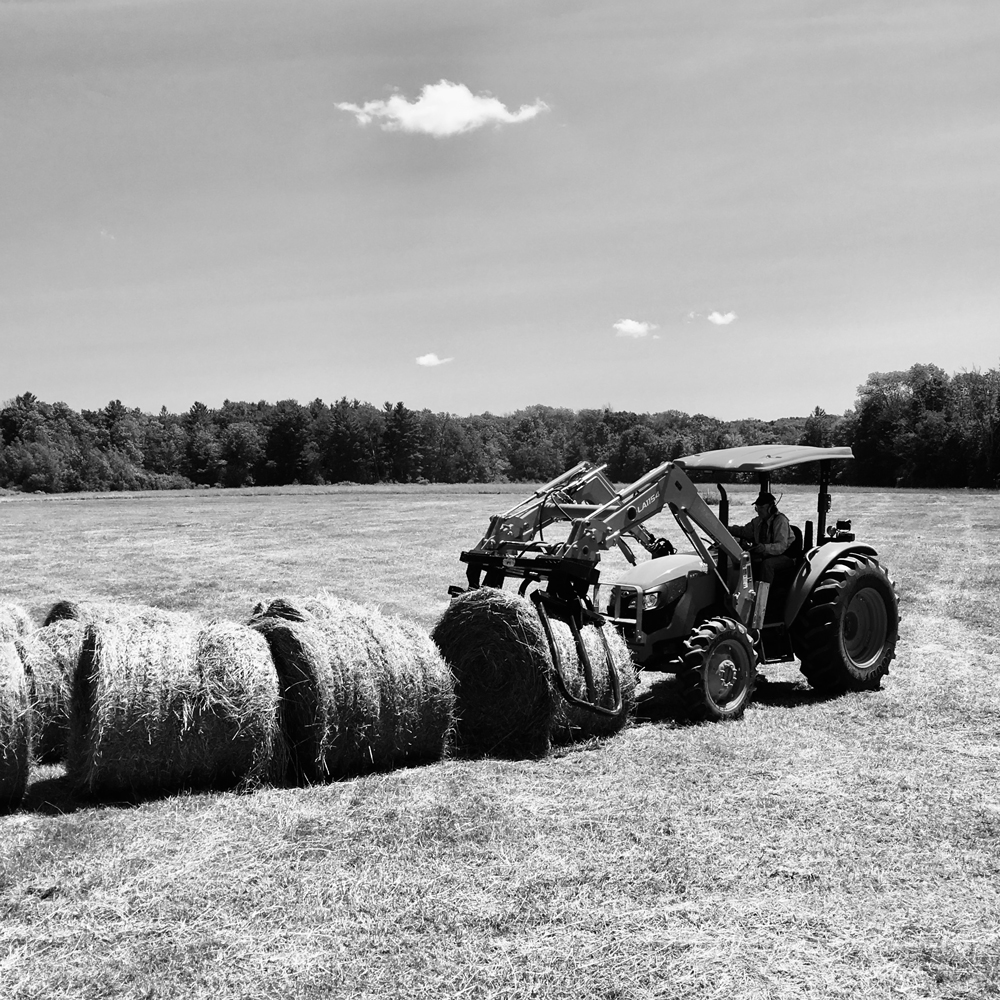
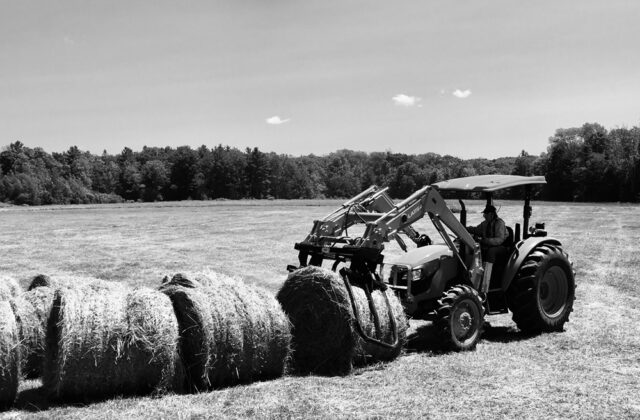
A Norfolk farmer maneuvers a round bale in a field on Spaulding Road earlier this year. Many farmers prefer the big bales because they can be fed to livestock with less feed waste and can be moved by machinery. For those counting, 15 to 20 square bales equal a single round one.
Wilber mentioned that field management is important even in a year with a bumper crop. “Last year was a great year for hay production for all the Northeast with multiple cuttings and good to great yields. If farmers didn’t fertilize after last year’s bumper crop, then this year they might have seen a lot less grass due to low fertility,” he said.
Jurgilewicz agreed that the fertility of a field is vital to a good crop under either wet or dry conditions. “When facing any adversity, healthy fields matter,” he said.
A dry season can also reduce hay yield because, in the absence of adequate rainfall, crops grow slower and remain shorter, offering less hay to harvest. Timing is everything. Producers must know when to cut so the hay keeps its nutritional value, making quality, not quantity the more realistic and valuable goal under these conditions. “I do my first cutting as soon as the hay is ready because it has the potential to dry up if left uncut, therefore having less nutritional value and making it less palatable for the animals. Leaving it to mature more for sake of higher volume results in more less desirable, junk hay,” said Wilber.
Jurgilewicz had a late start but produced more dry hay than high moisture hay this year. “The season started out wet, so I had a late start because of wet fields. In wet conditions, we are more concerned with not rutting the fields up. In dryer conditions we are more focused on the maturity of the grass and the overall quality of the crop,” he said.
Cutting hay demands both caution and creativity when extreme weather realities are involved and traditional practices must be adjusted. This is called smart farming, something both Wilber and Jurgilewicz follow. With almost 30 years’ experience making hay, Wilber has seen it all. “I try to keep everything in perspective. Over the course of a given 10-year period we’ve had a couple wet summers, some dry summers, a couple perfect summers and some where it’s a mixed bag,” said Wilber. Also in the farming profession for many years, Jurgilewicz summed up the job this way: “Mother nature is the boss. All we can do is prepare and make the most of the opportunities when presented to us.”
