How Lilith Fair Broke Barriers, Built New Pathways for Female Artists
By Patricia Platt
For fans of vocalists like Sarah McLachlan, Sheryl Crow, Emmylou Harris, Jewel, Bonnie Raitt, Tracy Chapman, Indigo Girls and Erykah Badu, the new 2025 documentary “Lilith Fair: Building a Mystery—The Untold Story” offers a captivating account of how female artists celebrated their music with a groundbreaking festival tour in the late 1990s and proved that female-centered lineups were both commercially viable and clearly desired by audiences.
Norfolk resident Carlene Laughlin, an executive producer of the documentary, recently hosted a conversation with producer Cassidy Hartmann in which they explored the origins, production and cultural impact of the film.
In the 1990s, the music industry operated on the belief that songs by female artists couldn’t be played back-to-back on the radio, that a concert could only support one female headliner and that music labels should sign only one female vocalist at a time. This marginalization forced women to compete for scarce opportunities. In 1997, McLachlan, the Grammy Award-winning Canadian singer-songwriter, and her co-founders said “Let’s prove them wrong,” and launched a series of all-women artist concerts they called Lilith Fair.
Lilith Fair quickly exceeded their expectations and expanded into a large-scale festival that toured in 1997, 1998 and 1999. It made more than 130 tour stops, featured some 300 female artists, played to over 1.5 million attendees and grossed more than $52 million—over $10 million of which was donated to women’s charities supporting survivors of domestic violence. More than anything, Lilith Fair was visionary, showing a future in which women could have equal billing.
The idea for the documentary began when Hartmann read an oral history of Lilith Fair published by Epic Magazine. She found it to be “an extraordinary underdog story of achieving this incredible success that no one thought would work. Also, everyone who was interviewed spoke about the experience in such a powerful way—it clearly really touched everyone who was involved.”
Hartmann and Nigel Sinclair, her partner in production company White Horse Pictures, met with McLachlan to see if she was interested in participating. After McLachlan approved the idea, they brought on Dan Levy as a producer. Said Hartmann, “Dan had attended Lilith Fair as a young person, and he really cared about this subject and about doing right by Sarah and all these women. His passion for the festival made him a perfect partner.” Levy suggested Ally Pankiw to direct. The producers then began securing rights to the Lilith Fair story and the extensive catalog of music they wanted to include.
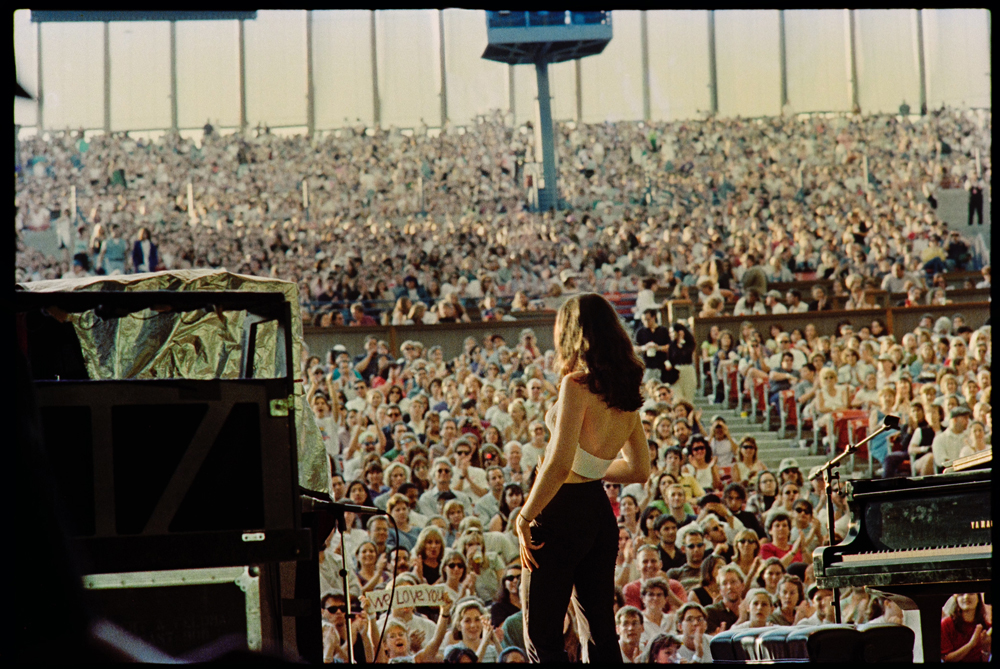
Lilith Fair. Photo by Merri Cyr
Their partnership with Epic Magazine and Elevation, a major Canadian production and distribution company, helped them access and structure Canadian financing—tax credits, grants and other incentives—and secure a licensing deal with the Canadian Broadcast Corporation, which formed a foundation for the project. Ultimately, Canadian sources covered about 40 percent of the budget, which allowed the team to finalize the remaining investment quickly and start production.
Carlene Laughlin was one of the earliest individual investors because she had a close relationship with White Horse and felt a deep connection to the story. As she explained, “When White Horse approached me about investing in a documentary about a concert called Lilith Fair, I had never heard of it, but I was a fan of Sarah McLachlan. I read the [Epic] article and understood the importance of telling this amazing story because of its relevance to how the collective power of women can change people’s perception of what women are capable of accomplishing.”
The production process took approximately two years. A creative outline was prepared, and the team began reviewing the material while conducting interviews with artists, crew and fans who had attended the festival. One of the biggest breakthroughs was the discovery of nearly 600 hours of previously unseen Lilith Fair archival footage stored in a garage in Vancouver. For any documentary team, that kind of discovery is a dream.
Asked about favorite moments, Hartmann recalled one bit of serendipity. “Isabel Merrell, co-executive producer, was scanning through the newly-digitized footage and thought she found Brandi Carlile in the audience. We were like, ‘That’s her as a teenager!’ We showed the footage to Carlile and she was delighted. Showing that she went to Lilith Fair as a young person and was obviously inspired by it made for a really fun interview.”
The documentary premiered at the 2025 Toronto International Film Festival, where the support was overwhelming. Later, ABC Studios came on board after viewing an early fine cut. The film’s release on Hulu has also been successful, receiving a perfect score on review site Rotten Tomatoes.
The messages from Lilith Fair remain relevant today. As Hartmann explained, “We’re in a moment where women are losing rights in many arenas, yet we’re also seeing a generation of women at the center of the music industry—like Olivia Rodrigo, who appears in the documentary and was an enthusiastic supporter of the project. Lilith helped pave the way for that. It proved that women artists were a commercial force and normalized the idea of multiple women sharing the stage. The film is nostalgic and it’s also hopeful. Lilith Fair didn’t start a revolution—but it did spark real change, and its ripple effects are still
visible today.”
