Mending Café: Repairing Clothes and Creating Community
By Bina Thomson
Spools of thread and jars of buttons decorated tables at the Norfolk Hub on the first Saturday of November as community members gathered for Norfolk’s first Mending Café. It wasn’t long before someone came by with a treasured vintage coat in need of repairs and the menders got to work.
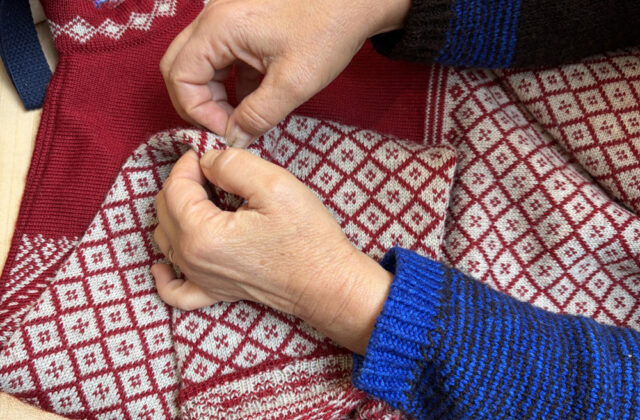
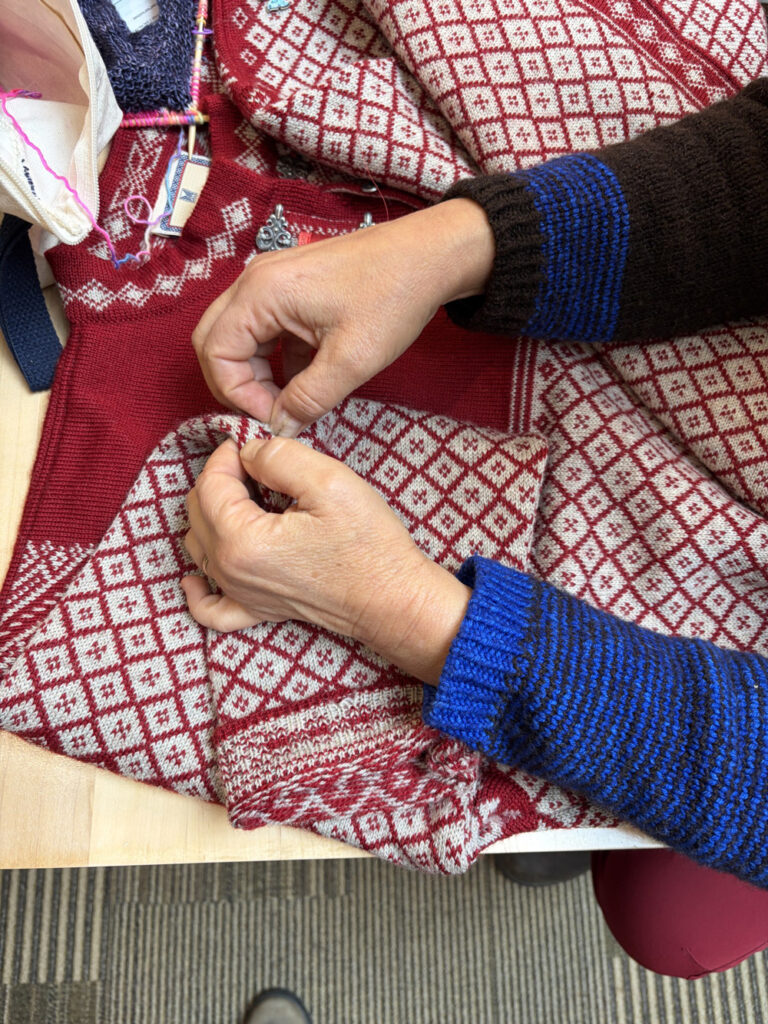
The café served 10 people that morning. Repairs included sewing buttons and stitching split seams on trousers, mending frayed edges and holes on a well-loved Dale of Norway sweater and some creative mending on a pair of shorts. The most heartwarming mend was a tail repair and new button eye on a beloved stuffed whale. The menders additionally sold several upcycled sweaters after repairing them.
The event was organized by Jen Pfaltz, who took over management of the Norfolk Clothes Closet this past spring. Pfaltz moved to Norfolk in late 2020 and quickly established herself in the community. Through her work at the Hub, she connected with Norfolk NET and the United Church of Christ Congregational (UCC). Pfaltz has worked with nonprofits for most of her career and is currently a fundraising coach for individuals seeking service dogs through the nonprofit Educated Canines Assisting with Disabilities.
The Clothes Closet is a project of UCC’s Green Team. As an advocate for sustainability, Pfaltz identified it as an interesting project, as well as a connection point for her mother, who was relocating to Norfolk. “Mom was moving here, and I knew it would be a good project for her,” said Pfaltz. “I also saw the Clothes Closet as an opportunity for community members to ‘shop’ used, rather than buy new. It doesn’t have to be all the time, but popping in and finding that item that you didn’t have to buy is great.”
Pfaltz rounded up a crew of stitchers and knitters to brainstorm ideas for improving the Clothes Closet. When a batch of moth-eaten wool sweaters were donated, Pfaltz distributed them to her group for repair and “creative mending.” Rather than precise, discrete stitches, creative mending uses sewing techniques that leave the repairs visible. According to Pfaltz, creative mending can be less intimidating than the skills needed for needlework and embroidery and allows anyone to upcycle. “I’ve always liked thrifting and upcycling and learning new things, and I love that in creative mending imperfection reigns, which is my new mantra.”
The idea for the Mending Café came from a friend who saw it in another city, and Pfaltz knew she wanted to coordinate one in Norfolk. The café encourages individuals to repair clothes, rather than donate them or just throw them away. The U.S. Environmental Protection Agency’s website lists discarded clothing as the main source of textiles in municipal solid waste and details staggering statistics on the increase in textile waste over the last 20 years.
Pfaltz was impressed with the number of repairs to items of sentimental value that attendees brought in, noting that “A lot of people are just hanging onto beloved items that they can’t wear,” but that they really wanted to keep enjoying. The stuffed whale brought in by a young girl had previously belonged to her mother, who said she couldn’t bear to part with it even after it was damaged by her childhood dog.
To Pfaltz and the other menders, the most meaningful result of the café was the sense of community. One attendee brought a bag of their own mending to repair in the company of others. Town residents stopped in to see what was happening and to simply chat with the menders. The moth-eaten sweaters repaired by the group and offered for sale were purchased by the individual who had donated them, happily closing the upcycling circle.
In addition to the proceeds from the upcycled sweaters, the café accepted donations to the Norfolk Food Pantry. Pfaltz plans for future donations to help support the UCC’s operating costs and utility bills. “If the church isn’t running, we can’t have a food pantry or a Clothes Closet,” noted Pfaltz.
When asked about future plans for the Clothes Closet, Pfaltz shared that she would love to have operating hours where an individual was on hand to provide professional clothing assistance, perhaps in conjunction with job placement training. Pfaltz shared that she is learning to make a braided rug using old comforters and sheets and hopes to offer community workshops teaching the technique. “It’s very low-skill,” she promised, noting that there are no expensive supplies to buy and uses items that can be tricky to upcycle.
The next Mending Café is scheduled for Saturday, Jan. 10, from 10 a.m. to 1 p.m, at the Hub. There will also be one on Saturday, Feb. 21, as part of Winter Weekend In Norfolk. This spring, the Clothes Closet will partner with Jackie McNamara from LIVE boutique in Winsted on a fashion show highlighting used, new and upcycled items. Noted Pfaltz, “Clothing matters to all of us—we all wear clothes! It’s reflective of who you are, and I think it’s cool for the Clothes Closet to build on that.”
Those looking to support the Clothes Closet are welcome to donate gently-used clothing or contribute to the church’s operating fund (donors are encouraged to list “Clothes Closet” on a check’s memo line for tracking purposes). For textiles beyond repair, the Norfolk Transfer Station offers textile recycling.
