The Celestial Sphere
March Skies and the Vernal Equinox
By Matthew Johnson
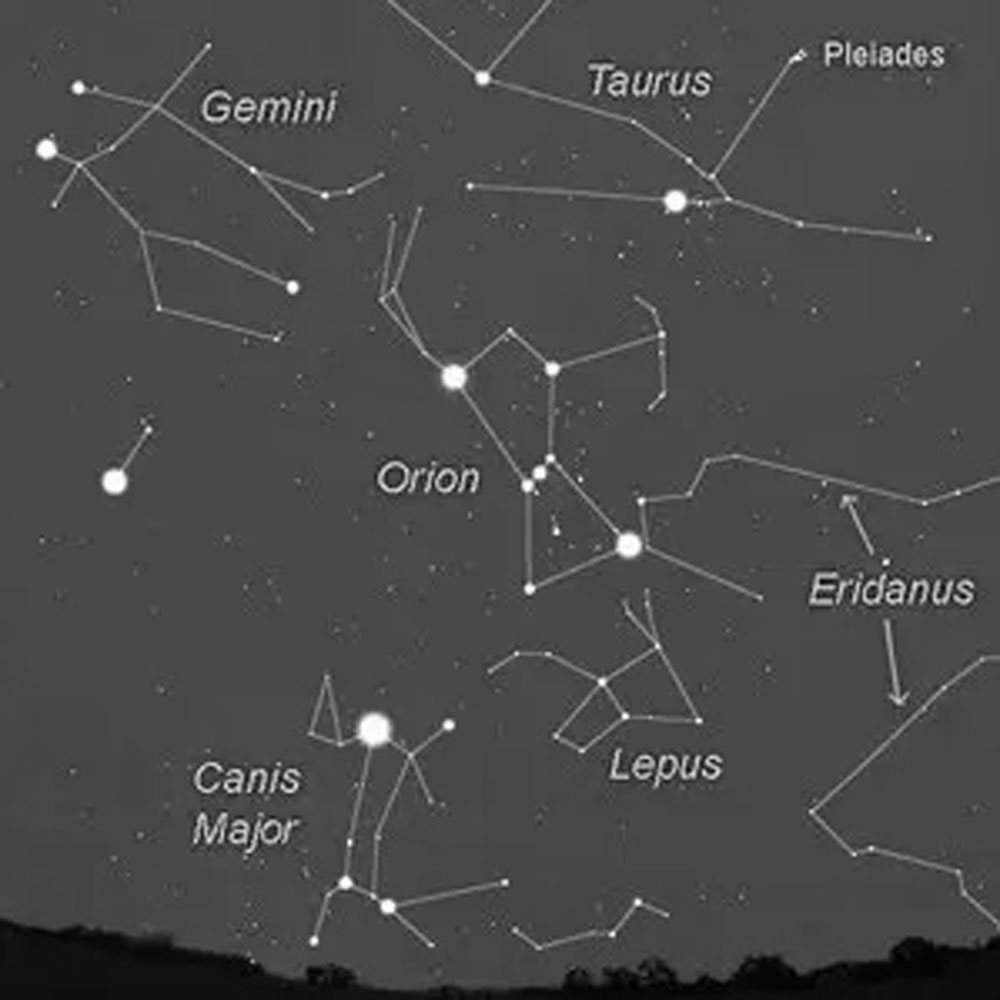
It has been an unusually cold winter, even by Norfolk standards. The constellations of Orion, and Canis Major, the great hunter and his dog, must have struggled during those frigid nights to rise in the east and traverse the southern meridian to set in the west as they found their way across the deep freeze of the celestial sphere.
At the present, the earth in its orbit around the sun is bringing us toward the vernal equinox. This occurs on March 20, heralding the first day of spring, bringing us warmer temperatures and longer days. On this day we will experience an almost equal 12 hours of day and night. Back during the December solstice, the shortest day of the year, we experienced only nine hours and 10 minutes of daylight. Since then, each day has lengthened by a few minutes so that by the end of March we will have gained more than three additional hours of daylight since December.
The Planets
On March 7 and 8 around 7:15 to 7:30 p.m., look low and to the west to find the planets Venus and Saturn. With the aid of a small scope or binoculars, Venus will appear brilliantly blue/white and Saturn will reveal its rings. However, Saturn is now turned towards the earth such that the rings will appear edgeon, which occurs only about every 12 years. Thus, the planet will look like a small yellowish circle with a line drawn across its center extending into space slightly to each side. Just past 7 p.m. on the 19th of March, Venus can be located in the lower western sky, just to the left of the crescent moon. This view changes the next night, as Venus will then be found just below the moon. On March 25 and 26, around 7:30 p.m., the moon once again can be used as a guide—this time to locate the planet Jupiter, which will be hovering next to the moon. Binoculars will reveal Jupiter’s four major moons Io, Europa, Ganymede and Callisto.
CENTER
The Moon
March 3: Full moon: entire disk illuminated. The Worm Moon, lunar eclipse.
March 11: Last quarter: right hand side illuminated.
March 18: New moon: no moon visible. March 25: First quarter: left side is illuminated.
March’s full moon is called the Worm Moon. During the month the ground starts to soften and earthworms will begin to appear, which in turn invites birds. Also known as the Sap Moon, it notes the time when sap begins to flow in our maple trees.
A lunar eclipse will be partially visible from Norfolk during the early morning hours of March 3. The eclipse begins at 4:52 a.m., reaching totality by 6:08 a.m. After totality, the rising sun blocks out the rest of the eclipse. Thus, the eclipse is only partly visible to observers on the East Coast. The complete event can only be viewed from Alaska, the West Coast of America, the Hawaiian Islands and eastern parts of Asia. During a lunar eclipse, the earth’s shadow gradually moves across the full moon. This causes the moon to slowly darken where it takes on a deep red glow. This is sometimes referred to as a Blood Moon. Unlike a total solar eclipse, where the sunlight is completely blocked creating darkness, during a lunar eclipse the moon slowly becomes less luminous, becoming a dull reddish at totality. The eclipse can be safely watched with the naked eye.
There are no major meteor showers in March.
The Sun
The sun fired off solar flares in December and January, as well as six X-class flares in the first four days of February 2026. This last burst was an event of extreme activity spanning roughly 400,000 miles of the solar disk, which is about half the diameter of the sun. This last event continued for 96 hours. X-class flares are the most formidable. This huge and powerful event raises questions about what our unstable star means for satellites, power grids and communications systems, affecting all aspects of society. These events will probably continue into March
