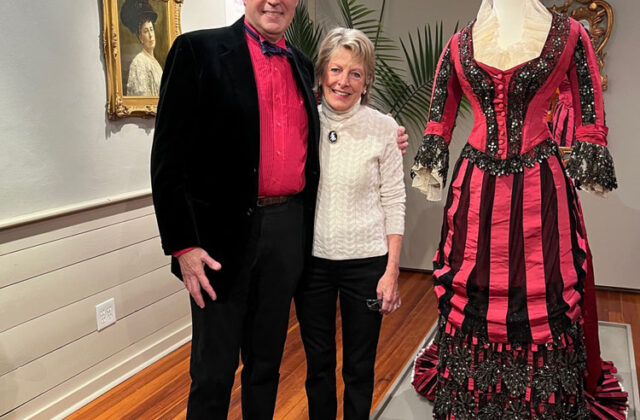
Chance Comment Yields Historic Gown
By Avice Meehan
It was a hot August day, nearly six years ago, when Barry Webber found himself inside a dumpster in Litchfield looking for something unexpected: An evening gown commissioned in the 1870s by a young Alice Eldridge from the House of Worth in Paris while she and her sister, Isabella, were on a European tour.
Webber, director of the Norfolk Historical Society, was in Litchfield to meet with Alice “Abby” Griswold Stetson, Alice’s great-granddaughter and namesake. Stetson, who now lives in Colorado, had agreed to give a dollhouse to the society that had belonged to her grandmother Isabel Bridgman. Stetson mentioned a dress, the name Worth and the rest is, well, history.
The crimson and black bustled gown—bedazzled with beads, sequins, lace and fabric rosettes—had been damaged by a burst pipe and reduced to a smelly mass of mold and mildew. But Webber thought it could be salvaged, along with a black beaded dress worn by Alice 50 years later.
The results are on display at the Norfolk Historical Society on March 15 and 16 from 1 to 4 p.m. in an exhibit that chronicles a story in textiles entitled “The Romance of Worth: The Eldridge Sisters and the Centennial.” It includes an ivory Worth gown made of silk brocade and embroidered Indian lawn worn by the petite Isabella Eldridge, founder of the Norfolk Library. The gown commissioned by the more colorful Alice, who at the age of 42 married Henry H. Bridgman, is being shown for the first time. It’s unlikely that the Eldridge sisters wore their Paris finery in Norfolk, but they could well have worn the gowns in Philadelphia in 1876 for the ball that commemorated the centennial of the nation’s founding.
“This was not a dress hung up in a garment bag,” said Webber. “It stunk and I had to drive home with the windows open.” After briefly laying the pieces on sheets in the sun—the next day, Hurricane Isias rampaged through Connecticut—Webber dried the Worth gown in an upstairs room with fans running around the clock. Webber estimates he spent hundreds of hours cleaning the gown, constructed of red silk faille and black silk netting. First, using a special textile vacuum purchased for the historical society, he removed years of dirt, mold and mildew. Then he assessed the work ahead, first removing the heavily damaged overlay on the front of the dress and separating the rotted silk netting from the intact fabric. Next, he researched sources of appropriate replacement materials from silk threads and netting, to the laces and fabric for the dust ruffle that would have kept dirt away off the gown’s sweeping train.
Webber felt confident reassembling the alternating panels of netting and silk faille for the overlay, reviving the dozens of tiny pleats on the train and recreating the dust ruffle, which took 18 yards of Leavers lace, a pleating machine and stiffened linen. Restoring the damaged sleeves, which would require removing and relining the sleeves, was another matter. Ditto finding the lace that would have framed the neckline.
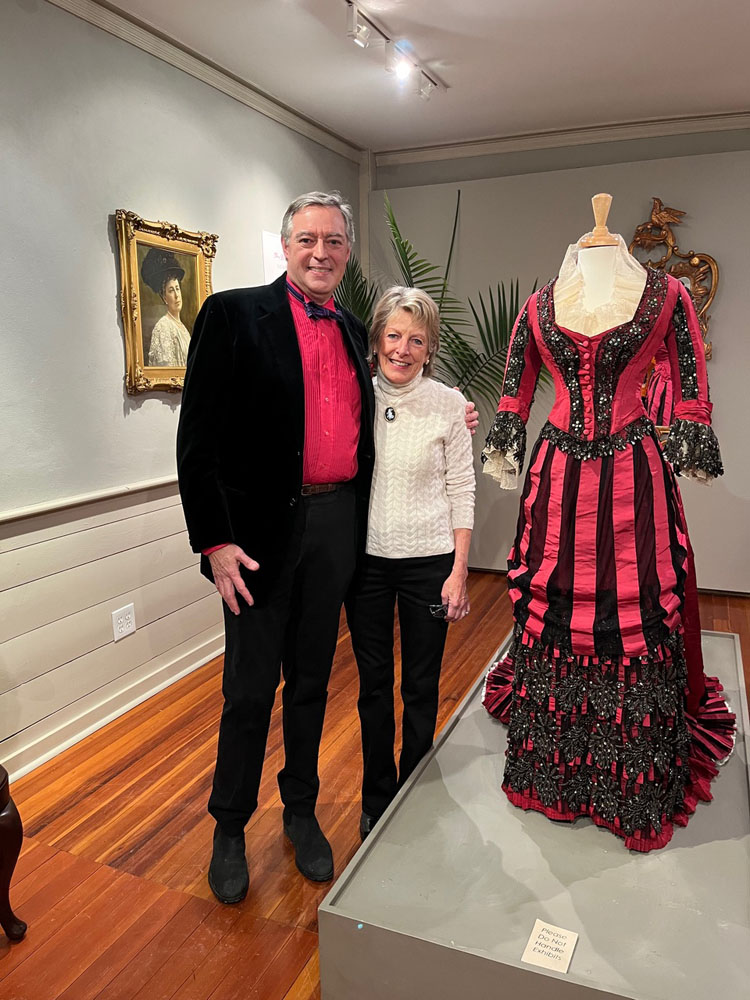
great-granddaughter of Alice Eldridge Bridgman for whom the stunning Worth gown was made.
PHOTO COURTESY OF BARRY WEBBER
But the restoration project took a small-world, only-in-Norfolk turn. Webber’s first bit of luck came through a conversation with Norfolk resident Susan Azziz, a puppet maker and costumer who also collects textiles. She saw the dress on a form and realized that she had an almost identical piece of lace in her collection.
Then, Lucy Mookerjee, the society’s curator of rare books and manuscripts, solved the challenge of restoring the sleeves and strengthening the bodice: Her niece, Flora Keene, is a master’s degree student at New York’s Fashion Institute of Technology with a burgeoning textile conservation practice. Keene took on the project and brought the bodice to her lab where the first step was to turn it inside out and assess the damage.
“The main problem area was the sleeves,” Keene said. “The heavily embroidered black net was shredded and there was lots of loss. The chiffon (lining) was totally gone and there were huge vertical tears in the sleeve.” She also disassembled the elaborate cuff with its discolored lace, beading and ribbon trim. Keene strengthened the sleeve itself with a black net support fabric—a similar support was added to the bodice—and then she drafted a new pattern piece for the silk chiffon lining, carefully putting the pieces back together by hand. She also managed to remove most of the dirt and yellowing from the lace cuffs before reassembling all the parts. And made some new buttons. “The thing about conservation,” she noted, “is that it’s invisible.”
