Sunscreen Safety for Tobey Pond
Protecting our beloved swimming area
by Linda Garrettson
All my life I’ve had a love affair with water.
It began at age four, much to the concern of my parents, as they watched me jump off a diving board into an Olympic pool. My love with water extended to less scrutinized swims at the Jersey Shore, a lake in the Poconos, and the Caribbean as I grew up. I’ve felt relief from assorted woes and ails in the Pacific, Philippine, Adriatic, Indian, and Mediterranean seas. Similarly, lakes in Colorado, New York State, and New England have added to my pleasure and well-being.
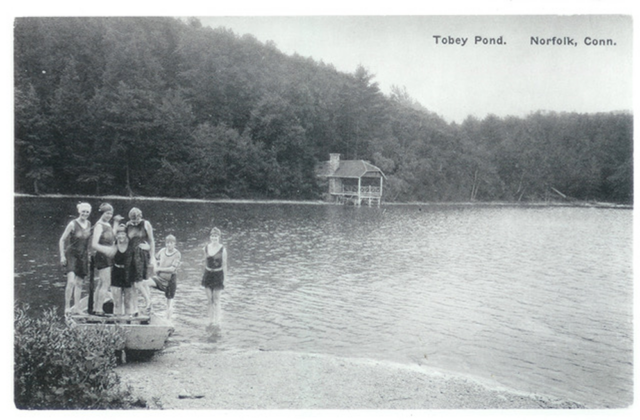
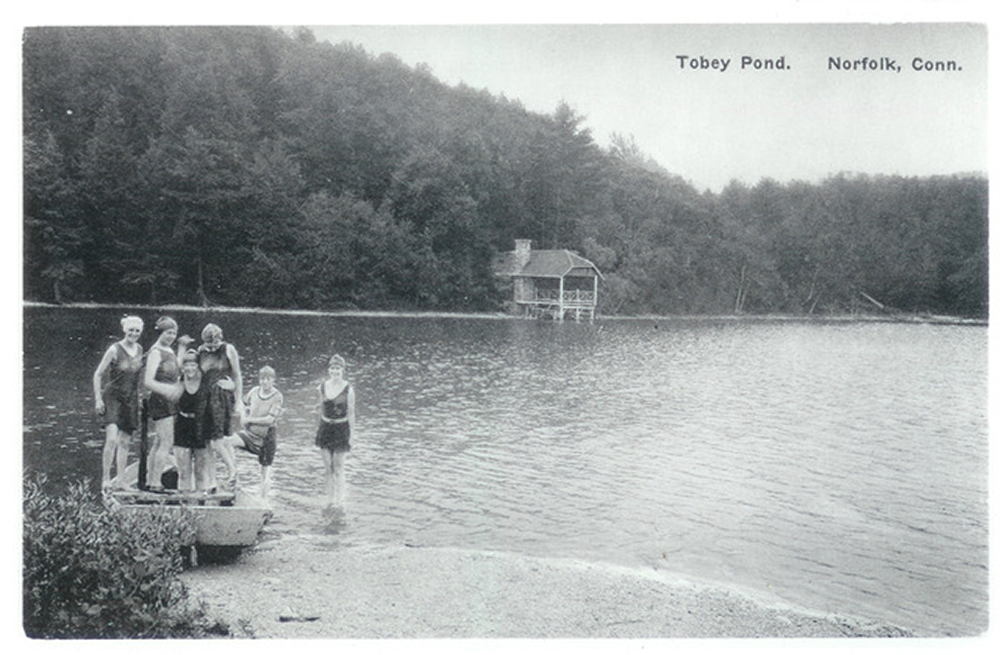
That said, of all the waters I’ve known, nothing compares to the lake we all know as Tobey Pond. The refreshing feeling of Tobey’s water is unbeatable to me. Tobey has long been part of our family history. My children learned to swim in that lake, and then my grandchildren. Longtime friends were made there, picnics were had, and even a few moonlight swims were stolen in that water. Tobey Pond beckoned my guests one New Year’s Eve to view a Blue Moon, which has little to do with blue, but rather the double appearance of a full moon in one month. I can’t remember a better New Year’s Eve.
As my appreciation for Tobey’s wonders grew, so did my curiosity about its origins. Perhaps the earliest history of Tobey Pond goes back to the last ice age 25,000 years ago, when an ice sheet, ranging in thickness from 1,000 feet to two miles, covered Connecticut. As the ice sheet melted, it moved, then stalled. Gravel and stones collected under the moving glacier, forming hills and valleys known as “kettles and bowls.” Melted glacial waters pooled and collected under the ice sheet.
Erica Hamlin eloquently describes this phenomenon in her “Bog Essays” when she says, “Moving mountains of ice seem to be the only possible explanation for these disruptions of the landscape.” We have those disruptions to thank for the hills and water features we live among today.
Looking past the ice age, we know change is inevitable. It is part of nature’s plan. The earth is warming. Warming brings a set of challenges to our planet, but so do we. Pollution to air, soil, and water, all speak to an increasing need to pay attention to our part in upsetting nature’s balance and intention. Instead of fretting over this, I started looking for ways to maintain the natural beauty of this place I call home, and a lake called Tobey Pond.
A recent certification in Sustainability exposed me to valuable information from a wealth of experts, particularly on water and the effects of chemicals, pollution, invasive species, etc. on our waterways. It occurred to me that even our beloved Tobey could be at risk. It doesn’t take a scientist to be skeptical of tropical-smelling sunscreen slicks and weed growth on and in our waters. While some changes may be beyond our grasp, some are well within our control, like the use of lake-and-human-safe sunscreens.
So what are the safest ways to protect ourselves from harmful sun exposure?
Certainly, sitting in the shade of trees that abound at Tobey cuts down exposure. Sun shirts and hats can be safe and an excellent way to protect us, especially for children who love to play on our sandy beach. Sunscreens, of course, are the go-to for humans.
As a person who has been labeled a “mayonnaise face” (this has something to do with coming from latitudes well above the equator), I am keenly aware of keeping those SPFs on my mayonnaise skin, but what is safe, and what is not? According to recent studies, avoiding UV filtered sunscreens is key to protecting our waters and humans. The following excerpt sums this up:
“It is now broadly recognized that aquatic environments—both marine and fresh water–have undergone substantial degradation over recent decades…An emerging target of possible concern has been ultraviolet (UV) filters, which notably comprise the “active” ingredients in sunscreens.” www.nationalacademies.org
The research states that mineral based, non-nano zinc oxide products are the answer. It turns out that what is good for Tobey is good for humans, too.
When Norfolk residents go to Town Hall on June 1 to purchase their Tobey (and transfer station) permits, they will receive a pamphlet on the need to use lake-safe sunscreens. The pamphlet will provide a list of recommended products, as well as where to buy them. Ryan will be carrying a supply at the Berkshire Store, so we won’t have to travel very far to get our summer sun protection. Happy summer everyone, Tobey will be open soon. Let’s keep it, and ourselves, safe
