A Centennial Celebration of Long-Term Forest Research
Aton Forest has a long history in Norfolk
By Carol Goodstein
Along with a growing population of moose, black bear and red fox, Norfolk’s roughly 1,500 residents have plenty of room to roam. Great Mountain Forest, The Norfolk Land Trust, state-owned lands and public parks welcome hikers, bikers, skiers, strollers and even, to a limited degree, hunters.
Norfolk’s Aton Forest, however, remains less accessible. As Aton Head Steward Billy Gridley explains, that’s because “since its founding in 1990 by botanist Frank Egler, Aton’s mission has been to pursue independent, long-term, low-cost, low-impact forest research. That’s what Egler did and what he firmly believed in.”
The iconoclastic Egler arrived in Northwest Connecticut in the 1920s, when his family bought a 200-acre summer retreat called Stenman Farm on Colebrook’s Pinney Street. Young Frank began his studies of the natural world at age sixteen, when he introduced pink phlox to the family property. Over the years, for both scientific and aesthetic reasons, Egler continued to introduce plantings from more than 600 taxa—or categories—and document how the forest ecosystem responded over time.
As Egler’s scientific inquiries expanded, so did his landholdings. He eventually acquired 1,500 acres while continuing to conduct research and write extensively for publications such as Journals of Forestry and Ecology and The Botanical Gazette.
Over the course of his career, Egler published nearly 400 articles on science and ecology and was a regular correspondent with pioneering ecologists, including Rachel Carson. In fact, Carson consulted Egler on the selective use of herbicides for Silent Spring, her seminal work that exposed the harmful effects of DDT and other pesticides. While her book is widely credited with launching the environmental movement, at the time of its publication, she was roundly attacked by the chemical industry. Egler was pivotal in helping her defend against the well-funded assault.
In 1962, the same year that Silent Spring hit the shelves, Egler arranged to meet Helen Binney Kitchel, a Connecticut state legislator from Old Greenwich at the Mountain View Inn in Norfolk. Egler hoped to persuade her to purchase and preserve Norfolk’s thousand-acre Spaulding Pond property. Kitchelwho was responsible for the protection of hundreds of acres in and around Colebrook, struck him as a likely candidate to help ensure that the woodlands, wetlands, meadows, and hayfields of what is now the Spalding Pond Preserve— a vast tract of land that lies between the Housatonic and Mad River watersheds—wouldn’t fall into the hands of developers or loggers.
When Kitchel couldn’t make it to the meeting, she sent her youngest daughter Happy, an internationally renowned nature photographer, in her stead. Happy agreed to the purchase of the land, and later, Egler arranged for the Spaulding Pond Preserve to be protected in perpetuity through a conservation easement with the Connecticut River Conservancy.
Not only did Egler and Happy’s arrangement result in a fortuitous outcome for the Spaulding Pond property, but the two married six years later. Until her death in in 1978, the couple moved between the Egler Reserve in North Norfolk and Colebrook and the Spaulding Pond property, which runs from the Botelle School down to Winchester Road.
In 1990, six years before his death, Egler formally created Aton Forest Inc., a nonprofit educational and scientific organization whose mission is to ensure the perpetuation of his lands and scientific studies.
In June of this year, Aton Forest will formally assume ownership of the Spaulding Pond Preserve, making Aton, with its 2,500 acres, the second-largest private owner of conserved land in Norfolk and Colebrook. Aton will then stand second to Great Mountain Forest, which stewards more than 6,400 acres.
Although both natural areas will fall under the auspices of Aton Forest and continue to serve the organization’s mission, the properties are now and will continue to be managed differently. While Spalding Pond is “forever wild”, the Egler Preserve is not. In this case, “forever wild” specifically refers to an ecosystem where nature is free to take its course, with minimal to no human intervention.
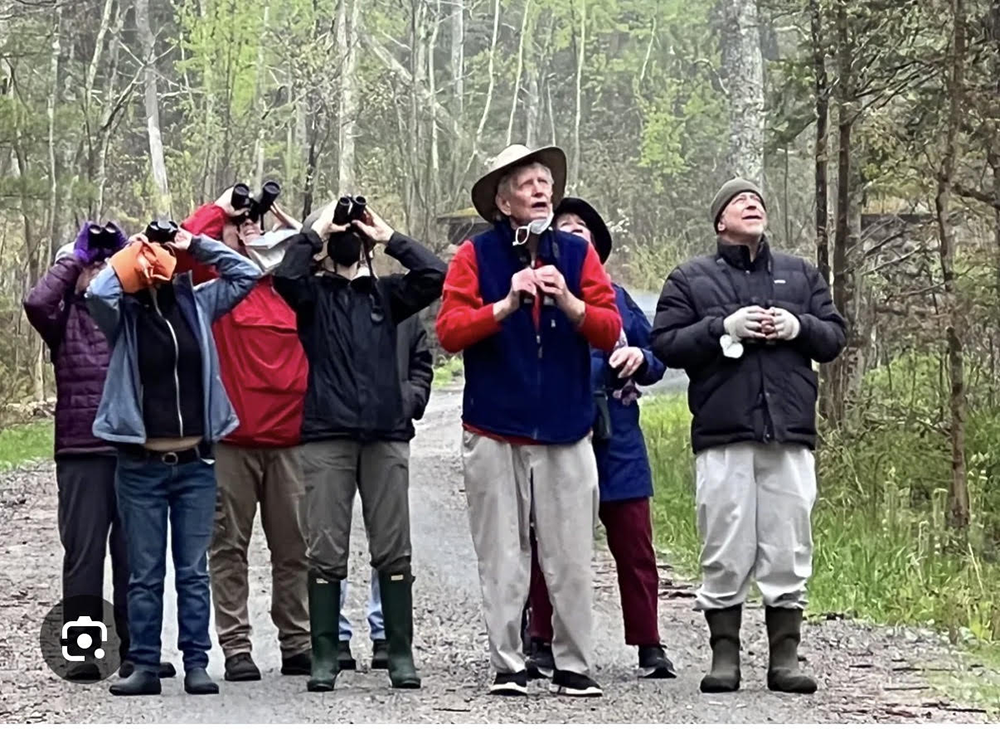
PHOTO COURTESY OF ATON FOREST
Meanwhile, the Egler Reserve continues to reflect Frank Egler’s vision, with both managed and unmanaged areas. “Egler’s interest in management was for scientific purposes as opposed to management for forestry and forest products extraction,” explains Gridley. “We will continue to honor the legacy of this great couple by studying changing forest health in both natural and experimentally created conditions.”
Additionally, Aton supports an independent Forest fellowship to advance the study of local flora, fauna, and ecological processes. The current fellow, Charley Eiseman is studying leaf-miners—the insect larvae of flies, moths and beetles that tunnel and feed inside the leaf tissue of plants. This summer, Aton Forest will celebrate its 100th anniversary with an exhibit at the Norfolk Hub during the month of July , an opening reception on July 10 at 4 p.m., and a lecture at the Norfolk Library on July 7 at 4 p.m.
