COOK FOR GOODNESS SAKE! Celebrating America’s 250th Birthday with Food
By Linda Garrettson
Meeting in Philadelphia 250 years ago, American patriots took the bold step of announcing their separation from the British Crown by signing the Declaration of Independence. Connecticut’s Roger Sherman, Samuel Huntington, William Williams and Oliver Wolcott were among those who pledged “to each other our Lives, our Fortunes and our sacred Honor” in support of the new nation’s independence.
“We hold these truths to be self-evident, that all men are created equal, that they are endowed by their Creator with certain unalienable Rights, that among these are Life, Liberty and the pursuit of Happiness,” the signers agreed. They were brilliant and daring.
While this is exciting, I wanted to know what fueled them. What did our “founding fathers” and their families eat? My research showed that they had simple palates focused on corn and apples and other foods indigenous peoples taught them to grow. Meat was likely to be rabbit, venison, quail or wild turkey. Berries were in abundance, as were wild greens, plus fish and shellfish, if one lived near the shore. Chestnuts, sunflower and pumpkin seeds, squash, pole beans, melons and stone fruits also worked their way onto the colonists’ tables. Pottage, or one pot dishes cooked over fire, were popular. So was “pease porridge,” immortalized in a nursery rhyme that ends “some like it in the pot, nine days old.”
Ice cream is an interesting culinary thread. Somehow this American staple regularly made it to the tables of refrigerator-less Revolutionary America. Thomas Jefferson, as ever, was an exception. On a trip to Monticello 60 years ago, I remember learning that Jefferson devised a refrigeration system using large slabs of ice cut from the Potomac River, perhaps also useful for preserving the paté and Camembert cheese considered staples at Monticello. “Give me liberty,” but not without the foie gras. Jefferson was highly educated and had refined tastes, as well as an enslaved chef well trained in the preparation of French cuisine.
General George Washington wore dentures, the poor soul. He survived on soft foods, likely applesauce, corn soup or corn pudding. Johnny Cakes, made with cornmeal, were his favorite breakfast. Martha Washington was famous for her 40-egg “Great Cake” or fruitcake. Hercules, the Washington’s enslaved chef, perfected souffles and chicken fricassee. Try to imagine, as I do, Abigail Adams and her four young children farming in Masschusetts while her husband, John Adams, was schmoozing in Paris to raise money for Washington’s underfed, under-clothed and under-paid startup army. Think of her arrival in Paris with the palate of a New England farmer, greeted by fine fashion and foods at the top of the culinary pyramid. She never lost her taste for apple pandowdy.
Benjamin Franklin, also in Paris with Adams, preferred Johnny or hoecakes to “Yorkshire muffins.” His tenure in France did not ruin his love of apples, cranberries and turkey. His respect for turkeys was so great that he thought our national bird ought to be the wild turkey. Let me think about that, bald eagle or turkey?
Alexander Hamilton, a delegate to the Constitutional Convention, grew up in St. Croix on a diet that included salted codfish and pork. Little is recorded about his favorite foods, but he did become an ice cream lover, thanks to George and Martha Washington. James Madison, who played a pivotal role in drafting the Constitution and later served as the nation’s fourth president, was married to the quintessential entertainer. Dolly Madison’s favorites included Hoppin’ John (black eyed peas and rice), Virginia ham, oysters and, you guessed it, ice cream. Rather than bore you with another cornbread recipe, or overwhelm you with a recipe for foie gras, I’ve revised some recipes from “Turtle Island: Foods and Traditions of the Indigenous Peoples of North America.” It’s a cookbook with recipes for today, using native ingredients. As you try them, imagine you are living 250 years ago, as a new nation is born. Perhaps you have the same dilemma as the Americans of 1776: What’s for dinner? Perhaps getting back to our roots is one answer.
SUCCOTASH WITH A TWIST
Ingredients
1 small onion, chopped finely 1/4 to 1/2 cup low sodium vegetable broth
A few pinches of sea salt
3 or 4 garlic scapes, chopped 2 ears of corn kernels
2 cups green beans, cut into 2” pieces 1 heirloom tomato, cored, seeded
and chopped Chives, chopped 1 tsp. sumac
Method
Sauté the onion and salt in vegetable broth until soft. Add the garlic scapes, continue to cook for a few minutes. Add the corn kernels, stir and contin-ue to cook for 3 to 4 minutes. Add the green beans, a few pinches of salt and stir. Continue cooking for a few min-utes until the beans are bright green and tender. Turn off the heat, add the tomato, chives and sumac. Blend gently. Serves two to three.
CORN PUDDING WITH MIXED BERRY SAUCE
Ingredients
3 ears of corn kernels
3/4 cups of seed or nut milk 1/3 cup of maple syrup
A few pinches of sea salt
2 cups of mixed berries, strawberries, raspberries or blackberries
1/3 cup maple syrup Pinch, sea salt
Method, pudding
Place the corn, milk, maple sugar and salt in a high speed blender and puree until smooth. Place in saucepan and heat to boiling, stirring constantly.
Reduce heat to medium and cook for 10 minutes, continue stirring until batter thickens. Divide among three ramekins, cool to room temperature and refrigerate overnight.
Method, berry sauce
Puree berries with maple syrup and sea salt. Refrigerate in an airtight container for several hours. Pour over the pudding and serve.
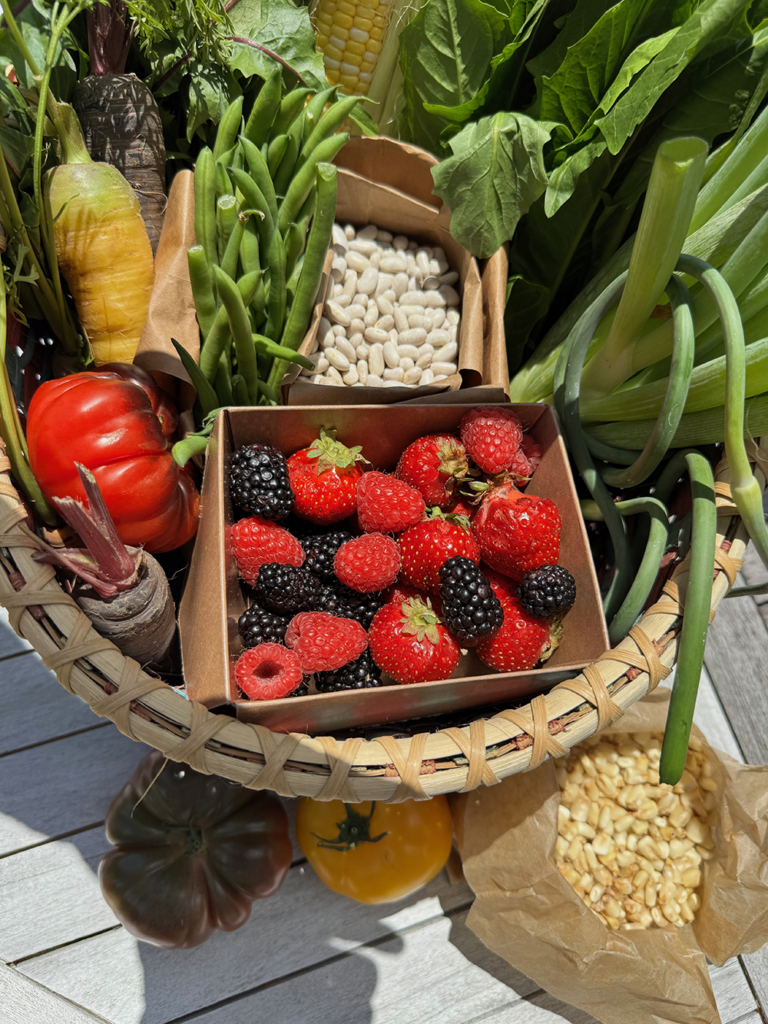
PHOTO BY LINDA GARRETTSON
