A Revolutionary Year
1776 Norfolk explored in summer exhibition
By Andra Moss
Communities across the country are looking back with wonder at 1776, the year that 13 British colonies initiated a revolution that, against astonishing odds, led to the birth of an independent republic. In Norfolk, two curators have combed the Norfolk Historical Society’s (NHS) collection for colonial-era items that could help illuminate what life was like in this small village during that tumultuous year.
Now open and running through October, the NHS exhibition, “Norfolk 1776,” presents “snippets of life in Norfolk in the years before, during and after the Revolutionary War and the impact of that war on the town’s residents,” according to Barry Webber, the society’s director.
Webber and co-curator Ann Havemeyer gathered early ideas for the exhibition from Chrissy’s “History of Norfolk,” which offered clues as to who was here in 1776, 18 years after the town’s founding. For instance, Chrissy named the 24 Norfolk men who mustered and headed toward Concord in April 1775 when the news came through that the British were attempting to seize colonial military supplies there.
There is no way of knowing if or when the Norfolk patriots made it to Boston, but their names provided a strong starting point to research colonial Norfolk. Says Webber, “We don’t have many early artifacts, but we do have houses! So, we started to tell the story of who these men were through their homes.”
One extant building from the period is the Widow Wilcox Tavern, built around 1765 by Ezekiel Wilcox on Norfolk’s Beech Flats (now Laurel Way). After Wilcox died of smallpox in 1774, his widow was given a license by the town to run a tavern from her home so that she could support her three young children. Another tavern was soon opened down the road by the Pettibones in a building that is now the Frog condominiums. By the late 18th century, there were at least three taverns in Norfolk, providing essential gathering spaces to learn news from travelers and discuss issues of the day. A Pettibone tavern table, crafted during the revolutionary period, is on view at the exhibition.
Similarly, one can find a locally built side table from the circa 1770 Amasa Cowles house, which is still aging comfortably on Colebrook Road. From the Stevens Homestead, built in 1764 on Old Colony Road, the front doors that welcomed family and guests in 1776 have also survived and are part of the exhibit, on display, providing a solid link to Norfolk’s past.
Havemeyer and Webber found that many early Norfolk settlers joined regiments in the fight for independence. Ammi Robbins, pastor of the Church of Christ in Norfolk became a chaplain in the Revolutionary Army in 1776 and kept a journal of his experiences. The journal, on display, is also the focus of a fascinating essay by Havemeyer in “The Owl,” the seasonal newsletter of the Norfolk Library. In it, Robbins noted crossing paths with other Norfolk men near Albany and Saratoga. Captain John Bradley, who lived in a house that still stands on Bruey Road, participated, along with other men from South Norfolk, in the October 1777 battle at Saratoga that changed the course of the war in the rebels’ favor. Back home, the people of Norfolk may not have received regular news of battles in distant New Jersey, Pennsylvania and New York, but they did live daily with the repercussions of the colonies’ separation from England. On Dec. 26, 1774, Norfolk voted in a town meeting to accept the Continental Congress’s Articles of Association. By doing so, residents also voiced their support for a boycott on the export and import of goods to and from Great Britain or its other colonies.
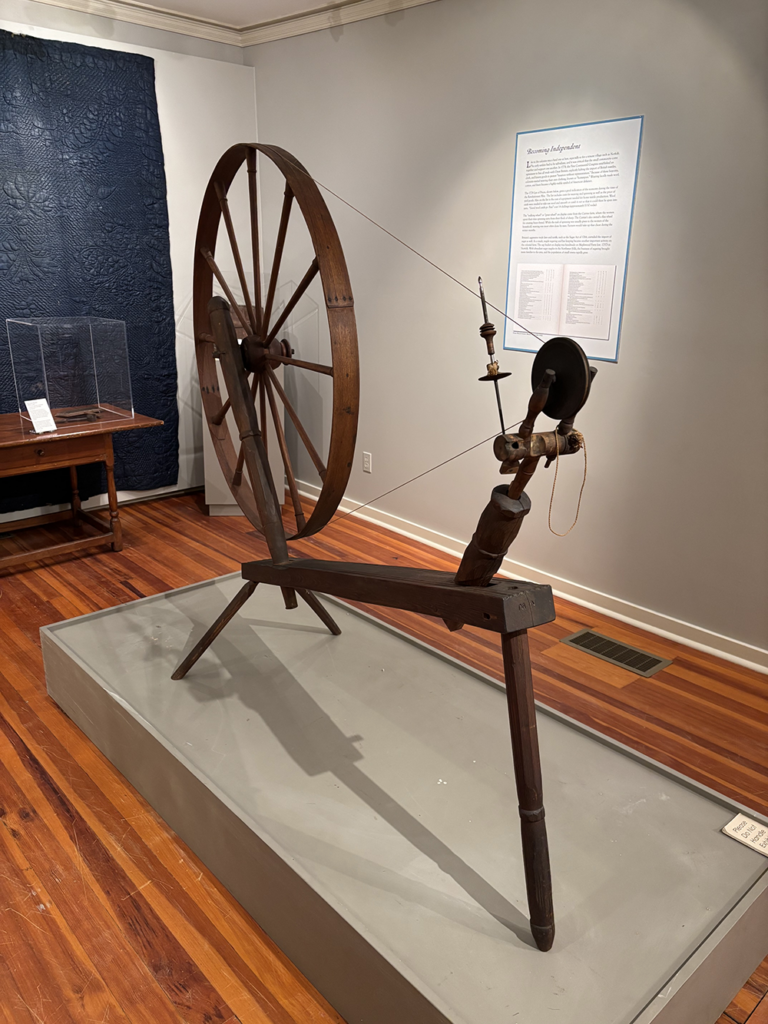
“Suddenly there were no imports of cloth,” Webber notes. “So spinning and weaving became very important. The fabric was needed for the soldiers as well as family.” Among the exhibition’s displays is a walking wheel from the Curtiss farm that self-reliant women of Norfolk would have used to spin yarn from the wool of local sheep.
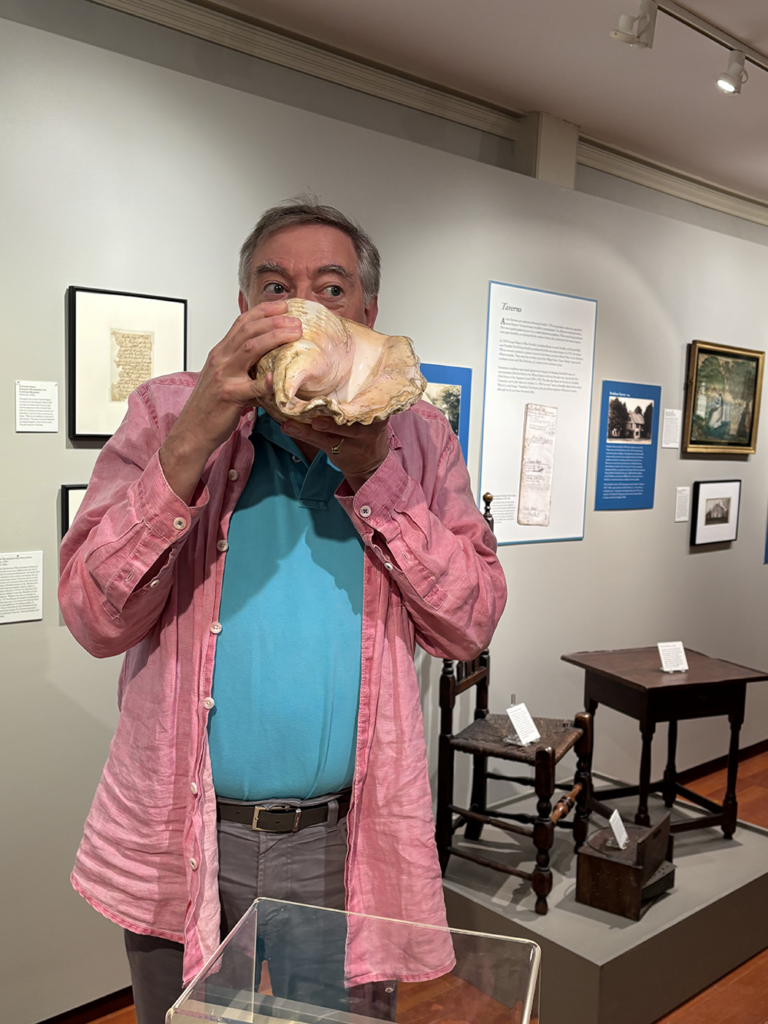
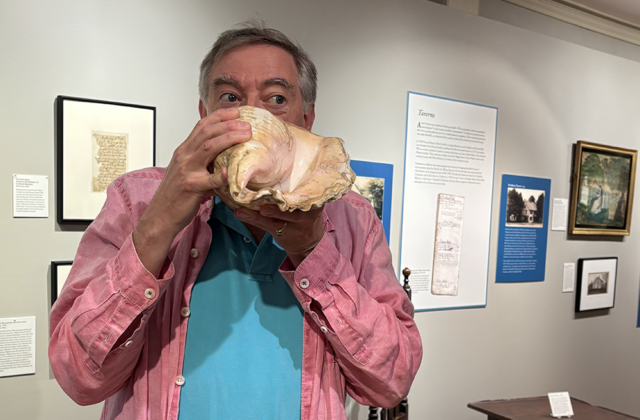
One of the more unusual items to greet visitors is a large conch shell, used by the Congregational church in its earliest days. Explains Webber, “There were no bells yet or ways to hang them. The shell was blown like a trumpet to call villagers to church.”
Another item that helps paint a picture of the town’s activities is a 1778 list of prices for everything from daily labor (higher during harvesting and mowing months) to fabric dyeing, barrel making and “womans work by the week spinning twelve run of lining.”
The exhibition is full of “artifacts that have come down the pike, so to speak,” says Webber. These objects, many of which have sur-vived for 250 years, still retain their power to communicate. “Norfolk 1776” brings to life the town, its people and the circumstances that shaped both it and the vital new nation it would soon become part of. Editor’s note: a history of the Wilcox Tavern, Stevens Homestead and other 18th-century Norfolk houses can be found online at nornow.org as part of the “This Old Norfolk House” series.