When Is a Check Really in the Mail?
By Joseph Kelly
The United States Postal Service (USPS), longtime target of many complaints and butt of numerous jokes, may seem an unlikely source of metaphysical speculation. But this year the USPS added a new wrinkle to an age-old question: When can it truly and truthfully be said that “a check is in the mail?” Is it when the envelope has been placed in a
USPS street box? In a slot at the post office? Turned over to a carrier or clerk? Or is it “in the mail” only when the USPS has applied a postmark?
The correct answer, as officially acknowledged by the USPS just this year, is that a postmark has to be applied. Just handing over your mail, even directly to a clerk, all by itself doesn’t cut it.
One can be excused for not being aware of this. Or perhaps being confused as to why this is even an issue. After all, hasn’t it always been the case that depositing mail at the local post office and getting it postmarked went hand-in-hand? Well, not anymore. Now any mail dropped off in local post offices like Norfolk’s gets sorted and then trucked to a much larger distribution center—in Norfolk’s case in Hartford. That’s where mail now gets processed and postmarked. Consolidating its operations in this way helps the USPS keep costs down. But relying on these regional centers means that the time mail gets placed in the possession of the USPS and the time when it is post-marked are no longer the same. They can be separated by hours or even days.
Last December, in an update to its authoritative Domestic Mail Manual, appropriately entitled “Postmarks and Postal Possession,” the USPS officially owned up to this change in its operations. While the Domestic Mail Manual is filled with mind-numbing operational language, its message is quite clear: This is how postmarking now works, so get used to it. Plan when you mail things accordingly. If not, you may end up paying a costly penalty, as Norfolk resident Larry Hannafin recently learned the hard way.
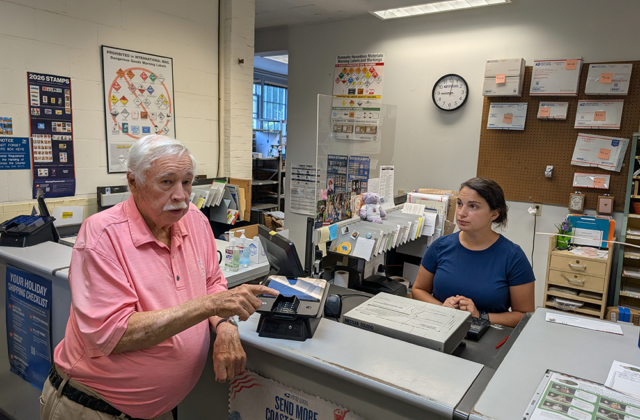
For his 2026-27 tax and sewer payments — both due on Saturday, Aug. 1— Hannafin went to the post office around 9:30 a.m. the day before and placed the stamped envelopes containing his payments in the outgoing mail slot. In so doing, Hannafin expected that they would get postmarked here in Norfolk on that date and therefore be deemed on time. The following week, however, Hannafin noticed the checks had not been cashed. He made inquiries and was told the payments had been received but were postmarked Aug. 5 at 7 a.m.— nearly four full days after being deposited. Hannafin, who has lived his entire life in Norfolk and in his younger years actually served as the town’s postmaster, was baffled and not happy to be told he was facing 18 percent late charges amounting to over $200, all because his payment was seen as late. “Why were they not date-stamped on July 31?” asks Hannafin.
To understand Hannafin’s dilemma, it’s helpful to keep in mind the dilemma facing today’s USPS. Thanks to our many digital conveniences such as email, texting and online bill paying, the USPS now handles far less mail than ever before but is still legally required to provide delivery service to every home and business in the country. This is a recipe for losing money, which the USPS has been doing for years. In a desperate effort to stem the losses, it’s been regionalizing and consolidating its operations, including closing small rural post offices (a perennial fear here in Norfolk), or dramatically cutting back on their operations.
This year, the USPS took these cost-cutting efforts to a new level by making changes to its transportation operations by consolidating the truck runs from local post offices to the regional processing centers. The truck that transports Norfolk’s mail to Hartford now comes at 4 p.m., an hour earlier than in the past. This latest change is what prompted the USPS to add the new section on possession and postmarking to its Domestic Mail Manual. Despite the existence of numerous processes that rely on the postmark—taxes, mortgage payments, mail-in election ballots—the postal service appears mildly defensive and even (arguably) a bit tone deaf about this whole question of what determines when something is “in the mail.” In FAQs on its website, the USPS insists that it is a “myth” that it ever offered the postmark as a way of proving when mail was sent.
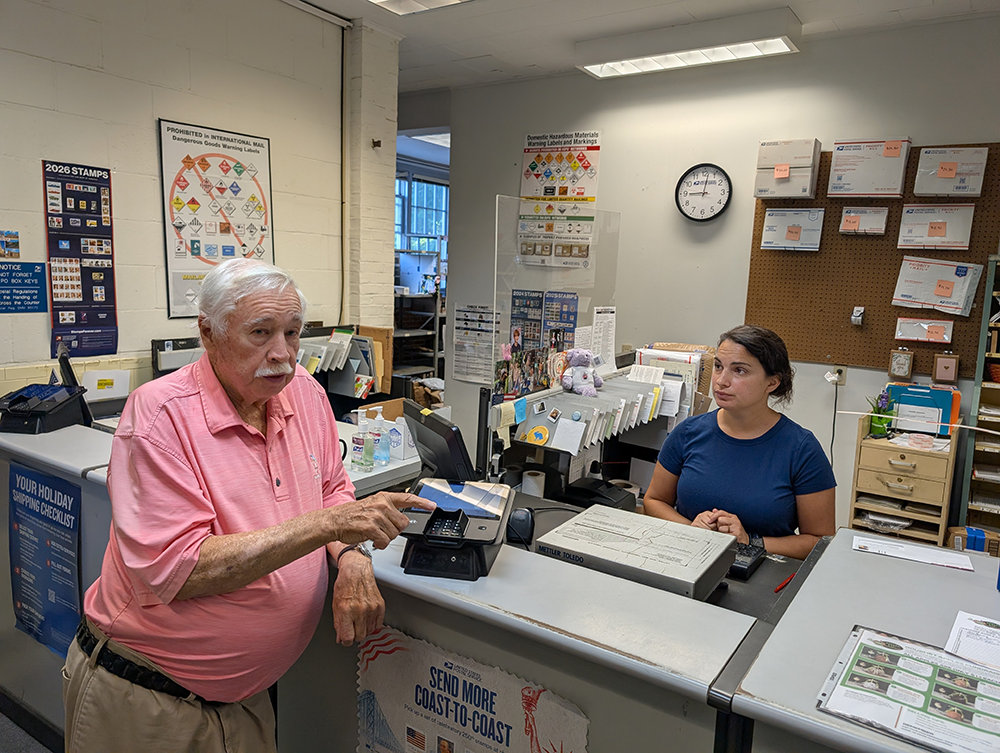
changes in how mail gets processed. A late postmark cost Hannafin over $200. PHOTO BY JOSEPH KELLY
Is there a way to avoid what happened to Hannafin and make absolutely sure that what gets mailed in Norfolk gets postmarked in Norfolk? Yes, there is, but it requires some extra effort. Go to the counter and request that the item be hand stamped. The postmark will be applied on the spot, free of charge—no questions asked—but you have to ask for this to be done. For a fee, the USPS also offers additional services that guarantee legal proof of a mailing date, such as Certified Mail, Registered Mail, or a Certificate of Mailing. Keep in mind that these services do not speed the mail on its journey, but they do provide proof of when it was dropped off.
Hannafin’s question about his tax payments— “Why were they not date-stamped on July 31?”—has been partially answered, but not completely. Even given the consolidation and restructuring of USPS operations, it remains unexplained why it took nearly four days for the envelopes containing his payments to get postmarked. Mail gets trucked from Norfolk to Hartford every afternoon except Sunday. The distance is less than 45 miles. Since mail gets delivered six days a week, processing facilities like the one in Hartford run almost continuously, with most of the machines running overnight. Yet Hannafin’s envelopes were not postmarked for nearly 96 hours. The question is—what gives?
