Norfolk Garden Gets National Attention
Smithsonian recognizes Roger Mitchell’s restoration of a Marian Coffin garden
By Joseph Kelly
A Norfolk garden designed by a leading 20th century landscape architect that was left to languish in disrepair for decades before being resurrected by its current owner, Roger Mitchell, is now receiving national attention through its inclusion in the Smithsonian Archives of American Gardens.
Located at Fernwood, a 1908 Arts and Crafts cottage on Litchfield Road (Route 272 South) designed by the architect Alfredo Taylor, the garden is the work of Marian Coffin, one of the first women to receive a degree in landscape architecture from the Massachusetts Institute of Technology (MIT). When the MIT degree failed to win Coffin employment at any of the architectural firms in New York City, she opened her own shop in 1905 and went on to an illustrious career with commissions from the Fricks, Fields, Huttons, Vanderbilts and other wealthy families. Among her most prominent works are the design of Delaware College (now the University of Delaware) and the gardens at Winterthur, the duPont family estate in Delaware. The garden at Fernwood, commissioned by the owner Elizabeth Farnham, was one of Coffin’s first undertakings and led to other gardens in Norfolk for George J. Dyer and Henry Parmellee.
At Fernwood, which is tucked away on the west side of the road atop five acres of sloping terrain, Coffin used walkways, stone steps, mortared walls and clipped hedges to establish a strong underlying structure that contains the overflowing informality of flowers and shrubs while also affording vistas down long allées and to the acres of woods beyond. The result is a contained landscape that complements Taylor’s romantic cottage design, connecting the house to the land in a way that is both intimate and expansive.
One enters the garden on the south end of the house, passing through a pair of gates and descending a set of cut stone steps. A grouping of potted plants draws hummingbirds to within view of the nearby screened porch while also leading the visitor into a 30-foot square enclosure. Encased by hedges and a stone wall, this garden space consists of circular borders and interlocking paths punctuated by eight tall, columnar arborvitae. At the center is a circular flower bed with a sundial in the middle. Coffin specified a color scheme for this garden of mauve, pink and purple through the use of phlox, gladiolus, Japanese iris, snapdragons, heliotrope, verbenas, hollyhocks and asters.
One leaves this initial space through an opening that affords a clear view west to distant woods while leading down to a second garden area with an entirely different feeling. Here one is surrounded by a pair of border gardens each 110 feet long running north and south, parallel to the back of the cottage, separated by a 10-foot-wide grass path.
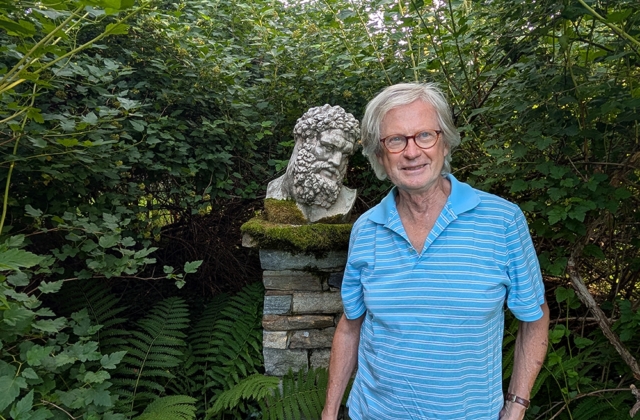
These borders are filled with groupings of flowers and shrubs delivering a succession of blooms throughout the season. Walking south along the borders ultimately brings you face to face with a bust of Hercules sitting on a cut stone pedestal surrounded by ninebark and rhododendron. Following the path in the opposite direction to its northern termination brings one to a curved, tiered planting of different shrubs.
This entire assemblage could scarcely be imagined when Mitchell and his partner Pete Peterson purchased the house in 2002. A succession of owners had abandoned any real effort at preserving the garden. Mitchell, who worked as an interior designer for years but has no professional landscape training, started his restoration by doing intense archival research. This led him to Coffin’s original drawings that provided precise measurements as well as several photographs of the gardens that accompanied a 1922 article in the magazine, Country Life in America. This research was essential, according to Mitchell, to understanding Coffin’s vision for how the enclosed garden, the borders and the house itself all worked together.
For well over a decade Mitchell worked entirely on his own—first clearing away massive amounts of bittersweet, honeysuckle and other invasives. To restore the original plant varieties, he sought out seedlings from nearby areas. Shrubs that could be preserved were shaped into form while others were eliminated. By around 2017, Mitchell felt confident enough to welcome the public. The Garden Conservancy began including Fernwood in its Open Days program and this year it was part of Weekend in Norfolk.
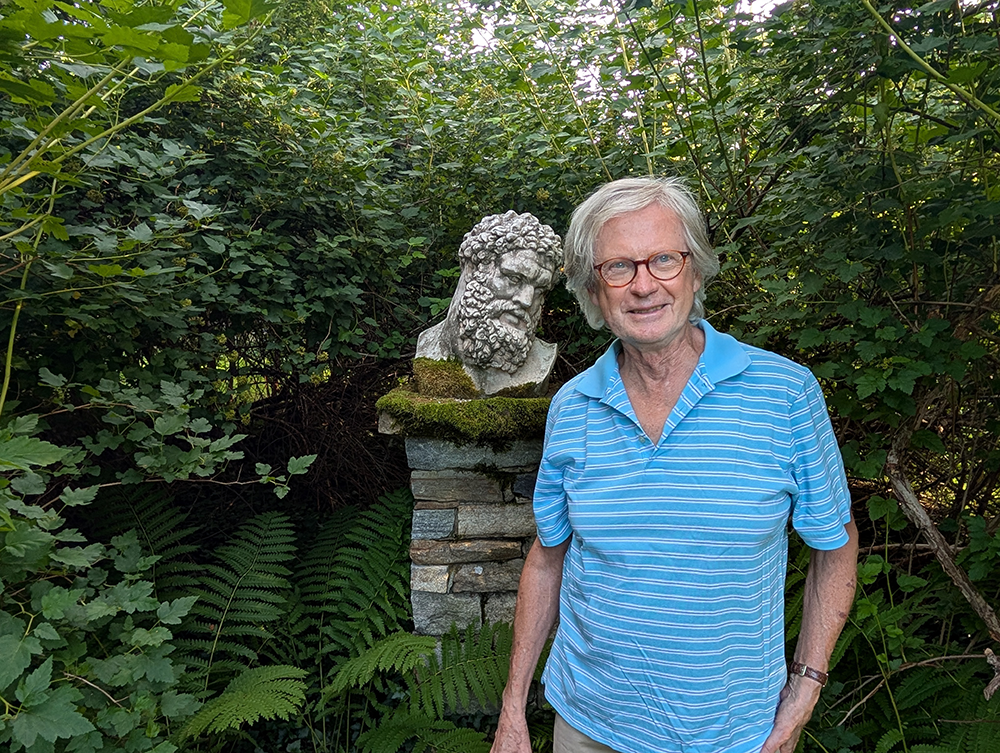
PHOTO BY JOSEPH KELLY
While Mitchell is committed to preserving the integrity of Coffin’s original design, he isn’t afraid to modify it. Where Coffin specified a 25-foot-wide grass path between the borders, Mitchell cut it down to 10 feet, creating more room for plantings. Coffin wanted one border devoted to flowers, the other to shrubs. Mitchell mixes them up.
At the same time, Mitchell seeks to restore elements that have been lost over the years. In Coffin’s original design of the enclosed garden there was a 10-foot diameter circular pool. It was eliminated at some point, allegedly because skunks kept jumping in and drowning. Mitchell is now looking to bring it back.
The Smithsonian Archives of American Gardens is a joint project of the museum and the Garden Club of America. Its goal is to preserve a visual record and narrative of gardens throughout the United States that are not documented elsewhere. The most frequently used portion of the archives is a collection of more than 3,000 hand-colored glass slides of private gardens from the early 20th century that in many cases have since disappeared, a fate that very nearly befell Coffin’s garden at Fern-wood had it not been for Mitchell’s unstinting commitment to restoring it.
To see the entire listing for Fernwood, including pictures and a short history of the garden, go to https://sova.si.edu/record/aag.gca and type Fernwood into the search bar, then click on the first listing: CT239: Norfolk – Fernwood. Entering CT 239: Norfolk-Fernwood directly into a search engine (e.g., Google) should also retrieve the listing.
