Billion Dollar Company Mines and Refines in Canaan
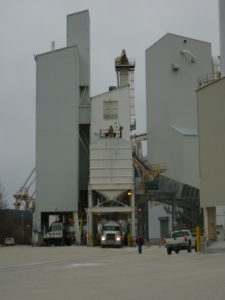
Trucks load up from the storage towers at the Minteq International facility in Canaan. Photo Credit: Bob Bumcrot
Specialty Minerals has been part of local history since 1800s
By Bob Bumcrot
Patrons of the Canaan Stop & Shop may have noticed the tall tower-like structures recently added to the large plant behind the store, and anyone who has traveled Lower Road in that town must have encountered the large trucks making endlessly-repeated short runs between the large quarry and the plant. Both the plant and the mine are now owned by Minerals Technologies, Incorporated (MTI) and operated by its divisions Specialty Minerals and Minteq International.
The Canaan facilities are part of a large complex of plants, mines, research centers and offices in North and South America, Western Europe, Turkey, South Africa Thailand, Indonesia, China, Korea, Japan and Australia. In 2006, net sales were over one billon dollars and there were 2,809 employees. The local plants and mine have over 120 workers.
The mine, which yields an excellent grade of metamorphosed limestone, has been in operation since the mid-nineteenth century. It was likely the source of limestone for the Beckley blast furnace in Canaan, now preserved as an industrial monument. At the beginning of the 20th century, several small operations were consolidated into the New England Lime Company (NELC), which employed a number of Norfolk residents, some for decades. The company was sold to Pfizer in 1960 and spun off in 1992 as Specialty Minerals and Minteq.
The open pit at the mine is presently about 1800 feet wide and 200 feet deep. There are about 200 more feet of good stone below the current floor, which steps up in a series of five “benches” along the side of Canaan Mountain. About once every other week the mine supervisor selects an area for a “shot,” in which a quantity of material is blasted from the wall of a bench. “It’s a relatively small shot,” said plant manager Mark Lambert of Barkhamsted. “We always try to do it on a calm day.” Large pieces are first broken up before being loaded into large mine trucks and transported to the on-site crushers from which the road trucks are loaded for the short journey to the plant.
The Minteq division extracts pure calcium. “This is the only facility in the world where calcium is extracted in this way,” said Mitchell. Some of the mineral is shipped to other plants that make automobile batteries and to mills where it is used as a reducing agent for rare earth metals. But much of it goes right across Daisy Hill Road to a separate, newer facility where Minteq manufactures metallurgical wire from calcium and other materials. This is used in steel and other metal mills that employ “lance technology,” in which materials are injected directly into molten metal by feeding it in 3/4-inch wire form through a specially-designed lance injector. The wire is shipped to the mills in large spools.
In the Specialty Minerals operation, the stone is further crushed into two grades. The coarser grade, like cornmeal, is shipped to manufacturers of sheet rock, floor tile and other materials. The finer grade, like face powder, is used for products such as joint compound. In response to increasing business, a new crushing machine has been installed and is scheduled to begin operation this January. “This is the largest crusher in the entire company,” said technology manager Greg Mitchell, a Norfolk resident with a degree in chemical engineering from Clarkson University. An employee of 27 years, Mitchell has also worked in Wisconsin and China.
The high quality of the raw material allows the plant to quickly supply crushed stone in a range of shades from blinding white to gray. Some material is shipped by truck and some is loaded directly into tank cars from the tall towers behind Stop & Shop. “We can do ‘just in time’ deliveries,” said human resources manager Katherine Hall, “in hours, not days.” Hall and husband Timothy, Norfolk residents, have two children in Botelle School.
During World War II NELC began extracting pure magnesium from the dolomite (limestone) rock, using the Pidgeon process (sometimes spelled pigeon), in which raw dolomite and ferrosilicon are heated in retort furnaces in sixteen-foot sealed tubes from which magnesium vapor is condensed. Although it was a carefully guarded secret at the time, this was a vital part of the Manhattan Project, for the first atomic bomb. NELC was later awarded an “E flag” pennant by the War Department for superior performance in the war effort. The four-by-eight-foot flag is still proudly displayed in the plant lounge. In the 1950s, the operation was converted to calcium production.
MTI was cited by Business Ethics Magazine in both 2003 and 2004 as one of America’s 100 most ethical companies. In the 1950s while the federal government was running part of the plant some PCB and mercury contamination was found in the vacuum system of a pump room. “The room was sealed as best as they could,” said Lambert. “No PCB was found in the ground water. It is still monitored several times a year. The employees of that time were tested, and there have been no issues.”
“It’s a good place to work,” said Ryan Fredsall,” an assistant supervisor in both divisions. “It’s a strong company with good benefits, doing an important job.” Fredsall, who grew up in Colebrook where his grandfather owned a sawmill, now lives in Norfolk.

Amazing information. Our town needs to be reminded often of the Contributions the people of Canaan and surrounding towns made to the WW2 times of ending the War. Time the workers are recognized Publicly.
No mention of Ophinhomer or even Einstein visiting the plant. Did either of both come here?
Wouldn’t it great to see a Statue of workers from the project erected on the land across from the fire department?