March, Through the Grapevine
By Leslie Watkins
Once upon a time, when jealous wives blamed the “other woman” for their husband’s infidelities instead of the husband’s lack of self-control, Zeus’s wife Hera had her hands full. During one of Zeus’s many indiscretions, this time with Semele, Hera tricked the young girl into demanding that Zeus reveal his true identity. Semele, a mortal, died as a result of seeing him. Zeus rescued his unborn child from her womb and stitched the fetus into his thigh. The infant demigod later emerged fully grown and was known as Dionysus or Bacchus, the god of wine, vegetation and ecstasy. Dionysus is the protector of those who do not conform to conventional society. He traveled the ancient world liberating people from social constraints and teaching them the cultivation of vines. We can celebrate Dionysus in our own backyards by growing and using grapes in many creative ways.
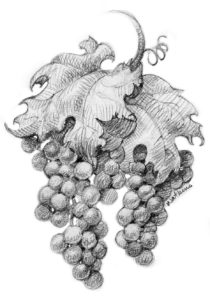
Illustration by Leslie Watkins © 2018
To be fruitful, the vines need a sturdy support that allows plenty of light and air to circulate around them. In nature, grapevines clamber over trees and fences. In vineyards, they adhere to their supports with tendrils that wrap around a trellis system usually constructed of wooden posts and wire cables. There are many ways to support grapes, depending on climate and conditions. Offering a higher support, the bilateral cordon method trains the vine into a basic T shape. Two horizontal cordons support a number of fruit-bearing canes that hang downward like a curtain. In northern vineyards vines are traditionally trained onto two or three cable supports in rows that make tending to and gathering the grapes easier.
In backyard gardens vines can be trained over a pergola to create a lovely shady retreat suitable for toasting Bacchus. Other supporting structures for grapevines might be garden fences, arbors and chicken runs.
The basics of cultivating good-quality grapes include excellent drainage, plenty of sunlight and routine pruning. Pruning is done to prevent the fruit from dangling onto the ground, to facilitate harvesting and to promote the overall health of the plant.
In 1854 Ephraim Wales Bull, from Concord, Mass., developed the Concord grape variety from wild species growing throughout New England. Mr. Bull sold cuttings from his vines worldwide for up to $1,000 each. The Concord is the grape that became a commercial success as both jelly and grape juice. Dr. Thomas Bramwell Welch and his family began making grape juice from Concord grapes growing on their home trellis in New Jersey. Using Pasteur’s method of pasteurization to stop fermentation, Dr. Welch persuaded Methodist churches to use his nonalcoholic juice during communion ceremonies. Welch’s Grapelade, a jam, was included in rations sent to soldiers in both World War I and World War II. It became popular during World War II when soldiers began to combine it with the peanut butter and presliced bread also found in their rations. It wasn’t long thereafter that PB and J sandwiches found their way into American lunch boxes.
It’s easy to grow table, juice and wine grapes for home consumption by providing ample room and a little care. Be sure to plant enough to share with the wildlife such as deer, opossums, raccoons and squirrels that will come to visit. Many birds will also be attracted, including turkeys, grosbeaks, mockingbirds, robins, bluebirds, catbirds, tanagers, waxwings, towhees and woodpeckers. The decorative vines can disguise less than beautiful structures and may be used for baskets, wreaths, garlands and ornaments.
Best Hardy Table Grapes
- Bluebell
- Brianna
- Caco
- Catawba
- Edelweiss
- Lorelei
- Ontario
- Somerset Seedless
- Swanson White
- Swanson Red
