How Times Have Changed
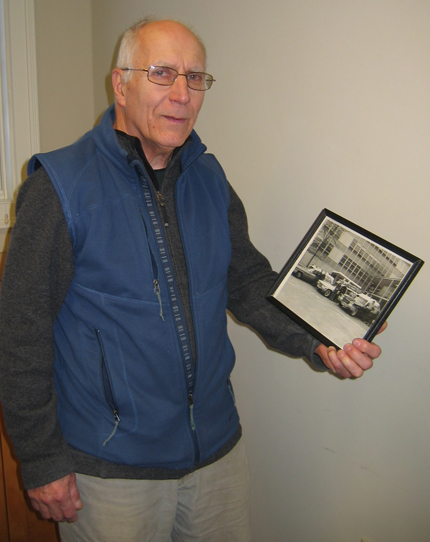
Bill Brodnitzki, a long-time volunteer with Norfolk Lion’s Club Ambulance, poses with a picture that shows him in 1972, standing withe service’s mid-1960’s Cadillac Sedan de Ville ambulance. Brodnitzki has served twice with the group for a total of 20 years. Photograph by Joel Howard
Becoming an EMT ain’t what it used to be
By Joel Howard
When Bill Brodnitzki started his first stint as an ambulance volunteer, he once answered a call when his neighbor yelled out, “Hey, Bill. You free to make a run?” Otherwise, like other volunteers, he answered his calls on a rotary dial phone. That was circa 1972, and a converted mid-60s Cadillac Sedan de Ville was the vehicle in which he rode to emergency locations.
Times have, of course, changed. The early 70s was a time when formal training didn’t exist and ambulance personnel provided what is referred to as “load and go” services. Their primary aim was to get the patient to the hospital as quickly as possible.
Fast-forward to today, when training is not only formal and vigorously enforced, but on-going as well. When Brodnitzki first volunteered, the designation Emergency Medical Technician (EMT) didn’t exist, while today there are several distinct levels of EMT, and beyond that the title of paramedic.
In 1984, citing the demands of family and career, Brodnitzki ceased his role as volunteer, albeit temporarily. He recalls that going out on so few calls left volunteers stressed with too much time to repeatedly run bloody accident scenarios through their heads. In the early 80s, he would go four or five months without going out on even one call.
Twenty years after leaving the ambulance, Brodnitzki’s wife, Gerry, heeded the call of service, earning her place as an EMT. That next year, 2006, Brodnitzki was back as an EMT as well. They are but a small part of the approximately 50 Norfolk volunteers who last year answered 265 calls for emergency assistance.
During his hiatus, protocols and expectation changed markedly. Today Brodnitzki is hard-pressed to calculate how many hours he spends on-call, responding to a call, in meetings, training and practice sessions.
And then there is documenting how all that time was spent. “Time at the computer takes roughly 20 to 40 minutes,” he says. “But chasing down the information and being sure it is absolutely correct, that can take a while.”
Years ago, ambulance personnel were required only to jot down a patient’s name and address in a ledger. That is a far cry from the information required today, which includes a patient’s past medical history, nature of illness or injury and constant monitoring of the patient en route. All of this is communicated to the destination hospital, including updates of vital signs and the patient’s overall condition.
Serving the ambulance, sponsored by the Lion’s Club, has dominated Brodnitzki’s role as a volunteer. His view of a community where neighbors help one another is cast deep into his psyche, and had inspired him in the past to serve on the Board of Education and as a trustee of the library.
In the ambulance building’s garage, he proudly shows off the new Dodge ambulance, extolling the interior layout, the power of the engine and the marvel of modern technology. He then flows easily into reminiscing warmly about his years with the group.
Slamming the rear door of the rig, Brodnitzki, 71, says with a reflective smile, “I don’t know how many more years I have left in me.” It is said with a confidence that he has more than just a few years to go.
