Library’s Annual Sale Builds a Community Around Books
By Ruth Melville
Photo by Savage Frieze
On Aug. 24 and 25, the Norfolk Library held its 43rd annual book sale. Thanks to the donation of about 13,000 books, and countless hours of labor by the Library Associates and their friends, approximately $14,000 dollars were raised to support the activities of the library. Equally important, a multitude of books were recycled and found new readers.
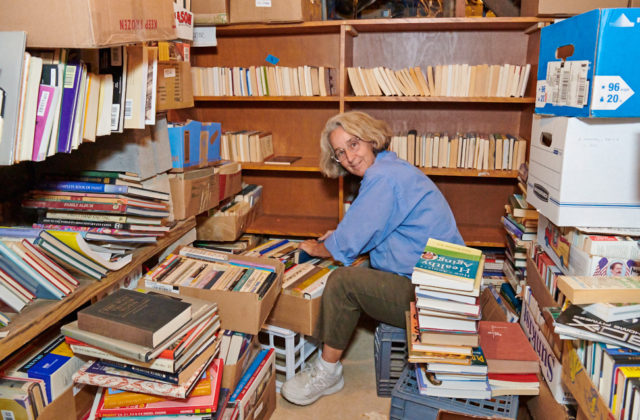
The massive job of sorting through the books every year falls to a team of volunteers, led by Bridget Taylor, who took over from her mother, Hatsy. For over 35 years, Hatsy, with only a few helpers, was the majordomo of sorting books for the sale. She was devoted and tireless, working throughout the year, but she could also be a bit temperamental and territorial. One woman remembers that being one of Hatsy’s sorters was the only job she was ever fired from. Bridget started helping her mother around 1980, and over the years she took on more and more of the heavy lifting and eventually the general organization.
Originally, donated books were collected and stored upstairs, in what is now the library boardroom. There was a chute—built by Bridget’s father, Henry—from a second-story window down to the ground, and boxes of books were launched down the chute and then loaded onto garden carts to be taken to the sale tables. Today the books are all sorted in the basement and then brought up to ground level by a long roller conveyer belt.
At the beginning of each summer, the volunteers get to work in the library basement, sorting through the piles and piles of books. Hatsy had kept a simple classificatory system in her head, but with the increasing number of books and volunteer sorters, Bridget had to draw up a written system with more refined categories.
Early on the Saturday morning of the sale, a large crew works to get the books out of the basement and onto tables under the tent. Bridget has a map of how the categories should be arranged—she “guesstimates” the amount of space they’ll need (there’s never enough)—and books come up out of the basement in sequence. “It’s a two-hour madhouse,” she says. Additional volunteers are needed throughout the two-day sale to restock the tables and serve as cashiers.
In its 43 years, the book sale has never been canceled, although Hurricane Irene in 2011 destroyed many of the books, which unfortunately had already been placed outside.
Since 2008, a special section of the sale has been set aside for the so-called books of better value (BBOV)—those books, such as first editions, signed copies or fine illustrated volumes, that might be sold for more money, often to book dealers. In 2013, Tricia Deans and Anne Frieze took over management of the BBOV and have since turned it into a major operation, doing online research to get a better idea of what to look for and what to charge.
The general sorters keep an eye out for the BBOV as they go through the stacks, and Deans says that over the years they have gotten better and better at spotting gems. They usually turn up one great book each year. Last year they had a real find: a first edition of The Great Gatsbythat sold for $1,000. Taylor estimates that the books of better value are now responsible for about half the revenue of the book sale.
About five years ago, Bridget instituted the policy of making all the books free on Sunday afternoon after 3. She had to fight for that, she says, and some people still aren’t sure it’s a great idea, but she feels strongly that although the sale is primarily about raising money for the library, it’s also about putting books in the hands of readers. And there’s undeniably something joyful about seeing people stagger out of the tent under the weight of a stack of books. Many are so grateful for their freebie finds that they choose to donate some money to the library anyway.
What about all the books that are left at the end of the sale? It can be a struggle to get rid of them. In earlier years, books were sometimes thrown away, which is difficult for a book lover to countenance. More recently, books have been collected for prisoners, under a program called Books for Bars. This year Judy Maxwell has arranged for the online used book seller Discover Books to pick up all the unsold books on Monday morning—giving them another chance to find their readers.
