New Lamps at the Norfolk Library Illuminate a Whimsical Walk Downton
Text By Michael Cummings Kelly
Photo By Doug McDevitt
To the number of reasons we already have for taking a leisurely walk through Norfolk’s anomalous, historic village can now be added the crooked pathway that courses down a gentle incline on the east side of the Norfolk Library.
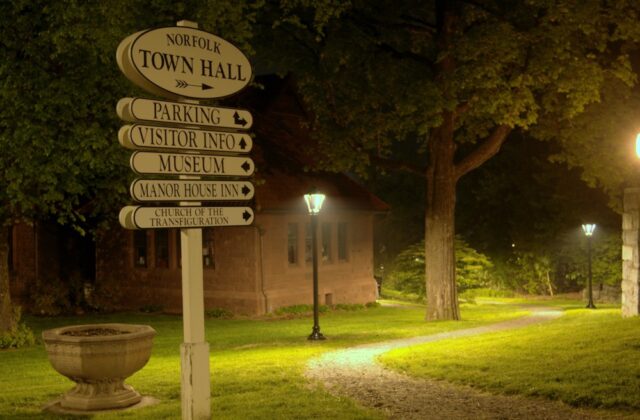
Where daily for 50 years a dozen New York-bound trains spewing plumes of smoke clamored in and out of a tunnel under Greenwoods Road, a charming path meanders connecting the village green and its historic houses (boisterous Route 44 notwithstanding) to downtown’s evolving commercial center. A pleasant walk by day, dark and forbidding after dark, this seldom-used lane has been transformed into a welcoming, felicitous promenade by new lighting from four recently installed, dignified black luminaires redolent of 19th-century Paris.
With shorter versions of the lampposts already installed in the parking lots of the library and Town Hall, the new lampposts are a culmination of the library’s master lighting plan that began with the beautifully rendered, artistic illumination of the shingle style exterior of George Keller’s storybook 1889 library. Working with Polaris Lighting Design of Delmar, N.Y., Norfolk Library Director Ann Havemeyer, together with her board of trustees, developed a comprehensive plan to decorate with light the library’s rough-hewn red freestone blocks, unique fish scale shingles, half turret and diminutive balcony.
Set strategically along the walkway on slim, graceful aluminum posts, the Lumec Metroscape LED lamps shed light downward to mitigate light pollution, suffusing pedestrians with warm lustrous light.
All truly great thoughts are conceived by walking.
—Friedrich Nietzsche
With sleepy Haystack Mountain as a backdrop, pedestrians enter the walkway near the 1895 Dr. William Wickham Welch memorial fountain, reincarnated today as a planter that brims with flowers selected every year by horticultural designer Barry Webber. To the right stands Alfredo Taylor’s 1905 artistic railing, which bestrides what once was the western end of the former railroad tunnel. Commissioned by the library’s founder, Isabella Eldridge, the decorative railing with its rough-cut granite posts and ornamental lamps was created to beautify the overpass and frame the view toward Haystack. It is a tribute to her father, the Reverend Joseph Eldridge, who, virtually alone, had the foresight and determination to stop the railroad from laying its tracks through the heart of the village green in 1871.
On the left is the Abel I. Smith children’s room, built in 1985 using matching red freestone from the original quarry in Longmeadow, Mass. Across the way, a sturdily wrought stone wall stretches. Built a few a years ago by skilled Ukrainian craftsmen, it is an elongation of the remnants of the 150-year-old stone retaining wall that once lined the town railroad tracks. Opposite the wall, a spectacular viburnum bush is saturated in early summer with brilliant white petals. It was planted by Children’s Librarian Eileen Fitzgibbons in memory of her brother Jay, who introduced her to Norfolk in 1980.
Farther along, tucked next to the library, a poignant memorial honors three longtime Norfolk residents who died tragically in 1999 when the terrorist pilot of EgyptAir Flight 990 deliberately crashed his Boeing 767 into the Atlantic Ocean near Nantucket. The words “Once upon a time” chiseled into a sculptural wing of granite points to a stone medallion encircled by cobblestones with the inscription: To Young Readers From the Friends of Gene & Barbara Billings and Robin & Henny Mead.
High above this memorial, seemingly illuminated at night by candlelight, Maitland Armstrong’s ethereal rose window beckons the eye. It is the easternmost of two identical stained glass windows that are sublime emblems of George Keller’s inspired 1911 rendering of the library’s cathedral-like Great Hall with its splendid four-story-high barrel-vaulted ceiling. A sanctuary for readers and researchers, the Great Hall is also the ideal setting for the library’s ongoing heady mix of social and cultural events.
On an embankment past the library, forsythia flaunts its yellow in early spring, marking the beginning of the Fred McGourty memorial garden, designed by his wife, Mary Ann, as an homage to the late local nurseryman, Master Gardener and author. Across the way at the foot of a hill, a recently cleaned-up overgrown tract of land awaits a pastoral reimagining with ground cover or other native plantings.
Near the end of the path is the bewitching wooden toy train, dedicated in loving memory of Blake Elin Vanderlip, which has, for so many years, enthralled and brought joy to multitudes of Norfolk children.
In only 130 steps the pedestrian has traversed decades of history and remembrance and has now arrived at the once bustling 1898 stone-clad train station that still anchors Norfolk’s pocket downtown—just across from the exciting new observation decks under construction overlooking City Meadow.
