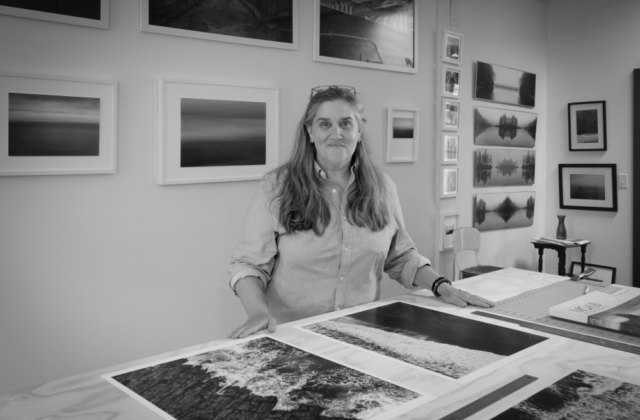
Babs Perkins Uses Intentional Movement to Produce Ethereal Photograpys
Text by Jude Mead
Photo Courtesy of Babs Perkins
Photography has the power to inspire and the ability to invoke an emotional response in people. It is a visual tool that allows photographers to show how they see the world. For professional photographer and writer Barbara “Babs” Perkins, photography is a passion. She uses it to express herself through images and to compliment her writing.
According to Perkins, each image in her recent photography exhibit at the Norfolk Library is a “study or a meditation on a particular location, but the location is not the focus. Rather it is the colors, tones, hues and depths of each image, and whatever thoughts or memories the image elicits that holds the viewer.”
In the library exhibit, Perkins showed recent work stemming from her travels to Iceland, Ireland, Croatia, and Italy, though it is not the location the viewer sees but rather a unique, dreamlike effect where the photograph becomes the entirety of the display. “All of my work, whether it is the documentary work or the fine art is all predicated on these ideas of context and memory. I started actively working with this technique about four years ago when I visited Ireland. Everything was so rainy and saturated that I couldn’t do my standard landscape photography. I had to find a way to capture what I was seeing so I used intentional camera movement to recreate that effect. These are single frame exposures made in camera without manipulation. I’ll remove dust spots and adjust the saturation or contrast but only to balance the image with the scene,” says Perkins.
By using light and intentional camera movement, her images look more like paintings than photographs. She also credits the capability of the digital camera that allows for immediate feedback when taking these pictures. “I can see the result of the attempt in almost real time. If it is overexposed or under exposed or too much movement or not enough movement I can try again.” she says.
When looking at a photograph, the viewer is transported to wherever the image takes them. “These are photographs of place, but the technique I use eliminates the distraction of recognition and the inclination to say “Oh, I know where that is,” but focuses instead on the feeling, the mood, and the atmosphere.”
She first showed this work at the Norfolk Artist’s and Friends Show in 2019 at the Art Barn at the Battell Stoeckel estate in a standard gallery presentation, but felt they lacked the textural quality she wanted. She started playing with ways to make her photographs unique. “I do all my printing in my studio. I have a direct relationship with what I see on my screen and what then prints. I don’t have to send out, wait a week and then resend if it is not what I want. This work is individually printed and hand cut to whatever felt right at the time when the print came out. The photograph is then permanently affixed to a foam core, so it sits off the watercolor paper from where it is mounted. It is then displayed in a shadowbox,” says Perkins.
The titles for this series were taken from author Carol Anne Connolly’s book, An Sanasan Uisce/ The Water Glossary. According to Perkins, the one thing that ties all the images together is water. “Connolly’s book is a small paperback printed as an art project. I had been searching for a copy for several years and then came upon it quite by chance on a trip to Ireland. I was staying at a B&B in Galway and while I was waiting in the common room to be checked in, there it was on the table. I’m lousy at titling works but decided with this series to further decontextualize the locations by giving them Gaelic titles.” For example, Ta blath ban ar gharrai an iascaire means choppy white waves on the sea but literally translates as white flowers on the garden of the fisherman.”
Once a photographic work is completed, Perkins detaches herself from it to look at it more objectively. “By detaching and discussing my work I get a different perspective on it. Once I have created it, I have done what I needed to do and said what I needed to say in the work itself.”
