A Bounty of Cultivated and Wild Mushrooms Can Be Found at Husky Meadows Farm
Mushrooms on the Menu
By David Beers
The old Curtiss dairy farm was quiet for many years. Then in 2015 an organic vegetable farm took root, called Husky Meadows Farm. Over the past seven years, the farm has diversified more each year. It is remarkable to see all that is going on. The farm now has two acres of vegetables, an orchard, an apiary, poultry, a commercial kitchen, accommodation for 10 overnight guests, culinary farm stays, a cooking school, a CSA, Friday night takeout dinners, prepared foods (soups and baked goods), a farm stand, a regular booth at the farmers market—and mushrooms.
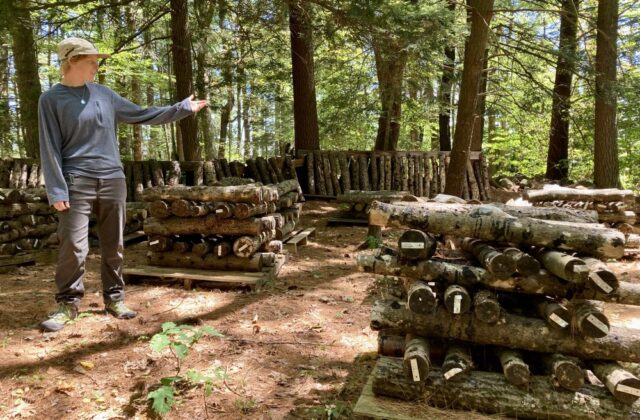
Both cultivated and wild foraged mushrooms are rising stars at Husky Meadows. In 2020, the farm began growing shiitake mushrooms in the dark pine woods across the road. The process of mushroom cultivation begins in the winter in the broad-leaved forest just to the east of the farm. Pole-sized trees are cut down and cut into four-foot lengths. The logs are kept under a foot in diameter so as to be light enough to carry by hand. Species include maple, birch and oak. Ash, cherry and conifers are not used because they do not grow these mushrooms.
In the early spring, the logs are inoculated with mail-order mushroom spore. (Yes, mail-order mushroom spore is a thing.) Two-inch-deep holes are drilled about four inches apart. These holes are filled with spore and sealed with food-grade wax. The logs are then stacked in a shady part of the forest in crisscross piles called ricks, with each log given some air space around it for proper ventilation and humidity. Newly inoculated logs need a year of fungal mycelial growth to spread throughout the log before the log can produce any mushrooms.
Once the weather is warm enough in May, logs that are at least two years old are soaked overnight in 100-gallon stock tanks to simulate the Japanese monsoon rains that causes fruiting in their homeland. The soaked logs are then leaned on sawhorses during the two-week fruiting phase. This is when the magic happens, and mushrooms begin to grow out of the mycelium-marinated wood and cover the logs. After the mushrooms are harvested, the logs rest in the ricks for at least eight weeks until they can be soaked again. Ricks are cycled through soakings to provide a consistent supply of mushrooms for almost half of the year, with many logs producing for over three consecutive years.
The farm plans to ramp up to at least 1,000 logs. This will allow them to produce an abundant crop of shiitake mushrooms every week from May to October. This summer they dipped their toes into adding log-grown lion’s mane mushrooms on beech logs and oyster mushrooms on aspen logs.
In addition to this fungiculture, the farm has a mushroom forager roaming around the woods and gardens. Rana Justice has the enviable ability to search out and identify most of our native edible forest mushrooms. At the farm, she is a gardener, trail maintainer, fungiculturist, forest forager and forest gnome. She has found maitake, turkey tail, black trumpet, helvella, chicken of the woods, chaga, reishi, russula, puff ball, bicolar bolete and golden chanterelle on the 300-acre property.
Justice and the Husky Meadows farm manager, Adam Buggy, have begun offering mushroom-centered events, starting last spring with log inoculation workshops for guests and for staff from the Greenagers program. Justice also began offering mushroom foraging walks last year. An hour-and-a-half foraging walk is $25, and a three-hour walk and taste is $45. The foraging walk is followed by a kitchen demonstration on how to properly prepare and cook wild mushrooms. For these events, only mushrooms that have no look-alike are foraged, such as maitake, chicken of the woods, chanterelle, puff ball and black trumpet. Future Seed and Spoon events will be listed on the website, seedandspoon.com.
Justice sums up her fungal passion when she says, “I admire the structure that is mycelium . . . the ability to grow, adapt, share, connect, transform, evolve. Maybe I want to be just like fungi. I am forever fascinated. So, if you ever want to talk about this community powerhouse known as mycelium, I am all ears.”
