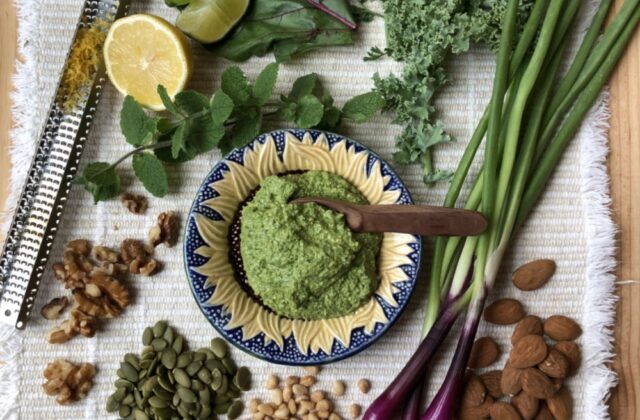
Presto Pesto Magic
Cook! For Goodness’ Sake
By Linda Garretson
It’s September and harvest season. In full force are the cucumbers, beets, squashes, tomatoes, greens and herbs. Like almost everything in the vegetable garden, it all comes at once. Then the question becomes, what to do with it?
That’s why I like pesto. Who doesn’t love the intoxicating aroma of basil and toasted pine nuts? It’s a great way to use the overabundance of greens, and it’s a great way to jazz up an otherwise ho-hum meal. It can be frozen, or refrigerated for a week or more. I use pesto as a garnish in soups and stews, stir it into tofu for a “scramble,” and use it as a sauce for vegetables and whole grains, or a dressing for salads. Let’s not forget its origins—on pasta.
Pesto dates back to the 16th century in northern Italy. The word means “pounded or crushed,” like with a mortar and pestle. Feel free to be a purist, but there’s no shame in using 21st-century devices for finely chopping your modern pesto.
Pesto is delicious, nutritious and a time-saver that makes a hero out of you when your refrigerator is reminiscent of Siberia in the winter. Exact quantities do not matter in Presto Pesto. It’s an opportunity to express your inner pesto self if you don’t happen to have pine nuts on hand, or your greens suddenly turn brown in the refrigerator.
Pesto typically suggests basil, garlic, olive oil, parmesan cheese and pine nuts, but in the my world, pesto can also be carrot tops, arugula, spinach, chard, any kale, cilantro, parsley, beet greens, turnip greens, mint, scallions, dandelions, watercress and more.
Nuts to only pine nuts, as good as they are. Almonds, walnuts, cashews, pumpkin seeds and sunflower seeds are all good options.
Pucker up for citrus. Lemons, oranges, limes, clementines or tangerines, including their zest, in lieu of extra virgin olive oil make a delightful switch to standard pesto. Why? Well, for taste of course, but also citrus zest has some anticancer properties.
And from the allium family there are chives, scallions, garlic and ramps. Ramps, yum.
So there you go—only three or four ingredients, plus your trusty food processor or blender. Anyone patient enough can use a mortar and pestle.
Presto Pesto Basic Recipe
Ingredients:
2 lemons, juice and zest
4-6 cups of greens, washed and drained,
arugula is my favorite
1 cup of toasted pine nuts
A pinch of sea salt
Makes 1½ cups
Method:
• Preheat the oven to 250 degrees and toast the pine nuts for 10 minutes until lightly browned and fragrant. Set aside to cool.
• Place the arugula in a food processor and process to a coarse chop.
• Add the pine nuts and continue to process a fine chop.
• Add the lemon juice and zest, and a pinch of sea salt. Continue processing. The pesto should have some texture. Add a little water, or more lemon juice if the pesto seems too dry.
• Refrigerate in glass jars with tight-fitting lids for a week or more, or freeze.
Note: Covering the pesto with parchment or wax paper prevents browning.
Don’t be afraid to experiment. Here are a few possibilities to get you started:
Parsley, pumpkins seeds and scallions
Carrot tops, walnuts, lemon juice and zest
Mint, scallions, almonds, lime juice and zest
Bitter greens, pine nuts, lemon juice and zest
Presto suggests “something that has been done so easily that it seems to be magic.”
Enjoy the magic.
