Norfolk’s Trash Dilemma
Sate decision leaves towns scrambling for options
By Joe Kelly
Norfolk prides itself on being pristine—“unspoiled” is the descriptor used on the town’s website. But that doesn’t stop the town from producing plenty of trash.
Residents deposit 750 to 800 tons of household waste at the transfer station on Route 44 every year—more than 900 pounds per person—in addition to 180 tons of recyclables and 200 tons of bulky waste. Household waste is then trucked to another transfer station in Torrington, consolidated with trash from other towns and transported out of state to landfills and abandoned coal mines in Pennsylvania, Ohio and Mississippi.
Relying on the Torrington facility and out-of-state landfills is relatively new for Norfolk. The town once sent its trash to a large waste processing facility in Hartford. When that plant closed in 2022, Norfolk and other towns were given until 2027 to come up with a long-term solution.
Until a few weeks ago, that five-year time-line seemed to make sense, in part because of leadership from the Northwest Hills Council of Governments (NHCOG), the regional planning and coordination body that serves Norfolk and other towns. NHCOG has been developing plans for a new, publicly-support-ed facility—the Northwest Resource Recovery Authority (NRRA)—that would operate the transfer station in Torrington while implementing greener alternatives for waste disposal, such as converting trash into building materials. It has done so with the help of a major state grant.
That five-year timetable may no longer workable because of two developments. First, as plans for the NRRA gained momentum, a private waste hauler, USA Waste & Recycling, made a competing offer of $3.25 million to buy the Torrington facility outright. Frank Antonacci, the chief operating officer of USA Waste, claims his company can process the waste from Norfolk and other towns more cost-effectively than the NRRA. Then, on Feb. 28, the Department of Administrative Services (DAS), the state agency currently running the Torrington facility, unexpectedly announced it would cease operating the transfer station in June.
The DAS announcement left town leaders across the Northwest Corner scrambling, forcing many communities to rapidly schedule non-binding votes to join the NRRA and express support for the NRRA plan. Torrington, Goshen and Salisbury had already voted before the DAS bombshell, but the goal is now to prompt the state to keep the Torrington facility open and allow more time for development of the NRRA option. Norfolk has scheduled an April 6 special town meeting to vote on this and other matters.
Underlying this saga is a long-standing public policy question: is waste disposal better left entirely to the private sector or is it properly a government function? For about four decades beginning in the 1980s, Connecticut’s trash was processed using a network of state-owned transfer stations, recycling centers and waste-to energy plants, operated by what became known as the Materials Innovation and Recycling Authority (MIRA). The plants were once considered technological marvels, and by safely burning millions of tons of garbage, they generated enough steam to produce the electricity that kept the lights on in thousands of homes. The largest of the waste-to-energy plants, used by Norfolk and 70 other towns, was in the South Highlands area of Hartford.
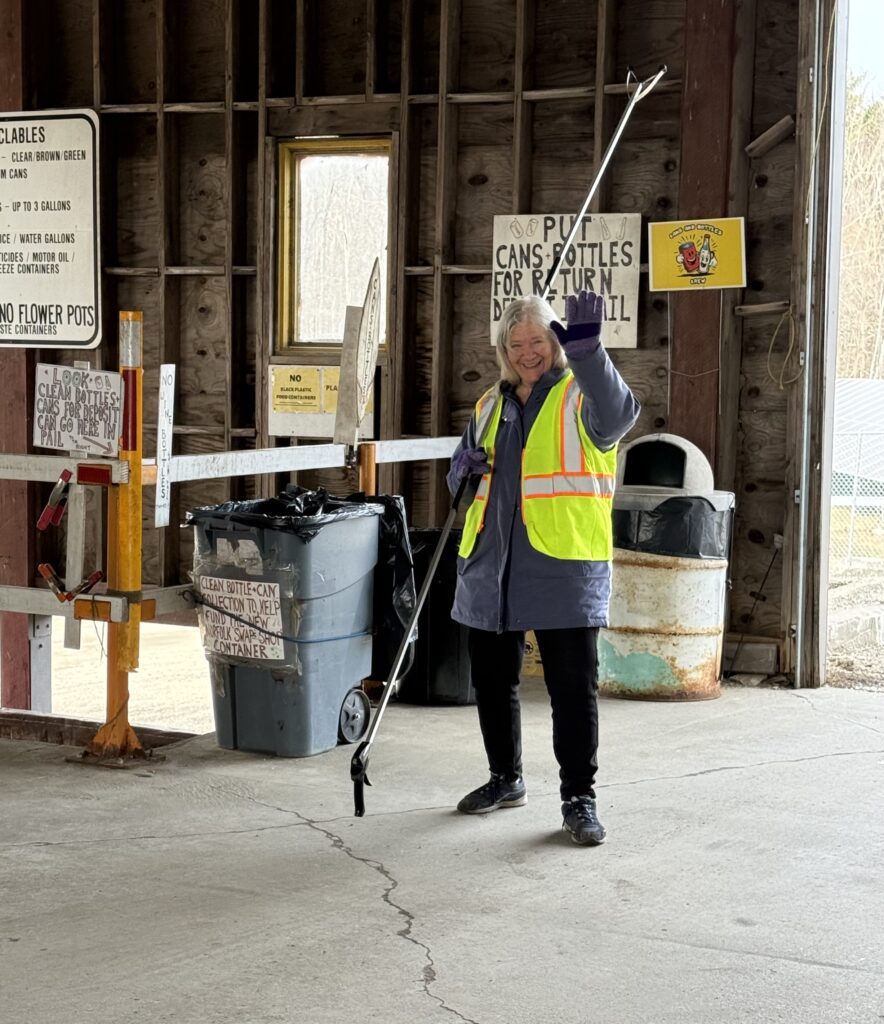
station, keeps her eye out for deposit bottles and cans. PHOTO BY AVICE MEEHAN
Over time these plants became outdated. A multi-million-dollar plan to upgrade the Hartford plant was rejected by the administration of Gov. Ned Lamont, leading to its closure in 2022. Since then, the state has moved to sell off all its MIRA assets, including the transfer station in Torrington, while giving Norfolk and other towns time to find a new solution. Some of the sale proceeds is ear-marked for the South Highlands neighborhood, which was heavily impacted by the plant.
Political intrigue ensued. After USA Waste made its $3.25 million offer to buy the Torrington transfer station, a provision suddenly appeared in a budget bill requiring any permit or license involving the Torrington Transfer Station to be given to the NRRA. This effectively blocked the sale to USA Waste. While no legislator accepted responsibility for the amendment, the Connecticut Mirror later reported that the wording came from an attorney representing a rival trash hauler.
Antonacci of USA Waste has reached out to Norfolk and other towns offering both five and 10-year contracts. He argues that they will result in lower costs. “We are not just good at what we do,” Antonacci said. “We are very, very good at what we do.” Antonacci said USA Waste will honor its offers regardless of whether it is able to buy the Torrington transfer station. USA Waste already operates a transfer station in Winsted.
While acknowledging that USA Waste is making an offer that is financially competitive, many town leaders expressed concern that USA Waste would end up with a monopoly on waste disposal. “The fear is that in five or 10 years down the line, if the fees being charged are too high, we would have no other option,” said First Selectman Henry Tirrell.
Antonacci noted that in the years just before the MIRA plant in Hartford closed in 2022, its fees increased significantly, prompting many towns to seek other solutions. Norfolk currently spends nearly $300,000 a year to run the transfer station. Under its current contract with USA Waste, the cost to manage both household waste and recycling is $136 per ton, an amount that would rise to $141 in July. The bid submitted by the company would be $123.90 a ton for household waste and another $45 a ton for recycling. Norfolk has a separate agreement with Paines Inc., which has been acquired by USA Waste, for managing bulky waste at $119 per ton. Scrap metal, which used to be managed by the Department of Public Works, is now managed by Tru-Hitch from Barkhamsted. It has provided the town with a new scrap metal container and will haul it at no charge.
Tirrell emphasized that the April 6 vote is non-binding and represents an expression of interest. NRRA is probably years away from becoming operational and the town would remain free to choose a different solution. Tirrell also pointed out that having a public option does not completely exclude private operators. If plans for the NRRA moved forward, USA Waste and other private trash haulers will likely get the opportunity to bid on managing the facility, Tirrell said. “The hope is that as towns join the NRRA, the state will see that there is interest and do the right thing,” said Tirrell. Backers of the public option hope the General Assembly will address the ongoing operation of the transfer station in Torrington by DAS, the continued development of the NRRA, and funding for redevelopment of the MIRA site in this session. State Rep. Maria Horn and representatives from the NWCOG, which received at $350,000 grant from the state Department of Energy and Environmental Protection, did not respond to requests for comment
