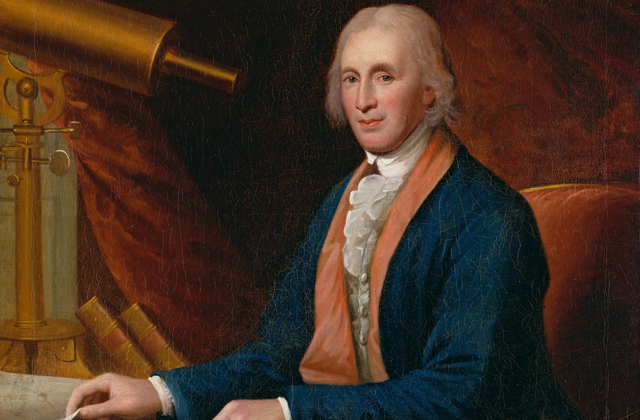
CELESTIAL SPHERE: Honoring an Astronomer and Patriot
By Matthew Johnson
As America celebrates its semi-quincentennial and the 250th year since the signing of the Declaration of Independence, this writer also celebrates the life of David Rittenhouse, an astronomer and political thinker who helped build the nation’s scientific infrastructure and informed its founding documents. The customary astronomical notes will follow at the end of the article.
David Rittenhouse may not be a household name like those of Thomas Jefferson and Benjamin Franklin, yet as a scientific and political figure, he was he admired by these great men and had a hand in shaping both the early United States and the scientific knowledge of the day. In short, he had his hands in both science and politics. In the year of the battles of Lexington and Concord, he delivered a lecture to the American Philosophical Society on the history of astronomy. In it, he linked nature to the rights of man, which for him included liberty, the right to self-govern and a denunciation of slavery. The Society ordered this lecture to be printed and distributed at the Second Continental Congress in 1776.
Born in 1732 near Philadelphia, Rittenhouse used books and tools that he inherited to teach himself science and math, as well as how to build clocks and sophisticated scientific instruments. In addition to astronomy, he also took up surveying and helped define the borders of New Jersey, New York, Maryland and Pennsylvania for the British Crown. In 1784 he and a crew completed the survey of the Mason-Dixon Line to the southwest corner of Pennsylvania.
Early in Rittenhouse’s career he built two orreries (models of the solar system) that showed solar and lunar eclipses and other astronomical phenomena for a period of 5,000 years, going either forward or backward in time. The first went to Princeton University (then the College of New Jersey) and the second to the University of Pennsylvania. He was one of the first in the U.S. to build a telescope, which he used to observe and record the transit of Venus across the sun in 1769. In 1781, he became the first American to view the planet Uranus. He built his own observatory on his father’s farm outside of Philadelphia.
Rittenhouse was a member of the American Astronomical Society and the American Philosophical Society, which was founded by Benjamin Franklin in 1743 for the purpose of “promoting useful knowledge.” He became president of the latter after Franklin’s death. He was also a member of the Royal Society of London, a rare honor for an American. He was listed by Jefferson as an example of “New World’’ genius in Jefferson’s book “Notes on the State of Virginia,” in company Franklin and George Washington.
From 1779 to 1782, Rittenhouse taught as a Professor of Astronomy at the University of Pennsylvania, also serving as vice provost and trustee. During this time, he also served as the Treasurer of Pennsylvania, a position he held from 1779 to 1787. He was appointed the first director of the U.S. Mint, a position he held from 1792 to 1795. During his lifetime Rittenhouse published several works on astronomy, magnetism and mathematics. Rittenhouse died in 1796. The two orreries are still on display today: one is in the library of the University of Pennsylvania and the other is in Peyton Hall at Princeton.
Moon Phases
July 7: Last quarter
July 14: New moon
July 21: First quarter
July 29: Full moon
Planets For those rising early on the morning of July 4, the bright orangered planet Mars can be viewed at 4:40 a.m. With binoculars, the green planet Uranus can be viewed along with Mars in the same frame. Both are found low in the east. After sunset, Venus is found in the lower west visible from 9-9:30 p.m.
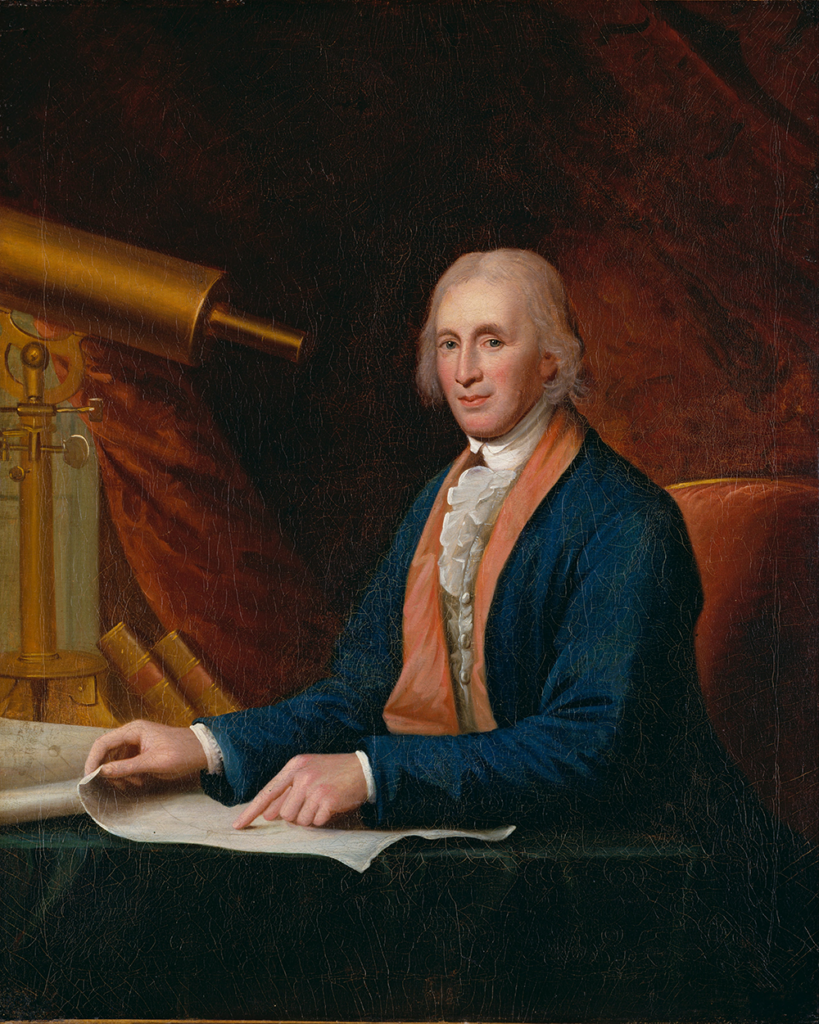
IMAGE CREDIT: WIKIMEDIA COMMONS
