Norfolk’s Newest Neighborhood Puts Down Roots
Haystack Woods lauded as a “model for the state”
By Joe Kelly
Norfolk’s newest neighborhood, the Haystack Woods affordable housing development, has officially come to life. A year ago, the 39-acre location—a former gravel pit off Old Colony Road—was little more than a muddy building site.
Now construction of the 10, two- and three-bedroom homes is largely finished. Appliances have been installed. Grass has been seeded. Trees, shrubs and perennials have been planted. Most important of all, people are moving in. Seven of the 10 homes have been sold or are under contract to first-time homeowners, a mix of singles, younger couples and more established families. All have jobs in Litchfield County, including Norfolk. Backyard barbecue grills have already been spotted.
The homes were developed for first-time homeowners whose total gross annual household income is 60 to 80 percent of the area median income for Litchfield County. Some were also set aside for households with incomes below that level.
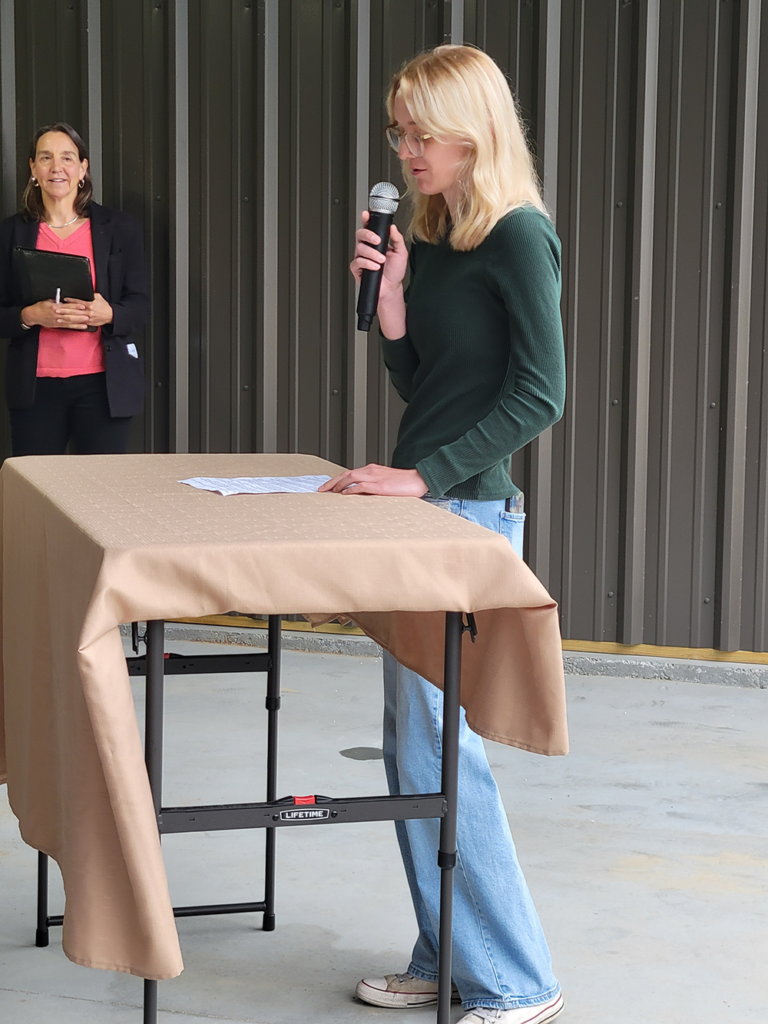
One new homeowner is Jordan Seibert, program coordinator at the Norfolk Hub. A Barkhamsted native and 2025 graduate of Charter Oak State College in New Britain, Seibert was looking for an apartment when the Haystack Woods houses first became available last year. “It’s a groundbreaking idea,” she said. “I never would have been able to
afford a house at this stage.” Siebert was among the speakers at a ribbon cutting ceremony on Monday, June 22, attended by a crowd of well-wishers including Lt. Gov. Susan Bysiewicz, who made a surprise appearance. “Norfolk is a model for the rest of the state,” Bysiewicz said, standing in one of the two carports, under the solar panels that generate electricity powering the homes. Other speakers included both current and former Norfolk First Selectmen Henry Tirrell and Matt Riska, State Rep. (D-64) Maria Horn and Seila Mosquera-Bruno, the state housing commissioner.
The houses are a mix of ranches and capes ranging in size from about 1,200 to 1,355 square feet. Thanks to the location near the base of Haystack Mountain, and with the varying one-and two-story rooflines, the development is less Levittown and more alpine village. The exteriors all draw from a uniform cream, grey and brown palette.
Construction was fast because the houses were built using prefabricated components—concrete walls, structural panels and roof trusses all with insulation already built in—allowing for speedy assembly on site. Residents can park in one of two multi-car carports where the roofs consist of racks of solar panels. The panels, battery storage, insulated construction and other eco-features are all part of what make the development net-zero—the renewable energy that’s generated equals what’s being consumed.
“We worked diligently to drive the energy consumption of these homes down, so we didn’t need as much solar” said Kate Briggs Johnson, an architect and president of the Foundation for Norfolk Living (FNL), which developed the project. According to Briggs Johnson, one new homeowner was wrestling with $800 a month electricity bills last winter in a previous home. By contrast, she said, the electric bill this winter in Haystack Woods should be just the $10 hook up fee.
The completion of the Haystack Woods development brings to 22 the number of affordable living spaces that FNL has created in Norfolk. Previously, FNL completed the renovation of several older structures in the village center, creating 12 apartments.
While the construction phase at Haystack Woods took just over 12 months, the project has been long in the making and required a year of hearings and meetings before Norfolk’s Planning & Zoning Commission and the Inland Wetlands Agency after the state required that Haystack Woods Road be constructed as a public road. Countless hours went into fine tuning designs and arranging financing.
Work started in earnest in 2025 after the state Department of Housing came through with a $4 million loan and grant to help cover the gap between actual construction costs and the revenue generated by selling the homes. That came on top of $2.9 million previously awarded for site work, infrastructure and building the access road. At the ribbon cutting ceremony, Briggs Johnson noted the extraordinary range of people and organizations that were involved in making the project happen—attorneys, land use experts, Northwest Community Bank, Eversource, the town public works department, not to mention nearby homeowners who put up with construction and blasting. While the houses are now finished, the young plantings that have just been put in (and which were funded privately) are a reminder that Haystack Woods is a home-grown idea, now just putting down roots…no doubt, with a long growing season ahead of it.