Winsted Church Auctions Tiffany Window for $1.25 Million
Sale highlights women’s role in Tiffany designs
By Joe Kelly
When medieval architects found ways to build taller cathedrals, the techniques they developed also made possible the enormous stained-glass windows that we so enjoy today, such as at Chartres and Sainte-Chapelle in France and Canterbury Cathedral in England. American-made stained glass is more recent, dating to the 19th century and the name most associated with it is Louis Comfort Tiffany. The eldest son of the founder of the famed New York jewelry house, Tiffany enjoyed success as both a painter and an interior decorator before becoming obsessed with perfecting a modern version of the ancient stained glass he saw abroad. The innovative techniques he developed at Tiffany Studios ultimately resulted in commissions for thousands of windows.
Remarkably, that includes nine windows in Connecticut’s rural northwest corner: five in Norfolk in the Battell Chapel of the United Church of Christ, two at the Second Congregational Church in Winsted and two more at St. Michael’s Parish in Litchfield. That number has dropped to eight since the Winsted church engaged the New York auction house Christies to sell the Boyd Memorial Window to raise funds for its mission and ministries here and around the world.
“People tend to think of a church as a building and a worship space,” said Pastor Dan Cote of the Second Congregational Church. “Selling the Boyd window allows us to continue functioning as a vibrant place of worship and also to sustain a wide range of ministries that impact the community and the world.”
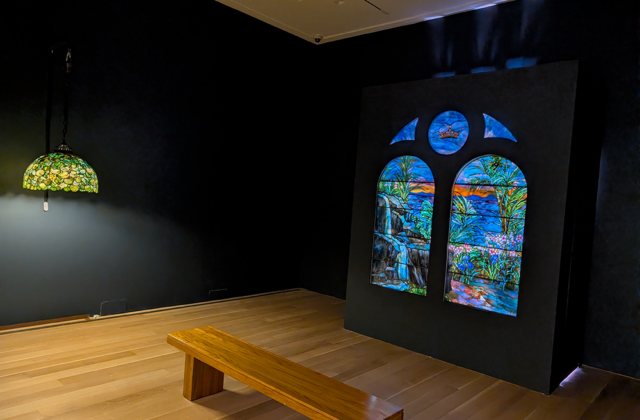
Located in the balcony to the upper right of the church’s main entrance where a replica takes its place, the window was donated by Ellen Wright Boyd in 1899, in honor of her parents, John and Emily Webster Beers Boyd. John Boyd had been a prominent local businessman, politician, and author of the “Annals and Family Records of Winchester,” which documents the town’s early settlers. Measuring about five feet wide and high, the Boyd window consists of a pair of arched panels (or lancets) featuring a large waterfall surrounded by palm trees, ferns, lilies and irises. Purple mountains loom in the distance, and a brilliant orange sunset stretches across both lancets. A jeweled crown sits at the top.
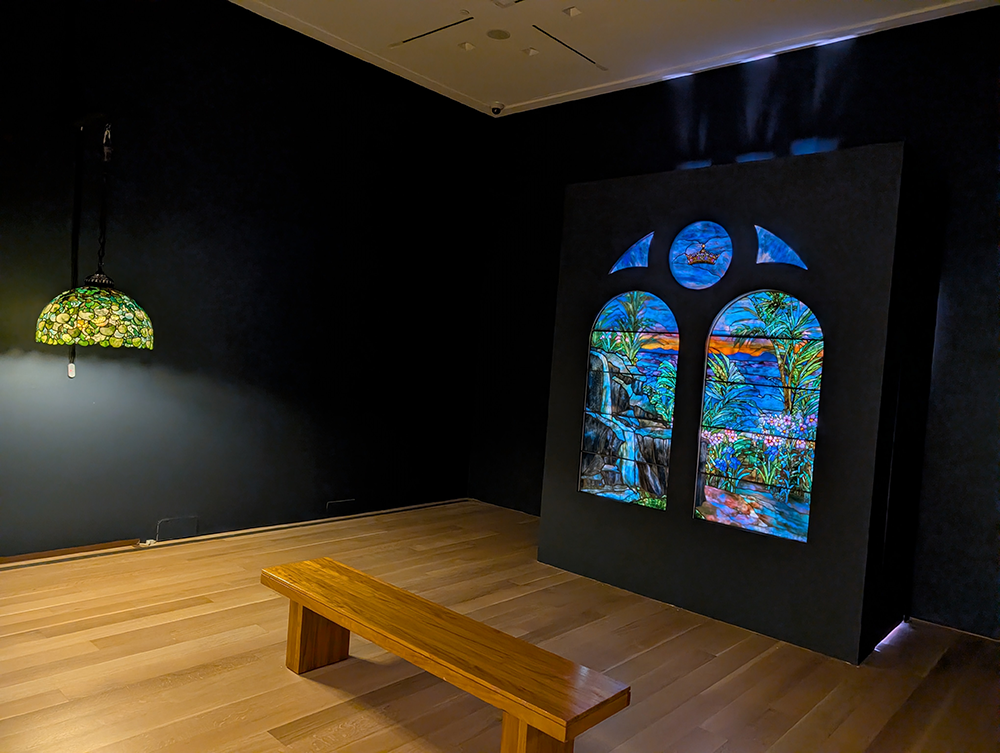
For the June 10 auction at its Rockefeller Center headquarters in New York, Christies staged the Boyd window in its own gallery, encased in a lightbox facing a wood bench and three Tiffany lamps. Bidding started at $800,000 and quickly hit the $1.25 million selling price. With the 27 percent buyer’s premium, the total of $1,587,500 met the presale estimate of $1.5-$2 million.
While Tiffany lamps with their richly colored glass shades have long attracted collectors, the windows are now drawing attention and high prices. Two years ago, Sotheby’s auctioned a Tiffany window originally commissioned for the First Baptist Church in Canton, Ohio, for $12.48 million—the highest price ever paid for a Tiffany work.
The windows commanding these prices—as well as the Boyd window and the windows in Battell Chapel—are all landscapes. According to Alice Cooney Frelinghuysen, the Anthony and Lulu Chao Wong Curator of American Decorative Arts at The Metropolitan Museum of Art, Tiffany led the way in making landscapes a fitting subject for church windows. More traditional windows would have featured scenes from the Bible or important religious figures. Tiffany also produced these—the windows at St. Michael’s Parish in Litchfield and the remaining Tiffany window at the Winsted church and are good examples. For all of this work, how much credit should go to Tiffany himself and how much to the designers, many of them women, that he employed? As many as 200 women worked at Tiffany Studios and were employed in the selection and cutting of the glass pieces used in windows, lamps and other creations—Tiffany thought women had a better sense of color than men. But it was long assumed that, unless otherwise noted, the designs were the work of Tiffany himself. This assumption came into question about two decades ago when researchers found hundreds of letters written by Clara Driscoll, who headed Tiffany’s glass cutting department, indicating that she was the principal designer of many lamp models.
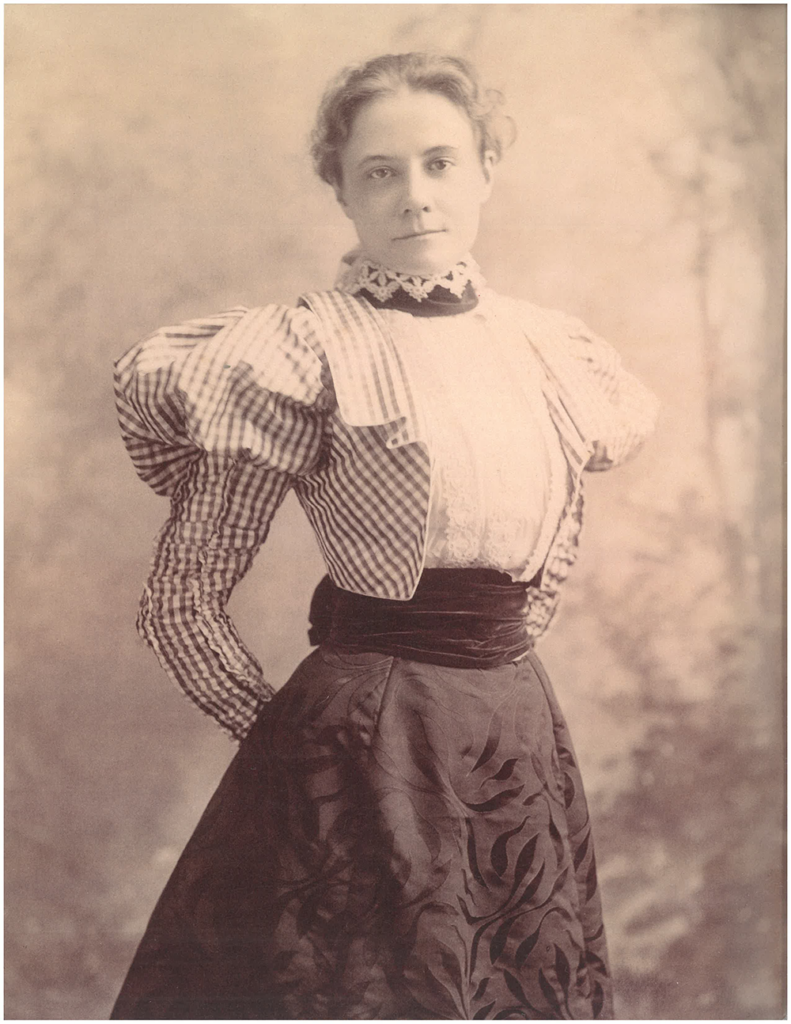
In the case of the landscape windows, Frelinghuysen’s extensive research uncovered signed drawings and an unpublished memoir documenting the role that Agnes Northrop played in the design of a number of landscape windows. Northrop was born and raised in Flushing, Queens, which was then known as the ‘garden center’ of the United States because of the large number of nurseries located there. Fitting Tiffany’s criteria—she was Protestant and unmarried—Northrop was hired in 1884 at the age of 27 and remained for nearly five decades until the Tiffany Studios closed in 1932.
Frelinghuysen summarized her research in an extensive article entitled “Agnes Northrop and the Women of Tiffany Studios,” which appeared in the Winter 2026 edition of the Metropolitan Museum of Art Bulletin. It was prepared in conjunction with the installation of the monumental “Garden Landscape” window in the museum’s American Wing. It is one of four windows that are definitively attributed to a Northrop design.
Should the windows in Norfolk’s Battell Chapel be attributed to Northrup? No signed drawings or other evidence has been uncovered to definitively answer that question, and any one piece could involve contributions from Tiffany, other designers and clients. But it is well established that Northrop worked only on windows and specialized exclusively in non-figurative, floral or landscape windows. Given that the Boyd and Battell Chapel windows are that type, an argument can be made that she could have have had a role in their design.
After Tiffany Studios closed in 1932, Northrop continued working in the field for a successor company. In her early 90s, she moved to the Gramercy Park Hotel in Manhattan where she passed away in 1953 at the age of 96. It is said she was designing new windows until nearly the end of her life.