Caring for Forests: Ethan Tapper’s Message of Stewardship
By Jude Mead
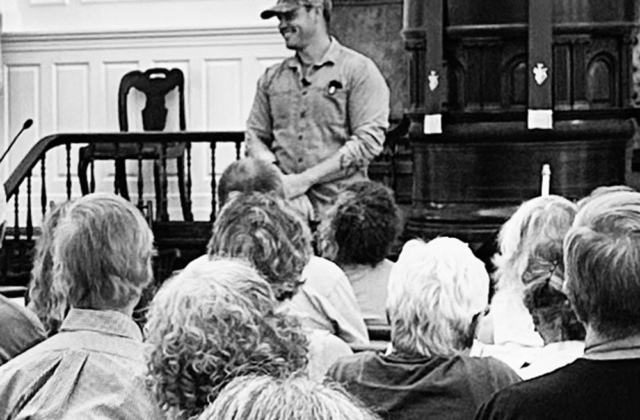
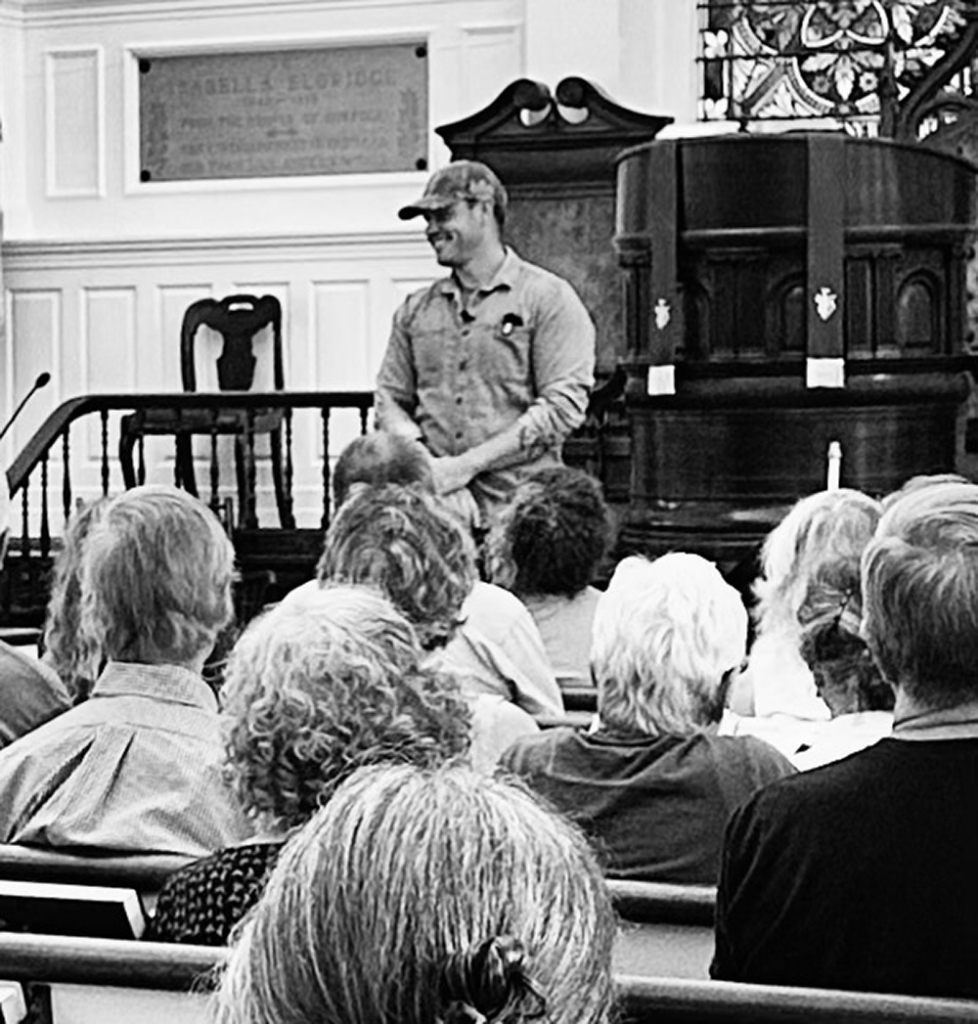
Ethan Tapper recently spoke at the Church of Christ Congregational on the green about his work as a forester, author and advocate for the natural world. The evening centered on his 2024 book, “How to Love a Forest: The Bittersweet Work of Tending a Changing World,” which explores how forests function and what it means to care for them in a rapidly changing world.
Tapper has spent much of his career helping people better understand forests. Over the past decade, he has led walks through forests, given talks and conducted trainings and other events across North America, speaking to conservation groups, landowners, educators, government agencies and community organizations. His engaging presentations combine personal stories with practical lessons about forest management, wildlife habitat and conservation. In some of his presentations he discusses the personal process involved in writing his book. Tapper explains that the book grew out of a simple daily writing practice. “I said to myself, what if I spend an hour all to myself every day and try to write for an hour. It ended up becoming this practice that I did for six years. Then naturally I found a publisher and after a long process the book came out September of 2024, eight years later.”
At the heart of Tapper’s approach is ecological forestry—the idea that a forest is more than its trees. Healthy forests are complex communities of plants, animals, fungi, soil and water, all interconnected. Rather than simply leaving forests untouched, Tapper argues that thoughtful management can sometimes restore damaged ecosystems, improve biodiversity and build resilience. That philosophy grew from his experiences caring for his own 175-acre forest in Bolton, Vt. After purchasing the property, Tapper began restoring its degraded woodland through ecological forestry practices. “At the same time of writing the book, I was involved in another process. In 2017, I bought a 175-acre piece of degraded forest that I decided to call Bear Island. It had every problem that a forest could have. And even though I had experience as a consulting forester and service forester, it was too much,” said Tapper. Rather than becoming discouraged, Tapper approached the restoration of Bear Island much like his writing process—one step at a time. “I did the same thing as the writing and worked to make it healthy one hour at a time or one half day at a time. I looked at it as a symbol of what is possible in the world.”
Tapper’s path to forestry was shaped by years spent outdoors and learning about forests. According to Tapper, the more he studies an ecosystem, the more he notices. “There is a thing about learning about ecosystems. The more you learn the more you see. When I first looked at a forest, I just saw only trees. Now I see red oak, sugar maple, red maple and all the different species, realizing how much is here. But at the same time, as you go deeper, you start to see all these things others may not, such as invasive plants.” That deeper understanding also helps explain why Tapper believes forests require thoughtful stewardship. “Forests have changed significantly over time. Most forests are young and usually dominated by a single generation of tree, but the forests of the past were defined by a more diverse population of trees. Forests today face serious challenges including invasive species, habitat loss, climate change and other human pressures,” he said.
Tapper believes, however, there is still tremendous beauty and abundance in the natural world and offered an optimistic message about conservation. His message is ultimately one of hope: stewardship begins with paying attention. By spending time outdoors, learning about the land and making thoughtful choices about how we care for forests, Tapper believes we can help these remarkable ecosystems remain healthy and vibrant for generations to come. In his book, Tapper captures that idea of stewardship. “Once I thought being a forester meant being a caretaker of trees. Now I see myself as the caretaker of a reimagined forest, the steward of every piece of this incredible volume of life,” he wrote.
