A Forest of Dreams
Planting the seeds of Norfolk’s wildlife habitat
By Carol Goodstein
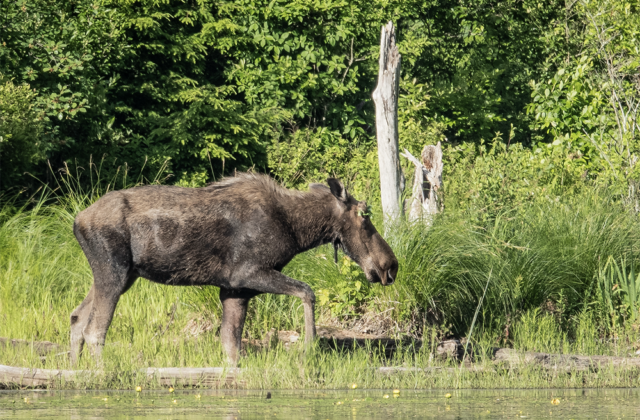
A moose and her calf spotted in a Colebrook backyard. Black bears lumbering across Route 44 to Norfolk’s City Meadow. A ruffed grouse who, this summer, took up residence in the Norfolk Country Club parking lot.
“This is what my grandfather envisioned,” recalls Betsy Gill, who says that when she was growing up in Norfolk during the 1950s “we never saw a black bear or a red fox.”
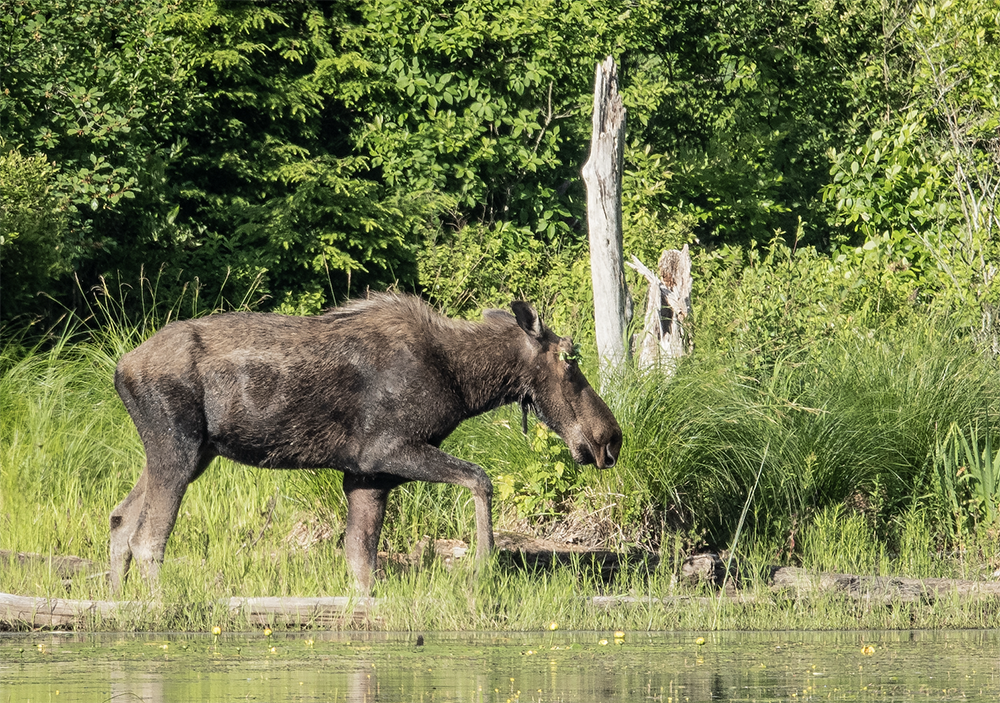
PHOTO BY TOM BLAGDEN
Wildlife sightings have become the norm in Norfolk. Do we have more wildlife now or do Instagram pics of bears rifling through kitchen cabinets merely amplify the anecdotal? If wildlife populations are increasing, why? And how can people coexist with the bobcats, bears and moose in our midst?
Inspired by William Temple Hornaday—an early 20th-century big-game hunter and chief taxidermist at the National Museum (later the Smithsonian National Museum of Natural History)—who maintained that the best way to protect endangered wildlife was to purchase and preserve large tracts of land as animal habitat, Gill’s grandfather, Starling W. Childs, and his friend Frederic Walcott bought 400 acres surrounding Tobey Pond in 1909. Their plan was to hunt game for sport while restoring duck, beaver and deer populations for future generations.
Soon after, Childs and Walcott acquired an additional 6,000 acres—most of it denuded to make charcoal used in iron production. They hired gamekeepers to introduce deer, pheasants and sand hill cranes. “Gamefield Road off of Windrow Road, which runs down to Tobey, had lots of little hutches used to breed grouse,” recalls Norfolk’s Star Childs, Starling W.’s grandson.
Childs and Walcott imported ducks from Canada including redheads, pintails and canvasbacks, which flourished in their new habitat. In 1912 Walcott wrote: “Tobey Pond looks like a lake in a zoological park. We have from two to five hundred ducks there all the time now; they have stopped over on their way south, attracted by our own ducks, now numbering more than two hundred and representing more than 14 varieties.”
To further expand their wildlife habitat, Childs and Walcott reintroduced native trees, and when Starling Childs’ son Edward C. “Ted” Childs took over operations after graduating from Yale Forestry School in 1932, he began to actively manage the land while running the forest as a conservation laboratory.
The regrowth of forest across New England in the wake of the migration of agriculture across the Mississippi—along with the enforcement of hunting regulations—led to a dramatic increase in wildlife in and around Norfolk. As Great Mountain Forest Executive Director Mike Zarfos explains, “Eastern reforestation is one of the most dramatic examples of this phenomenon on the planet.” By 1825 only 25 percent of Connecticut was covered in forest; today, 60 percent of the state is forested.
Not all these forests are at the peak of health. With no natural predators, invasives like Japanese barberry, goutweed and bittersweet—brought here for landscaping and erosion control—are crowding out native plants and taking over landscapes, even in relatively resilient forests.
These invasive plants can have serious consequences for wildlife. By encouraging birds such as American robins and northern cardinals to nest earlier than they naturally would, they expose nests to greater risks from predators like raccoons, red squirrels and weasels. As these predators become more successful, larger predators—including bobcats—also benefit from the increased availability of easy prey.
The result is a ripple effect through the ecosystem: native birds and small mammals produce fewer surviving offspring, while predator populations can increase. Bobcats, for example, were nearly extinct in Connecticut until unregulated hunting ended in 1972.
Since then, their population has rebounded, and they are now thriving across the region.
As fourth generation land manager and forester Jody Bronson points out, bobcats and foxes are finding food not only in thickets but also backyards. “I have noticed that recently more people are raising chickens,” says Bronson. “The good news is that the foxes and bobcats keep the rabbits and voles away from our vegetable garden!”
Black bears, another species of backyard opportunists, are visiting Norfolk with increasing frequency. “From bird seed and household garbage to raspberries and peaches, if they smell food they like, they will find a way to get it,” says Bronson.
Extinct in Connecticut in the mid-1800s, the return of forests has meant the return of bears. Today, 1,200 black bears live in Connecticut. While a far smaller population than in the neighboring Berkshires, home to about 5,000 black bears, our state is experiencing far more home break-ins and property damage—mostly, according to the Department of Energy and Environmental Protection because people aren’t securing their trash and bird feeders.
The gangliest, largest and arguably most surprising mammals to spot in Norfolk are moose. While in North America, most of these ungulates—hoofed members of the deer family—are found in Canada and Alaska, moose made their way here during the 1990s. Today, Great Mountain Forest hosts about 20—or a fifth—of the state’s moose population.
While visitors to Great Mountain Forest would be hard-pressed to catch a glimpse of these naturally reserved mammals, moose can be highly aggressive if threatened. Not only are they big—bull moose weigh between 900 and 1,400 pounds—they’re fast, able to run 30 to 40 m.p.h.
Wildlife conservation has evolved since Hornaday’s promotion of private preserves. The current approach is designed to link fragmented parcels of forest and allow animals to roam freely along wildlife corridors.
As climate change accelerates, each decade driving animals to move north an average of 11 miles and 36 feet higher, Norfolk’s high elevation and cool microclimate—and its thousands of acres of protected lands—will serve as a climate refuge for migrating species.
“Dad inherited a forest of dreams,” said Star Childs. “If you grow it, they will come. That’s the simple story of how the wildlife return. If you grow the forest and protect the wildlife and their habitat so they have adequate opportunities to browse or graze or prey—garbage cans notwithstanding—they’ll find their way here.” ■
Editor’s note: The author is a member of the board of Great Mountain Forest.
