The Mindful Moments of Miranda Lee
Interview by Jude Mead
For the past four years, Miranda Lee has shared her yoga skills and yoga teaching tools with the broader community through Find That Pause, a free Saturday morning mindfulness program that began at the Norfolk Library and has since grown into a multi-library and hospital wellness program.
For Lee, mindfulness isn’t simply something she teaches—it’s something that helped her find her way back to herself. As an overwhelmed young mother, Lee remembers walking circles around her minivan in the driveway, searching for just one quiet moment to breathe. Her own experiences eventually led her into yoga, meditation and mindfulness, and ultimately into work with cancer recovery patients and people living with chronic pain.
Today, with more than 500 hours of yoga teacher training and additional training in neuroscience-based meditation, mindfulness and nervous system regulation, Lee combines ancient practices with modern science to give people practical tools for managing stress, pain and difficult emotions.
How did your own experiences shape your decision to become a yoga and mindfulness teacher?
I was born with scoliosis, and as a teen my pediatrician suggested my mother take me to a yoga class. We had a fantastic teacher who also taught meditation, and I came out of those classes feeling so much better—less discomfort in my back and a real sense of calm. I kept it up and noticed it was helping with my anxiety and stress. I just kept following that thread—studying with teachers in India, the U.K. and the U.S.—and gradually I became immersed in it.
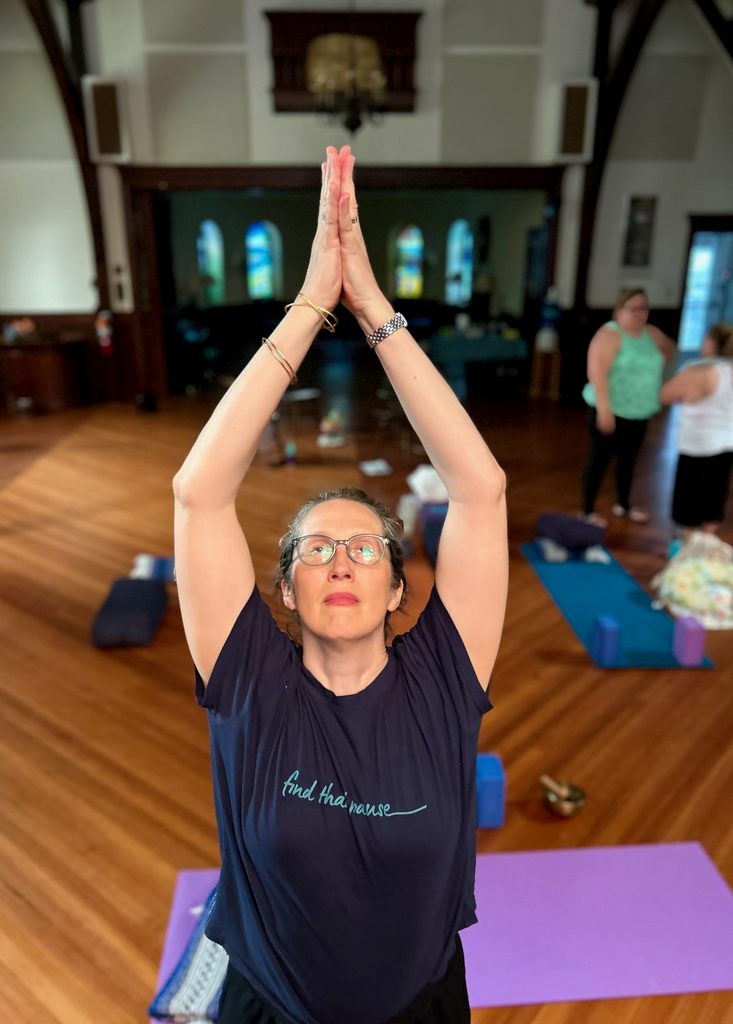
Photo by Jennifer Almquist
What was it about yoga that made you realize there was more to it than physical exercise?
Yoga is designed to work on your physical body, yes, but also your mental, emotional and even spiritual well-being. In India, Ayurvedic doctors prescribe yoga for both physical and mental health conditions. That’s not new, that’s thousands of years of accumulated wisdom. Once you feel that in your body, there’s no going back to thinking of it as just a workout.
At what point did yoga shift from something that helped you personally into something you felt called to teach professionally?
It happened in India. One of my teachers said: “As I teach you now, so should you go out and teach others.” That hit me. I felt called to share what I was learning. I could also see so clearly how much suffering existed around me and I knew these practices could help.
Why do you think people struggle to make time for practices that could ultimately help them function better?
Because we live in a culture that glorifies doing. We’re in sympathetic nervous system overdrive most of the day—information coming at us constantly, to-do lists that never end. And, most people don’t fully understand how critical nervous system regulation is. It’s what makes everything else possible. We’ve just never been taught that.
Do people need a lot of time to benefit, or can small moments make a difference?
Small moments absolutely make a difference, and that’s kind of the whole point. Every time you take 30 seconds to breathe and break that urgency spiral, you’re training your nervous system to regulate more quickly, to build more capacity to manage stress over time. What my class adds is community and consistency. But the practices themselves? You can do them anywhere, anytime.
What are some nervous system tools someone could use in their car, their kitchen or at work?
One of my favorites—and one of the most well-researched—is the physiological sigh. You breathe into your belly, then your chest, top it off with a little extra inhale and then sigh it all out. That’s it. It drops adrenaline levels fast. It’s simple, accessible and it really works
What have your clients with chronic pain and illness taught you about the nature of pain and what it means to heal?
So much. I’ve come to understand that pain is far more complex than we’ve been taught. It’s a message from the nervous system, and that nervous system can be in protection mode for so long that it keeps sending danger signals even when the original injury has healed. My clients have also taught me that healing must include the mind, not just the body. When they start to understand that they can send messages of safety to their own nervous system—and that their brain can change—that’s real healing.
How do you reconcile traditional practices with modern neuroscience?
I don’t think there’s much to reconcile. Modern neuroscience is largely validating what these ancient traditions have been saying for thousands of years: that the mind and body are not separate, and that neglecting one while treating the other leaves enormous healing potential untapped.
Can you explain how breathing exercises regulate the nervous system?
When we breathe slowly and deeply, especially with a long exhale, we’re sending a direct signal to the nervous system: we’re safe. That long exhale activates the rest-and-digest state and brings us back into regulation. It sounds simple, but for a lot of people, the nervous system has been in protection mode for so long that it takes real practice and patience to shift. But here’s what’s incredible: neuroplasticity means the brain can change at any age. It’s never too late to start.
If you could leave our readers with one piece of advice about wellness and self-care, what would it be?
Stop waiting until you have more time. The things that change your life don’t take much time or effort—they take intention and consistent small steps. It’s the 30 seconds you pause, the moment you choose to step back instead of spiral into stress. The more you give your nervous system small signals of safety, the more resilient it becomes. If you want to try it with a community around you, come join us on Saturday mornings at Norfolk Library.
Readers can learn more at findthatpause.com and register for the Saturday class at norfolklibrary.org.
