Aging in Place
Historic Church Ceiling Needs a Refresh
By Avice Meehan
After more than 200 years of good and faithful service to the congregation of Norfolk’s United Church of Christ, the soaring barrel vault ceiling of the Meeting House requires a major overhaul. The wood lathe and plaster ceiling, likely installed in 1813, has developed serious fault lines, and the church council decided on Sept. 16 that it was no longer safe to hold worship services in the space.
The huge oak doors of the Meeting House were closed the next day. The cast bronze bells that ring out over Norfolk’s Village Green on the quarter hour were stilled because the vibration poses too great a risk to fragile plaster. And until further notice, Sunday services will be held in the adjacent Battell Chapel, itself a historic building illuminated by newly restored stained glass windows. Soon, hymnals and prayer books will be removed from the pews, and plywood will be installed to protect the large altar window and pipe organ.
The speed with which the Norfolk congregation acted has everything to do with a ceiling collapse that occurred in August at a Congregational church in Putnam, Conn. That event prompted Marie Civco to commission an expedited inspection of UCC Norfolk’s ceiling by Paul Bastiaanse, president of Valley Restoration Inc., who oversaw the restoration of the church’s iconic steeple. The news was not good: the ceiling system had deteriorated markedly since the last survey three years ago.
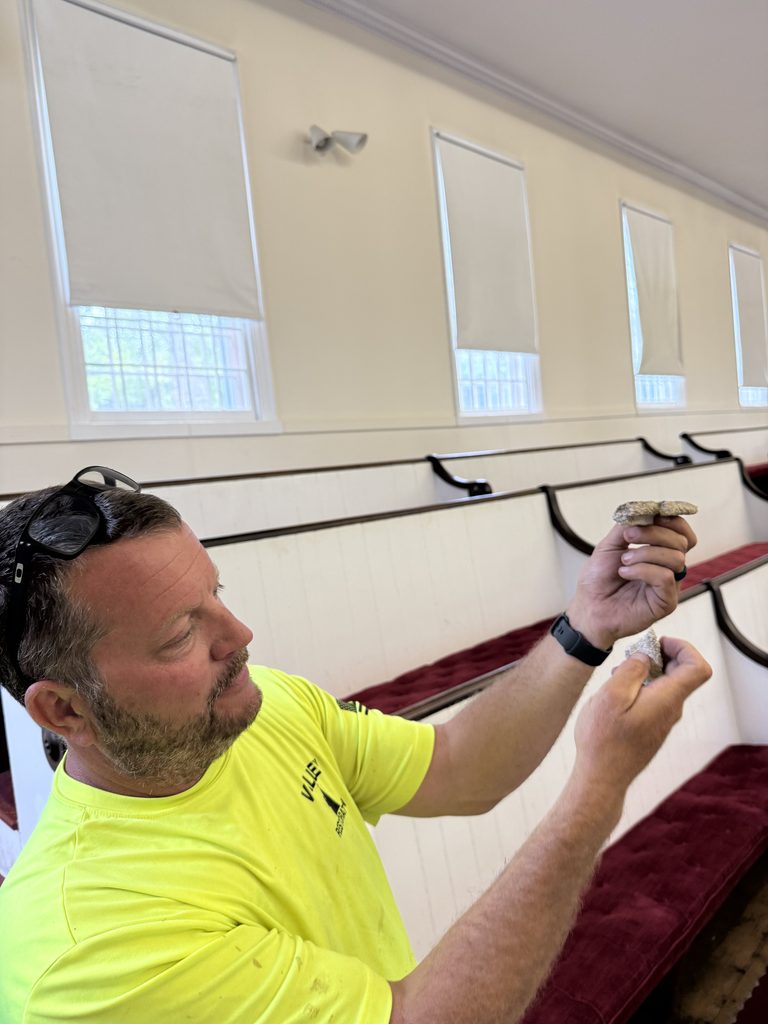
Photo by Avice Meehan
“Sadly for the community of Putnam, what happened there has made everybody aware of the risks of not maintaining a system like this. We are blessed to have the chapel space. Am I sad? Yes,” said Rev. Erick Olsen, church pastor. Olsen noted that the church had planned to host a trumpet and organ concert featuring music that might well have shaken loose the plaster. “We will have a fitting celebration when that time comes and will pull out all the stops,” he pledged.
Members of the church community are already planning the restoration. Once it became clear that the ceiling could fail, Civco contacted Connecticut’s State Office of Historic Preservation to find out whether the church’s planned application for a $200,000 challenge grant to restore the altar window could be changed. The answer was yes. The agency had earlier supported the steeple restoration.
The price tag is likely to be steep, upwards of $300,000 or more. That being said, restoration of the ceiling system will also enable the church to tackle nagging maintenance issues—such as how to clean the circulating fans or replace the light fixtures along the upper edges of the ceiling—at the same time. It will be January before the church learns whether the grant application is successful and, if so, the amount of matching funds that will need to be raised.
On a recent Thursday morning, Civco, Bastiaanse and Olsen surveyed the ceiling from the sanctuary and balcony. Later, they went up through the steeple to assess the condition of the plaster and lathe from the attic, where a wooden walkway provided the means to move from one end of the church to the other. It was hard-going and dark.
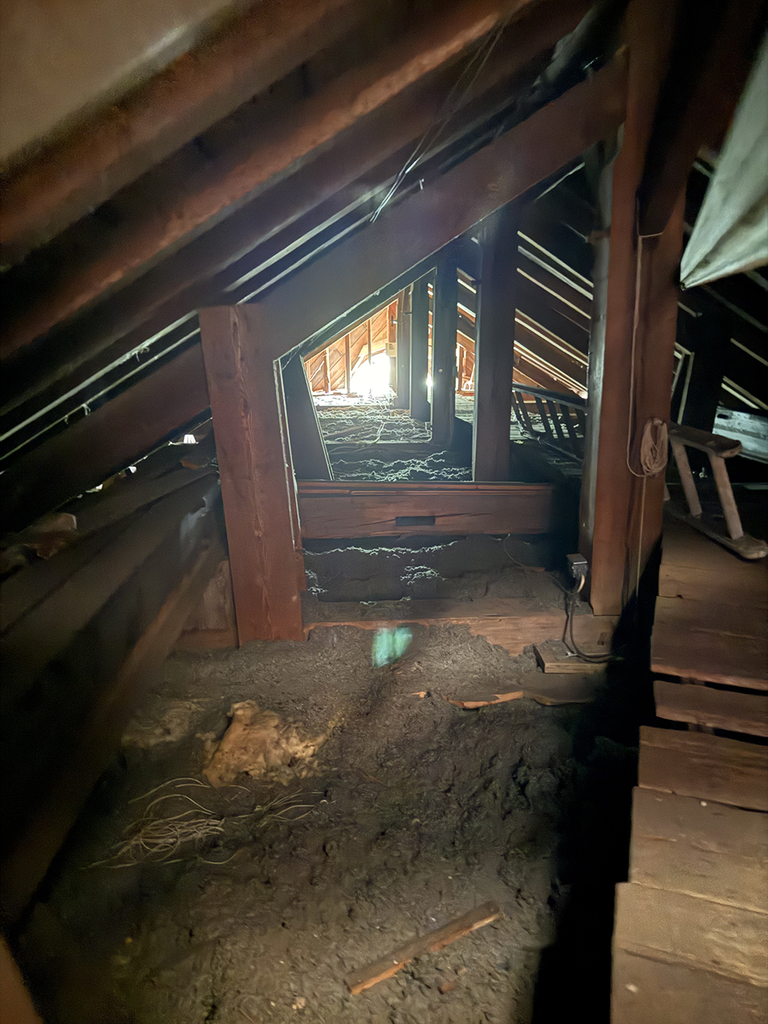
Photo by Avice Meehan
Bastiaanse said that to build a ceiling like Norfolk’s, wood lathe would have been soaked in horse troughs and, completing the circle, horsehair would have been used to bind the plaster. Three coats of plaster would have been applied to the damp lathe, creating a lug, the plaster that folds over the wood slats, and a key, the plaster that goes between the slats. Together, the three parts form a hanging ceiling that supports itself.
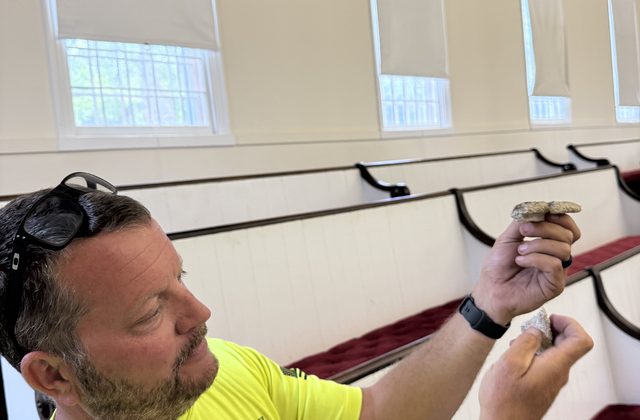
“We test the keys,” said Bastiaanse, holding a piece of crumbling plaster between his fingers. When a key fails, weight is redistributed through the rest of the ceiling, placing additional pressure on adjoining keys until the system begins to fail.
Repair options can range from demolition and rebuilding to the use of new materials to strengthen the existing ceiling. In that example, which is what he recommends for Norfolk, the ceiling system is flooded with an acrylic resin that, in Bastiaanse’s words, “goes through all three plaster layers and glues it back up to the lathe.”
Bastiaanse said, in response to a question from Olsen, that the ceiling was affected by four variables: age, insulation (which causes moisture to accumulate), cracks that connect to each other and vibrational damage caused by proximity to Route 44. To restore the ceiling, workers will need to operate from the back of the church and will start by removing the insulation.
Sometime after 1813, the barrel vault ceiling was covered by a flat ceiling, which was removed when the church was renovated in 1880. That step likely prolonged its life for another 146 years.
