Norfolk Scholar Marinates on Medieval Cookbook
By Avice Meehan
Anyone with a tattered copy of the “Moosewood Cookbook,” the bible of vegetarian cooking published some 50 years ago, understands that cookbooks are about more than recipes. They can signal political and cultural beliefs, social aspirations and more.
So consider the significance of a cookbook published more than 600 years ago. It was the first written in English—albeit Middle English, the language of Chaucer. It was filled with recipes borrowed from Europe and the Arab world, all crammed into a book or codex measuring a mere 5.5 inches by 3.8 inches. The other two editions, published in 1390 and 1425, exist as long rolls, hardly practical for use in any kitchen, no matter how grand.
Welcome to the world of “The Forme of Cury,” which scholar of medieval English literature and language and Norfolk resident Lucy Mookerjee translates as “The Way to Cook” from the Middle English original. “The recipes would have been impossible to make,” she said during a recent conversation, noting that ingredients such as rice were not even available in England in the 14th century.
Although Middle English and medieval cookery may seem obscure, Mookerjee’s scholarly path runs straight through the heart of Norfolk. Her family has deep ties to the community and, after graduating from Trinity College, she went to work for the late Star Lawrence, then-editor of W.W. Norton & Co. She expected to study poetry in graduate school but was smitten by a course on the history of the English language and didn’t look back.
As Mookerjee neared the end of her doctoral studies, she realized that she enjoyed research more than teaching. A fortuitous conversation with Barbara Roberts, a Norfolk resident and former head of conservation at the Frick Collection in New York, brought her to the Morgan Library, home to a rich collection of medieval manuscripts—including “The Forme of Cury”—and a series of rewarding collaborations. She has lived in Norfolk since the death of her husband, Robin, a decade ago.
Mookerjee, who cheerfully admits that she’s not much of a cook, began to wonder whether “The Forme of Cury” served a purpose beyond putting lavish meals on the table as she worked on a definitive addition of the text. English was beginning to emerge as a language, competing against French and Latin. King Richard II was only a few years away from being deposed by the future King Henry IV. Yet here came this book, written in Middle English, carrying a royal imprimatur, as well as the endorsement of philosophical and medical authorities of the day.
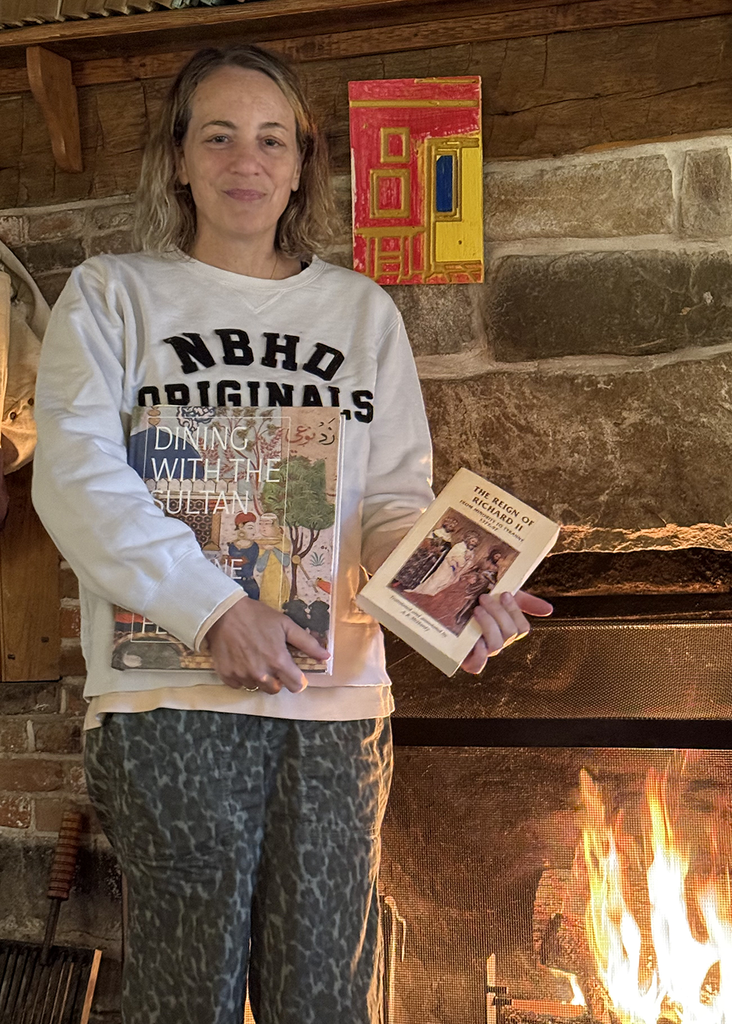
Photo by Avice Meehan
“This looks less and less like a neutral domestic cooking manual and more and more like [a] carefully branded artifact of royal authority,” Mookerkjee observed during a recent talk at the Norfolk Library. She plans to delve more deeply into the idea over the next year with the support of a fellowship from the National Endowment for the Humanities. The fellowship was cancelled and then restored after a legal battle.
Mookerjee’s definitive edition of “The Forme of Cury” will be published in 2028 by Medieval Institute Publications as part of its “The Middle English Texts Series.” In addition to a deeper look at the political role played by the cookery book, she hopes to take a closer look at the recipes themselves, their origins and whether or not one could actually cook them. Just don’t ask her opinion on whether the English invented lasagna—the answer is no and revolves around the meaning of the Middle English word looseyns, which is rooted in the word lozenge. Lasagna has an entirely different derivation.
Cotagrys
(From “The Forme of Cury”)
Take an hole rowsted kok. pulle hym & hylde hym al togyder saue þe legges tak a pygge & hyld hym fro þe myddes dounwardes. fyl hym ful of þe fars & sowe hym fast to gyder. do hym in a panne & seeþ hym wel. & whan þey buth y sode: do hem on a spyt & rost hit wel. colour hit wiþ yolkes of ayroun & safroun. lay þeron foyles of gold & of sylver and serve hit forth.
In modern English, this would be:
Pluck a capon. Trim away all of it except for the legs. Fill it with sugar and spices. Take a suckling pig and trim away everything from the mid-section down. Sew the front half of the pig to the legs of the capon; put it in a pan and bring it to a boil. Once it is cooked through, put it on a spit and roast until crisp. Brush the exterior with a saffron-egg wash. Cover it in gold and silver leaf and serve it forth.
Scholar’s note: the recipe’s curious title, “cotagrys,” appears to derive from the mythical Cockatrice, a medieval beast with a rooster’s head and a dragon’s body. Yet the recipe instructs the reader to use the rooster’s legs, not its head. What’s happened here? Some have suggested that the uncanny “Cockatrice” is so called because it hatched from a rooster’s egg, but that legend postdates the cookbook’s production by 300 years. Has our 14th-century scribe (tired, cold, uncomfortable, overworked, underpaid) accidentally substituted the capon’s legs for its head while copying “cotagrys” from another manuscript of “The Forme of Cury”?
