A Wall That’s Also a Bridge to the Past
By Andra Moss
The rustic stone wall is a Connecticut icon. Historians estimate that most of the roughly 100,000 miles of stone walls that criss-cross the state were built between 1750 and 1850 by settlers clearing their fields. One Norfolk resident has recently added 65 feet of historic stone wall to the tally, but its purpose is not to keep the cows or cornstalks in. Lynn Clayton has designed her stone wall “for the people walking by,” she says, and has embedded in it reminders of Norfolk history.
In the late 19th and early 20th centuries, Norfolk was a thriving summer resort town. Local publications of the era noted the arrival of hundreds of people a day at its peak. These gentle hoards were welcomed at establishments such as the Norfolk Inn (where the ambulance building sits today) and multiple boarding houses situated throughout the town center.
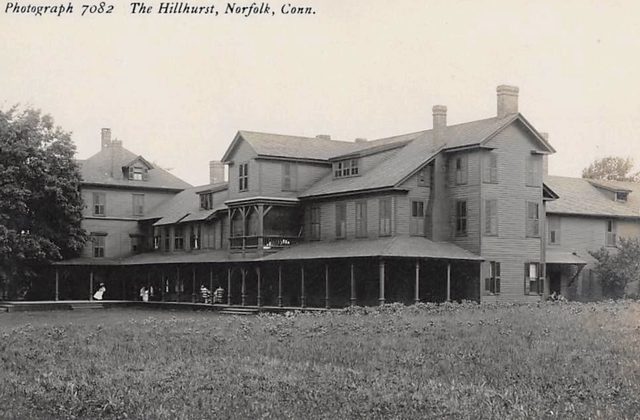
One of the largest Norfolk hotels was the stately Hillhurst, built around 1882 by Robbins Battell at the crossroad of Maple Avenue and Shepard Road on land purchased from Frederick Shepard. The L-shaped Hillhurst Hotel boasted 100 rooms, a tennis court, guest dining room, multiple parlors and a series of porches where one could enjoy the view down Maple Avenue to the Village Green. An ad from 1903 says it welcomed guests from June 1 to Nov. 1.
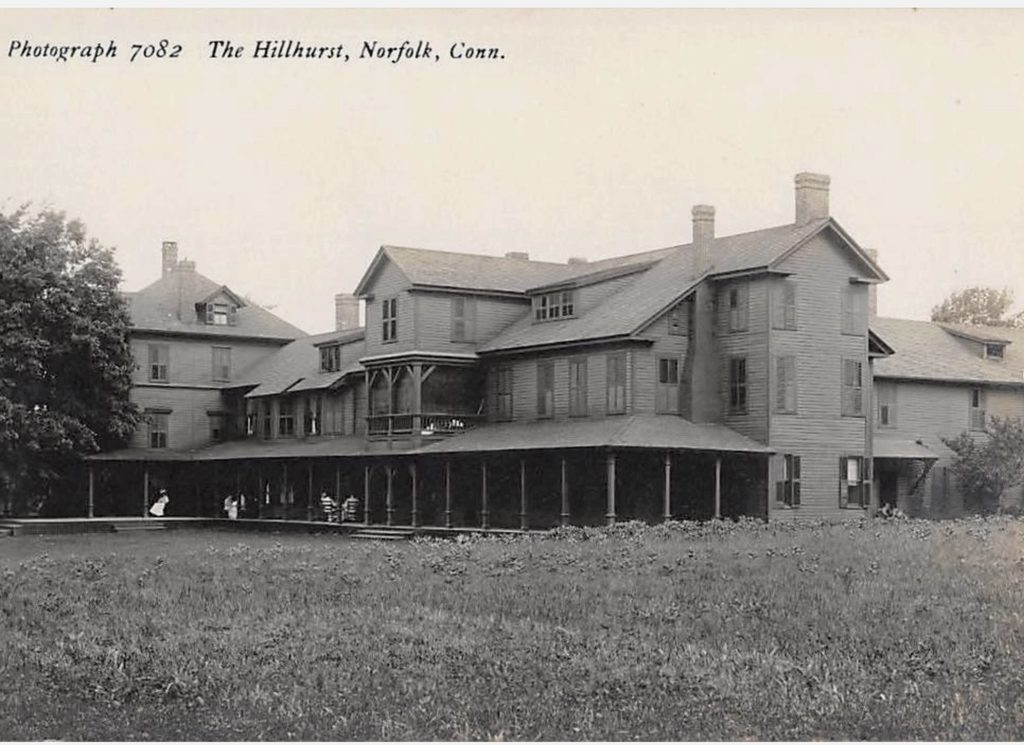
Guest visits ranged from short to summer-long stays. One gentleman, perhaps in search of a discounted rate, corresponded in 1909 with the Hillhurst manager about reserving a room for his sister, as long as it was no more than $15 per week.
That letter is one of more than 70 artifacts from the Hillhurst Hotel now in the collection of the Norfolk Historical Society, says Barry Webber, the organization’s director. The eclectic collection—a room key, guest mailboxes, even an invitation to a concert held at the Hillhurst by the Beethoven String Quartet from New York City—has recently been augmented with items unearthed by Clayton, owner of an over three-acre parcel on Lovers Lane that once held several of the Hillhurst Hotel’s outbuildings.
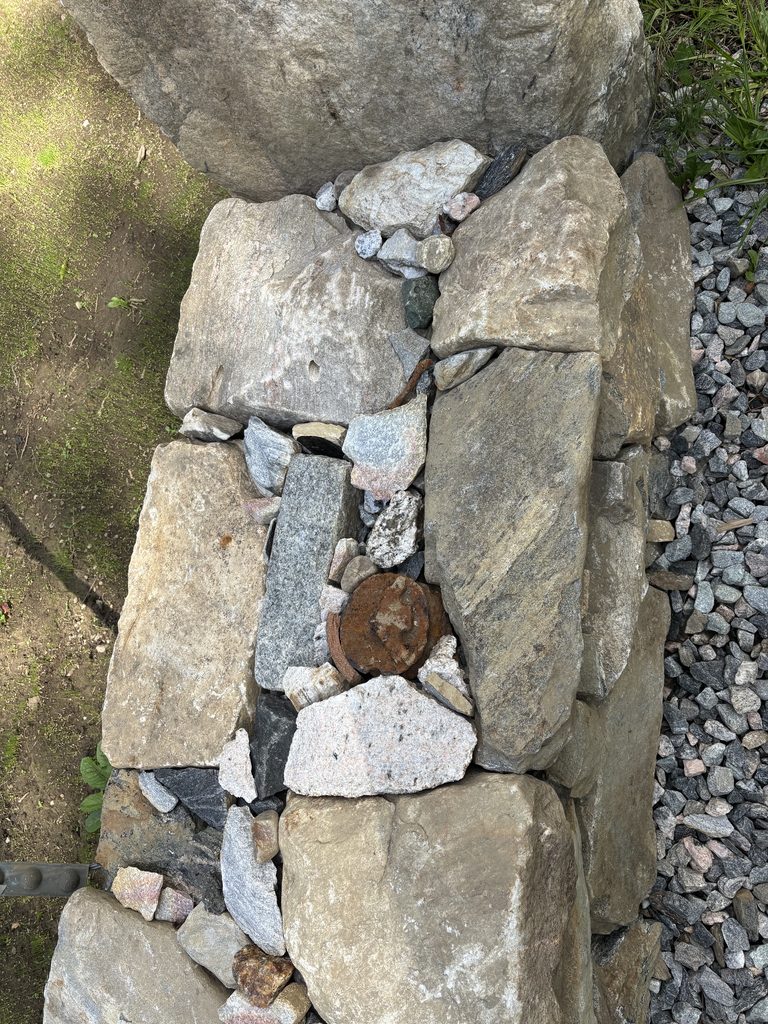
Photo by Andra Moss
Almost immediately after purchasing the property in 2018, Clayton began clearing the extensive overgrowth that choked much of her long front yard. “It looked pretty scary from the road,” she admits. After several years of clipping away, in 2023 she discovered a large pile of “beautiful rocks” that she understood to be the collapsed foundation of a Hillhurst stable or spring house. She enlisted the assistance of Norfolk’s Jeremy Schneider of Got Your 6 Construction LLC and his backhoe to exhume them.
Before long, Clayton and Schneider had unearthed an impressively large collection of cut and field stones, and Clayton decided she had to do something special with them. Looking around, she saw the outlines of a park-like setting and envisioned a beautiful stone border. “I designed it for people to stop and sit on,” she says, specifying that the double wall should be 19 inches high—a comfortable bench height.
Her partner in the wall’s construction was Norfolk’s Chadwick Achenbach, whom Clayton met while volunteering at the Norfolk Transfer Station Swap Shop. Achenbach is the artisan behind Chadwick’s Earth-Works, a custom landscape and natural stone wall design and build endeavor.
Achenbach began assembling the mortar-free wall of carefully fitted stacked stone in July. Schneider set the large capstones in place and Clayton used her wheelbarrow to move piles of mid-sized and small rocks up to the front of her property for Achenbach to select from. Achenbach, who started building walls at age 13, describes working with the historic dry-cut stones as “a joy.” The front, street-facing half of the wall features many of the unearthed foundation stones. The back side is primarily composed of field stones.
As the wall began to emerge, Clayton carefully developed the spaces behind it. She planted a willow tree in honor of her father and used a ring of rocks to create her “secret garden.” Within it are three birch trees, gifts from each of her children.
Stones aren’t the only legacy of the Hillhurst Hotel on Clayton’s property. She describes finding a vast network of century-old water pipes and clay tiling running underground. This doesn’t surprise Webber, who says that Battell piped fresh water up to the hotel from a spring further down today’s Lovers Lane.
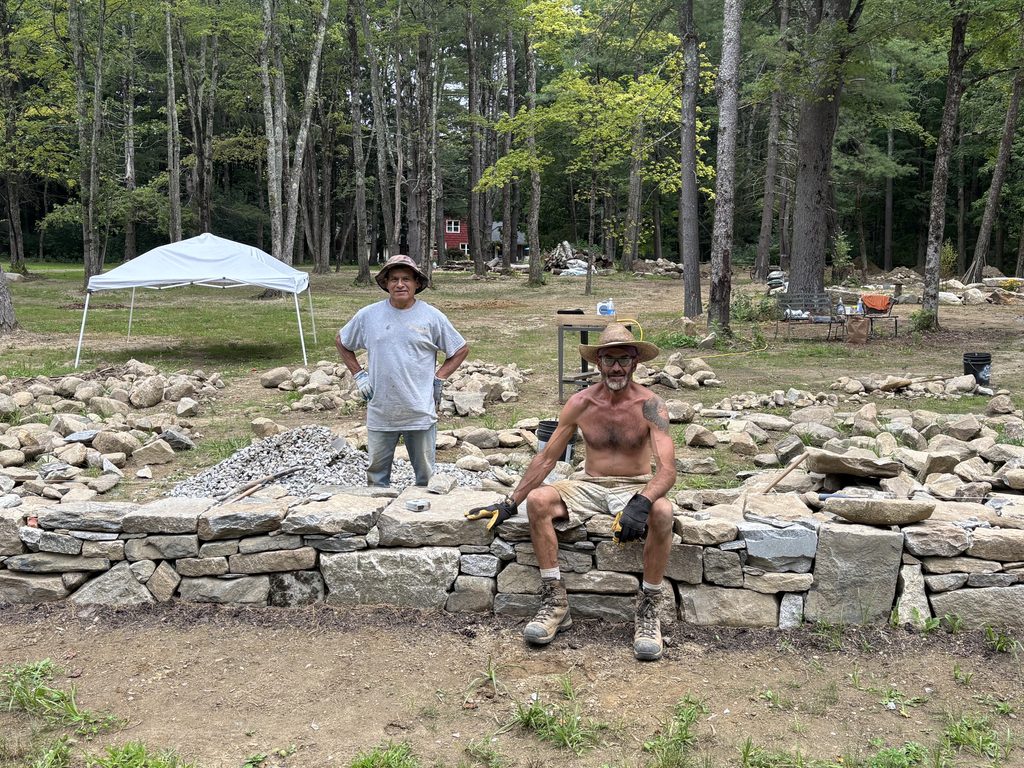
Photo by Andra Moss
As well, there is an area behind her house which Clayton surmises held one of the hotel’s larger dumping grounds. She notes that “Every time it rains more items come to the surface–pottery, tools, pots, pans, sugar bowls.” One day she filled a bucket with an assortment of Hillhurst-era ephemera and delivered it to Webber at the historical society.
She and Achenbach did keep a few interesting pieces for their own special purpose. Embedded alongside the stones in the wall one can find shards of found utilitarian items that each hold a memory of a lost building and its era.
As Clayton’s vision for the property continues to develop, she welcomes others to share in the experience of crafting the future from the past. The stones, repurposed as a structure that can last another hundred years, have once again been put in service to the town and its visitors. Clayton couldn’t be more satisfied with the outcome, saying “I do hope people will come sit on my wall and soak up some history.”
