Sadie and Shakespeare
The Bard and a highschooler inspire young readers
By Jude Mead
While many teenagers spend their summer vacations relaxing or working seasonal jobs, rising high school senior Sadie Rotolo is sharing her passion for one of history’s greatest playwrights with the next generation.
Rotolo recently led a weeklong Shakespeare program at the Norfolk Library, where she introduced elementary-aged children to “A Midsummer Night’s Dream” through storytelling, discussions and hands-on art projects. Each morning, young participants explored the magical world of fairies, enchanted forests, mischievous sprites and unlikely friendships while discovering that Shakespeare’s works can be both entertaining and accessible.
Rotolo first discovered Shakespeare in middle school while attending programs at Shakespeare & Company in Lenox, Mass. It is one of the nation’s premier Shakespeare theaters and educational centers, where students learn not only to understand Shakespeare’s language but also to perform it with confidence, creativity and joy.
While the plays themselves were initially unfamiliar, it was the welcoming community that sparked her interest. “I first learned about Shakespeare in seventh grade,” Rotolo said. “My interest didn’t reside in the material itself, but in the people who participated beside me.” Over time, Rotolo developed a deep appreciation for Shakespeare’s dramatic storytelling. “I’ve always loved the complex-ity and drama of it all,” she said. “It can be a lot for the little guys to handle, but I think that’s what makes his works so entertaining and worth understanding.”
She also believes Shakespeare’s enduring popularity comes from the flexibility built into the plays themselves. “I believe his stories last longer than anyone else’s because his scripts allow more freedom for interpretation and presentation,” Rotolo said. “The stories he presents are fairly simple when broken down but are so well thought out that they are referenced in works today, whether intentionally or not.”
For this summer’s program, Rotolo chose “A Midsummer Night’s Dream,” one of Shakespeare’s most beloved comedies. “I chose Midsummer because it’s usually the first of Shakespeare’s plays taught in school,” she explained. “But after hosting my programs, I’ve gotten a better idea which plays will gain better interest from the kids next year.” The play follows four young lovers who become lost in an enchanted forest, where fairies use magic that leads to humorous misunderstandings.
With help from Oberon, Titania and the mischievous Puck, the confusion is eventually resolved, celebrating imagination, forgiveness and the unexpected power of love. Rotolo guided students through the story by breaking it into short, engaging scenes and focusing on the parts that most appealed to them while encouraging them to become comfort able with Shakespeare’s language. Her teaching approach reflects what she has learned through years of studying at Shakespeare & Company. “I have a better understanding of how to analyze and find the most important parts of Shakespearean texts,” she said, “narrowing them down to have meaning but clarity so the children can understand.”
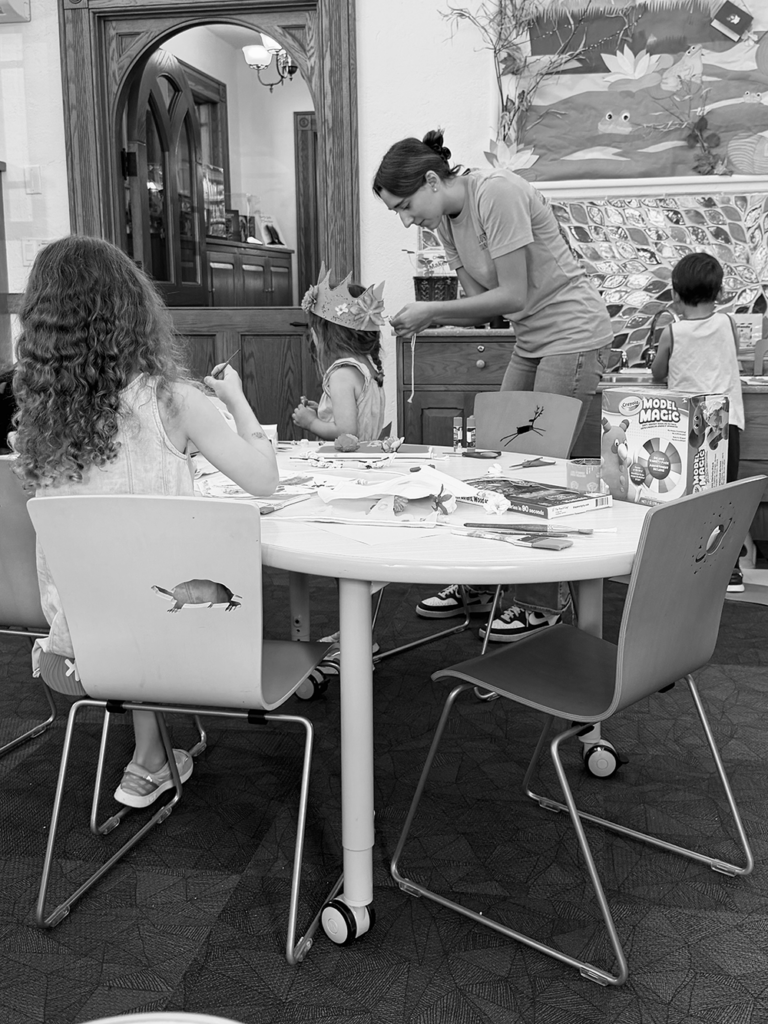
her fairy crown. PHOTO BY DANESHA MEAD
Rotolo believes every child learns differently and adjusts her lessons to meet students where they are. “Catering to each child’s level of understanding is the most important thing, as well as not pushing concepts onto those who aren’t as interested in the story,” she said. “Reading a children’s version of the story is always a good first step, but some learn better by reading the actual script or doing art projects relating to the story.”
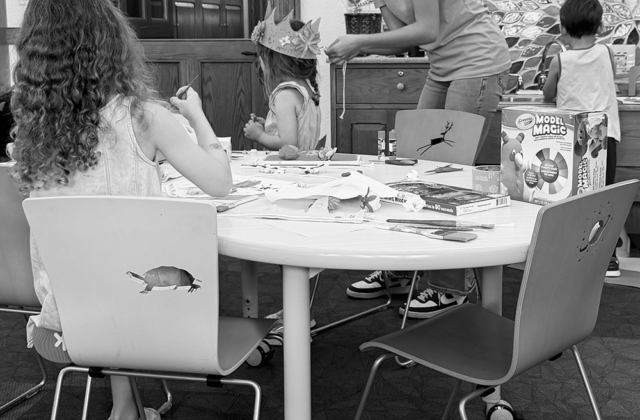
Rotolo also believes that introducing Shakespeare early helps children develop confidence long before they encounter the plays in school classrooms. “Learning Shakespeare at a young age in an enjoyable setting is important because they’ll have a high opinion of it before joining a school’s curriculum, which makes it seem like a dull topic most kids dread reading,” she said. “Performing it also provides a solid foundation for public speaking.” Art became an important part of the week’s activities as students created projects inspired by the play. Children designed colorful fairy flags and banners representing the magical forest and its enchanted inhabitants. They crafted flower crowns like those worn by Titania and her fairy attendants using paper flowers, ribbons and greenery. Modeling clay also allowed them to bring creatures from the enchanted forest to life.
“The most fascinating part of Midsummer for all the children is the fairies and magic involved,” Rotolo said. “The children at my first session, at Litchfield Montessori School, had a blast creating their own costumes, and the second session group at the Norfolk Library adored making fairy crowns.” These hands-on projects helped reinforce the story while giving each child an opportunity to express their imagination. By the end of the week, Rotolo had made a centuries-old play feel fresh, welcoming and exciting for young learners.
As she prepares for her senior year, Rotolo said she “definitely plans to continue hosting [Shakespeare] programs during the sum-mer whenever places have the time for me to host. As for my career, I’ll wait until I get to college to decide that.”
Whatever direction she ultimately chooses, Rotolo hopes her students will carry something lasting from their introduction to Shakespeare. “I hope when they perform in other shows that they feel more confident after tackling Shakespeare’s challenging words,” Rotolo said, “and when forced to read whatever play is given in school that they won’t resent the book lying on their desk.”
Through enthusiasm, creativity and thoughtful teaching, Rotolo has demonstrated that Shakespeare isn’t just for actors or scholars—it can belong to children as well, inviting them into a world where fairies dance, magic fills the forest and imagination knows no bounds.
