Norfolk Then…
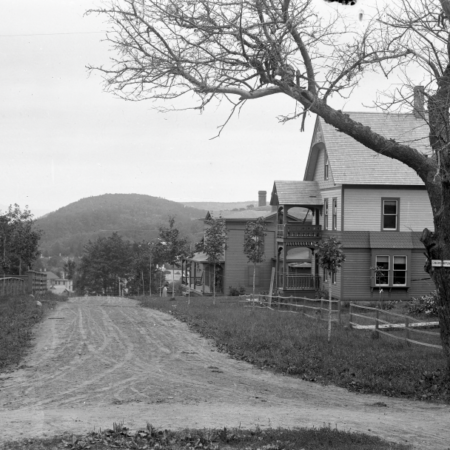
Photo courtesy of the Norfolk Historical Society Emerson Street is pictured about 1903 when it was known as Emerson Place. The house partly visible on the far right belonged to Isabella Beecher Hooker, who summered in Norfolk. Hooker worked for over 30 years for the cause of women’s suffrage. Next door was the home of […]
Norfolk Then…
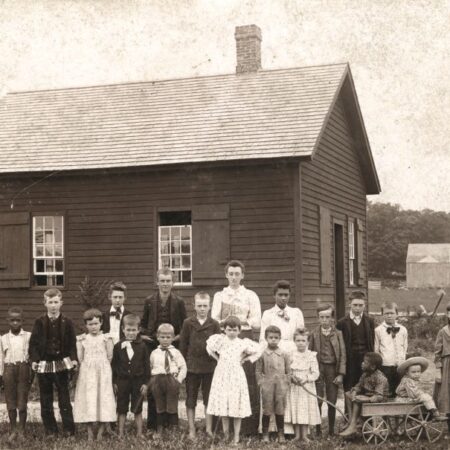
Photo courtesy of the Norfolk Historical Society The North Middle School on Ashpohtag Road was one of eleven district schools that served children across Norfolk’s widely scattered settlement in the 19th century. Most were one-room schoolhouses equipped with a pot-bellied stove, and teachers boarded in homes nearby. One notable student who began her education at […]
Norfolk Then
The Hillhurst Hotel stood at the northeast corner of Laurel Way and Maple Avenue. Originally a farmhouse, it was enlarged twice to accommodate 100 summer visitors. With an elevation of 1,400 feet and expansive views to the west, the Hillhurst attracted many guests, some of whom spent the entire summer there. A porch ran the […]
Norfolk Then…
The building we now know as the Art Barn, home to Yale Norfolk School of Art, was built in 1898 as a carriage house and barn for Carl and Ellen Battell Stoeckel. The elegant brick building was used for more than just housing horses and carriages. The Stoeckels hosted annual meetings of the Litchfield County […]
Norfolk Then …
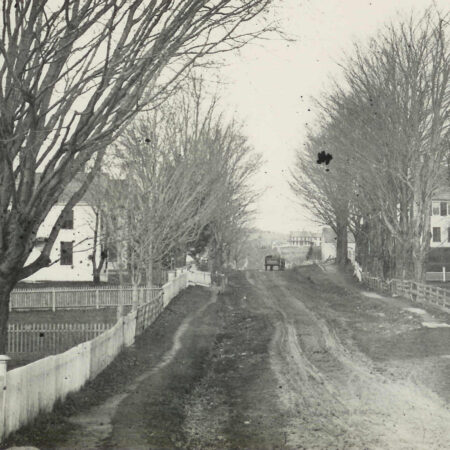
Maple Avenue was once known as the “Highway to Judge Pettibone,” whose house is pictured on the right in this view looking north from Greenwoods Road. Judge Augustus Pettibone (1766-1847) was the son of one of the first settlers of Norfolk and represented Norfolk in the state legislature. The house eventually passed to his grandson […]
Norfolk Then…
Norfolk had a thriving economy in 1860 when this business directory was published in S.D. Northway’s Norfolk Almanac. The S.D. Northway Manufacturing Company was located in South Norfolk and produced a variety of leathers, calf skins, and hides. Its annual almanac contained the usual astronomical data as well as interesting town, county, and state statistics. […]
Norfolk Then …
An aerial photograph of Norfolk provides a glimpse of the town blanketed by snow on a winter’s day. At left, the Catholic Church designed by Alfredo Taylor still has its tower with open belfry. Next door, children play in the yard behind Center School, set well back from the road. This imposing brick structure had […]
Norfolk Then…
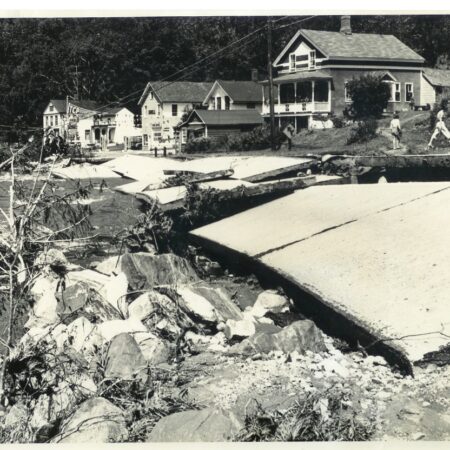
After the catastrophic gasoline spill on Nov. 5, a longtime firefighter remarked that the disaster was in the top three to have hit Norfolk townwide, the others being the destruction of the Hardware Store on Station Place by fire in 1987 and the flood of 1955. The Hardware Store fire was discovered at 3 o’clock […]
Norfolk Then …

In the fall of 1953, Norfolk was grappling with school regionalization. Planning for a regional high school had begun in 1951, after the Gilbert School in Winsted announced that it could no longer educate high school students from neighboring towns. Voters from each of the six towns involved—Barkhamsted, Colebrook, Hartland, Harwinton, New Hartford, and Norfolk—had […]
